
Struggle for Hindu Existence
*Hindu Rights to Survive with Dignity & Sovereignty *Join Hindu Freedom Movement to make Bharat Hindu Rashtra within this lifetime *Jai Shri Ram *Jayatu Jayatu Hindu Rashtram *Editor: Upananda Brahmachari.
Unfortunately, Hindus are ‘eighth-class citizens’ and ‘victims of state-sanctioned apartheid’ in India.
Hindus in Hindu Rashtra: ‘Eighth-class citizens’ and ‘victims of state-sanctioned apartheid.
Utpal Kumar
PART- I
Why New York Times cries ‘majoritarianism’ as Hindus remain ‘second-class citizens’ in India
Or should we say ‘eighth-class citizens’ and ‘victims of state-sanctioned apartheid’, as a new book suggests?
 The New York Times is at it again. A week before India celebrated its 77th Independence Day, it came up with another alarmist article, titled “India Is On The Brink” (9 August 2023). The latest provocation was the violence in Manipur.
The article, written by Debasish Roy Chowdhury, a Hong Kong-based Indian author, is deeply problematic and propagandist. It says that the “fuse for the current unrest in Manipur was lit by the politics of Hindu supremacy, xenophobia and religious polarisation championed by his (Modi’s) Bharatiya Janata Party.” It’s ironical to see a Hong Kong-based author criticising democracy in India!
It continues, “In Manipur, Christians are bearing the brunt as the state’s BJP government stokes the insecurities of the majority ethnic Meitei, who are predominantly Hindu. State leaders have branded the Kuki who populate the hill districts and who are mostly Christian as infiltrators from Myanmar, blamed them for poppy cultivation intended for the drug trade and evicted some of them from their forest habitats.”
Even a cursory look at the history of violence in Manipur, including the current one, would show that it’s a battle between two ethnic groups of Manipur, and the religious aspect is peripheral. The mischievous attempt to project the violence as a Hindu-Christian battle, in which Christians, which tribal Kukis have converted to in the last century, are facing persecution of the worst kind is to give the rising, new India a bad name globally. It fits into the vastly jaundiced Western narrative, of which NYT is a prominent flagbearer, showcasing India to be currently passing through a nightmarish majoritarian phase.
While reading the NYT article, one would assume that a particular community (read “Christian Kukis”) is at the receiving end of violence. The truth is that both communities (“Christian Kukis” and “Hindu Meiteis”) have been grievously hurt and brutalised, with one set of atrocities dwarfing the other. Also, to give the ongoing Manipur crisis a political colour is to turn a blind eye to a long history of violence in the state; in fact, since 2014, the situation in the region has seen a discernible improvement. For the first time in 75 years, it finds itself in the mainstream of the Centre’s development initiatives, and not on the margins. There was a time when the Manipur valley would find itself being forcibly blocked and cut off by insurgent groups from the rest of the country for months at a stretch.
As for poppy cultivation and large-scale infiltration from Myanmar, especially since the tumultuous resumption of military rule in that country, these are open secrets in Manipur and have been confirmed by several independent, non-partisan sources. The fact is that the current violence in Manipur was the result of a court ruling in favour of granting Meiteis a tribal status and thus the resultant benefits that have long been enjoyed by the Kuki and other hill tribes. This, in itself, is a vindication that violence isn’t a majoritarian project. The NYT, by brushing aside these obvious realities, brandishes both its ignorance and inherent anti-India bias.
Even a cursory look at the history of violence in Manipur, including the current one, would show that it’s a battle between two ethnic groups of Manipur, and the religious aspect is peripheral. The mischievous attempt to project the violence as a Hindu-Christian battle, in which Christians, which tribal Kukis have converted to in the last century, are facing persecution of the worst kind is to give the rising, new India a bad name globally. It fits into the vastly jaundiced Western narrative, of which NYT is a prominent flagbearer, showcasing India to be currently passing through a nightmarish majoritarian phase.

While reading the NYT article, one would assume that a particular community (read “Christian Kukis”) is at the receiving end of violence. The truth is that both communities (“Christian Kukis” and “Hindu Meiteis”) have been grievously hurt and brutalised, with one set of atrocities dwarfing the other. Also, to give the ongoing Manipur crisis a political colour is to turn a blind eye to a long history of violence in the state; in fact, since 2014, the situation in the region has seen a discernible improvement. For the first time in 75 years, it finds itself in the mainstream of the Centre’s development initiatives, and not on the margins. There was a time when the Manipur valley would find itself being forcibly blocked and cut off by insurgent groups from the rest of the country for months at a stretch.
As for poppy cultivation and large-scale infiltration from Myanmar, especially since the tumultuous resumption of military rule in that country, these are open secrets in Manipur and have been confirmed by several independent, non-partisan sources. The fact is that the current violence in Manipur was the result of a court ruling in favour of granting Meiteis a tribal status and thus the resultant benefits that have long been enjoyed by the Kuki and other hill tribes. This, in itself, is a vindication that violence isn’t a majoritarian project. The NYT, by brushing aside these obvious realities, brandishes both its ignorance and inherent anti-India bias.
In India, this “first claim on resources”, especially for the largest of minorities, is government agnostic; in fact, it continues with a greater zeal during the current Hindutva government at the Centre. Numbers again don’t lie. So, in the last eight years of the Modi government, the Muslim communities, comprising just over 14 per cent of India’s population, received 31.3 per cent houses under the Pradhan Mantri Awas Yojana, 33 per cent of funds under the PM-Kisaan Samman Nidhi Yojana, and 36 per cent of loans under the Pradhan Mantri Mudra Yojana. Then there is a PM Shadi Shagun Yojana, exclusively for Muslim girls, under which they would get Rs 51,000 if they complete graduation before marriage. To add to them other monetary benefits for minorities, from scholarships for Muslim students to monthly stipends for moulvis, and the appeasement cycle becomes all-pervasive.
Appeasement is still fine. But what’s truly unsettling are the legal-constitutional discriminations against the majority community that continue unabated during the so-called majoritarian government in India. While India’s minorities are free to run their religious and educational institutions unhindered by State interference, Hindus having no such freedom find themselves being constitutionally-legally mandated to be treated as the ‘second-class citizens’ in their own country — Anand Ranganathan calls them the “eighth-class citizens” subject to “state-sanctioned apartheid” in his just-released book, Hindus in Hindu Rashtra.
So, why does NYT fail to see what’s so obvious, statistically and otherwise: That there is no discrimination, far less persecution, of minorities in India? In fact, if anything the majority community has been at the receiving end of political appeasement in favour of Muslims as well as legal-constitutional discrimination against Hindus. But, as the NYT logo suggests, the American newspaper prints only those news reports and analyses that it thinks are “fit to print”. No wonder, it was unabashedly pro-Hitler in the 1930s, “serving as a sturdy fount of Dr Goebbels’s propaganda”, or accusing Poland of starting World War II by invading Germany, or, worse, downplaying the Nazi Holocaust, as Ashley Rindsberg writes in The Gray Lady Winked.
The NYT management, in the name of printing “all the news that’s fit to print”, chose to conceal the brutal, inhuman side of Nazis in the 1930s and ’40s. Following the same template, it today prefers an autocratic Xi Jinping over a democratically-elected Narendra Modi. For it, Chinese hegemony is another name for democratic benevolence, and Indian pluralism is nothing but the worst of Hindu majoritarianism on display.
PART- II
Orwellian reality check for India: An Islamic Republic or a Hindu Rashtra?
Over a lakh Hindu temples being controlled by the State, more than 10,000 Hindu-run schools closed due to RTE Act; 77% of Delhi is being claimed to be Waqf land: Welcome to the ‘Islamic Republic of India’
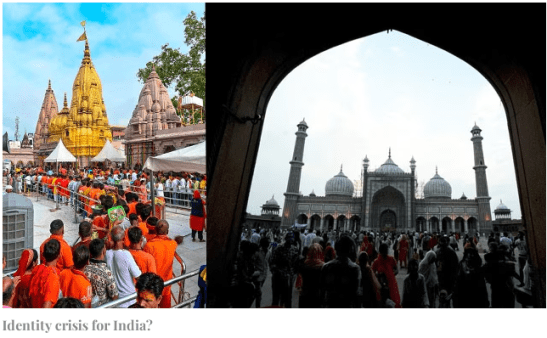
The Indian State’s relationship with Hindus and Muslims often reminds us of the tumultuous times a typical middle class parent would have in handling a well-behaved elder brother and a relatively unruly, defiant younger one. While the elder is expected to act decently, and is often taken for granted for his goodness, the younger one gets away with his mistakes and is often pampered to avoid tension in the house.
Jawaharlal Nehru displayed this characteristic soon after Independence when he showed “great strength and courage” in getting the Hindu Reform Bill passed, but “accepted the policy of laissez faire where the Muslims and other minorities were concerned”, as MC Chagla, noted jurist and a member of the Nehru Cabinet, wrote in his memoirs, Roses in December. Chagla was actually “horrified to find that… while monogamy has been made the law for the Hindus, Muslims can still indulge in the luxury of polygamy”.
The minority appeasement scaled new heights in the coming decades, especially as the term ‘secularism’ found itself inserted into the Constitution through the 42nd constitutional amendment in the time of Indira Gandhi’s Emergency. This happened much against the wishes of the fathers of the Constitution who had discussed in detail why secularism should not be given a space in the hallowed book. Over the decades, the Hindus became — to use Anand Ranganathan’s words in his new book Hindus in Hindu Rashtra — “eighth-class citizens and victims of State-sanctioned apartheid”.
Terms like “eighth-class citizens” and “State-sanctioned apartheid” may seem too harsh, but when one examines the data, looks at the numbers and goes through the examples put in by Ranganathan, it appears to be a tragic reality of post-Independence India. After all, it’s one thing to appease a particular community, and absolutely another to legally and constitutionally discriminate against another. The first one can still be acceptable, but how can a community be discriminated against institutionally, constitutionally and legally?
The State control of Hindu temples, for instance, not just violates the idea of ‘secularism’ that was put with so much fanfare in the Preamble of the Constitution in 1976, but also disdainfully discriminates against the majority community. As Ranganathan states, “Governments of just 10 states control more than 110,000 Hindu temples. Tamil Nadu Temple Trusts own 478,000 acres of temple land. The Tamil Nadu government alone controls 36,425 temples and 56 mutts; for Karnataka, the figure is 34,563.” Even the Kerala government, currently run by ‘Godless’ communists, for whom religion is “the opium of the masses”, manages 3,058 temples!
Historically, every invader wanting to destroy India and dismantle Hinduism first targeted Hindu temples. Though eminent historians led by Mohammed Habib, father of Irfan Habib, peddled economic reasons for temple destruction, the fact is they were targeted and destroyed primarily because Hindu temples had been more than just centres of worship; they actually patronised education, art, dance, trade, economy, et al. It was this temple ecosystem that ensured Hindu society was only marginally affected by the vagaries of political instability.
The State control of Hindu temples is also one of the biggest scams in the country. TR Ramesh, who has been fighting the temple war for decades now, says that the Tamil Nadu government, which should be earning at least Rs 6,000 crore per annum from the 2.44 crore sq ft of temple land it controls, earns just about Rs 58 crore. Worse, most of the temple lands across states are being encroached upon by land mafia, of course with political support and connivance.
No doubt, the current government at the Centre has done a yeoman job in renovating some of the most sacred Hindu temples, whether in Kashi or in Ujjain, but one wonders how many temples Hindus could have renovated themselves had they controlled their own temples. So, what differentiates the current dispensation from its predecessors is the degree of sympathy: While the governments before 2014 largely saw Hindu temples with distrust, in the past nine years, this distrust has given way to sympathy. But not sympathetic enough to leave the cash cow which Hindu temples are for the government of the day.
The institutional indifference, if not discrimination, isn’t just confined to the legislature and the executive; the judiciary too is a party to this. Writes Ranganathan, “A petition by Swami Parmatmananda and Swami Dayananda Saraswati has been pending in the Supreme Court since 2012. For more than 10 years. They can allow midnight hearings for granting mercy to terrorists but cannot spare time for this.” Swami Dayananda Saraswati passed away in 2015 without ever seeing the judiciary entertaining his plea.
However, the State discrimination vis-à-vis Hindu temples is not all. What the grand old party did in 1959 by introducing a legislation to largely overturn a Supreme Court judgement to bring Hindu temples under State control, the Congress-led UPA’s Right to Education (RTE) Act in 2009 has done exactly the same for Hindu educational institutions. Like the State control over temples, the State interference with Hindu schools remains a sad reality, nine years after the Modi government came to power with a thumping majority in May 2014.
As per the RTE, which doesn’t apply to minority schools, a privately-run educational institution, indeed Hindu, has to reserve 25 percent of its seats for poor and disadvantaged students. This means only the privately-run Hindu schools have the onus to serve poor students.
These Hindu schools aren’t just expected to reserve 25 per cent seats for children belonging to the economically weaker sections (EWS), but also shell out for their textbooks, uniforms, transport, etc. Theoretically, the government compensates these schools for the financial losses. But, a 2017 CAG report revealed that the government took as much as 307 days to release these funds to schools. No wonder, a recent report estimates that the RTE is responsible for the shutting down of more than 10,000 Hindu-run schools. Yes, more than 10,000 schools! And the Hindutva government has been silent about it for the past nine years!
The government’s silence over the Places of Worship Act, 1991 is equally disconcerting. The Act prohibits conversion of any place of worship and provides for the maintenance of the religious character of any place of worship as it existed on the 15th day of August 1947, and for matters connected therewith or incidental thereto. In 2019, the Supreme Court, in its Ayodhya judgement, as Ranganathan writes, “wilfully ratified this Act that obligates maintaining all religious places, except Ram Janmabhoomi, as they were on 15 August 1947 — a 75-year-old date in an 8,000-year-old civilisation”. The Act is discriminatory in a very fundamental manner: It takes away the basic right of an aggrieved citizen to appeal to the court of the law if he believes his place of worship had been vandalised and destroyed. There is no legal recourse left for him now.
It’s, however, the Waqf Act of 1995 that is scariest of all. It threatens to turn this country into what Ranganathan calls the “Islamic Republic of India”. First, the part-petrifying, part-stupefying trivia: That Waqf is the third largest landowner in India, after Defence and the Railways; that 77 per cent of Delhi is Waqf land, including Delhi High Court, Central Vista, CGO (Central Government Offices) Complex, and Jawaharlal Nehru Stadium; even Mukesh Ambani’s house is on Waqf land; that the 1,500-year-old Manendiyavalli Chandrashekhara Swami Temple in Tamil Nadu is on Waqf land — interestingly, Islam is 1,300 years old!
What makes the Waqf Board lay such bizarre claims?
Waqf means the permanent dedication by any person, of any movable or immovable property for any purpose recognised by the Muslim law as pious, religious or charitable. Once a Waqf land, it is always a Waqf land. It can never be gifted, inherited or even sold.
Ranganathan explains in detail how legally and institutionally the Waqf Board is being helped into turning this country into the Islamic Republic of India. Section 4 of the Waqf Act, 1995, for instance, “bestows on the Waqf survey commissioner the authority and power like that of a civil court. Besides, the entire cost of surveying is to be borne by the State. So, in essence, a Hindu’s property, once declared a Waqf property, wholly arbitrarily, will be surveyed by Waqf, and the cost incurred on this count will be paid for by the Hindu taxpayer”. Interestingly, the Waqf Boards are headed and constituted only by Muslims.
Then there is Section 40 of the Waqf Act, which gives “the Waqf power to decide if your land is Waqf or not. In fact, if your property is laid claim to by Waqf, it is your responsibility to disprove its claim. And till such time you disprove it, it is Waqf land.”
Even more inexplicable is Section 107 of the Waqf Act, which ensures that the Statute of Limitation does not apply to Waqf. This means that the Waqf, unlike others, doesn’t have to worry about the passage of time for laying claim to and recovering any property. Given these discriminatory institutional and legal advantages given the Waqf Boards, one wonders why only 77 per cent of Delhi is being claimed by them. Maybe in a few decades, the entire Delhi will be on Waqf land, and the country can qualify to be the Islamic Republic of India! Maybe then The New York Times and the ilk would stop crying ‘majoritarianism’.
In his seminal work, 1984, author George Orwell wrote: “War is peace. Freedom is slavery. Ignorance is strength.” One can add a line to this — majoritarianism is minorityism — and India’s post-Independence saga can be aptly summed up.
…
Views expressed in the above piece are personal and solely that of the author.
The above article in two parts was published in Firstpost stated Aug 16 & Aug 18, 2023, respectively.


 Struggle for Hindu Existence
[…] Karnataka Police convene meeting of gym owners following protests against Love Jihad […]
[…] False Claim of Waqf Exposed in Pune, Maharashtra; Row Escalates in Karnataka’s Gokak […]
[…] NHRC seeks urgent report from J&K Police on ‘targeted’ Hindu killings. […]
[…] [Disclaimer: The content in this RSS feed is automatically fetched from external sources. All trademarks, images, and opinions belong…
Well done but to no effect