
Struggle for Hindu Existence
*Hindu Rights to Survive with Dignity & Sovereignty *Join Hindu Freedom Movement to make Bharat Hindu Rashtra within this lifetime *Jai Shri Ram *Jayatu Jayatu Hindu Rashtram *Editor: Upananda Brahmachari.
Nepal is under the threat of Islamic communalism.
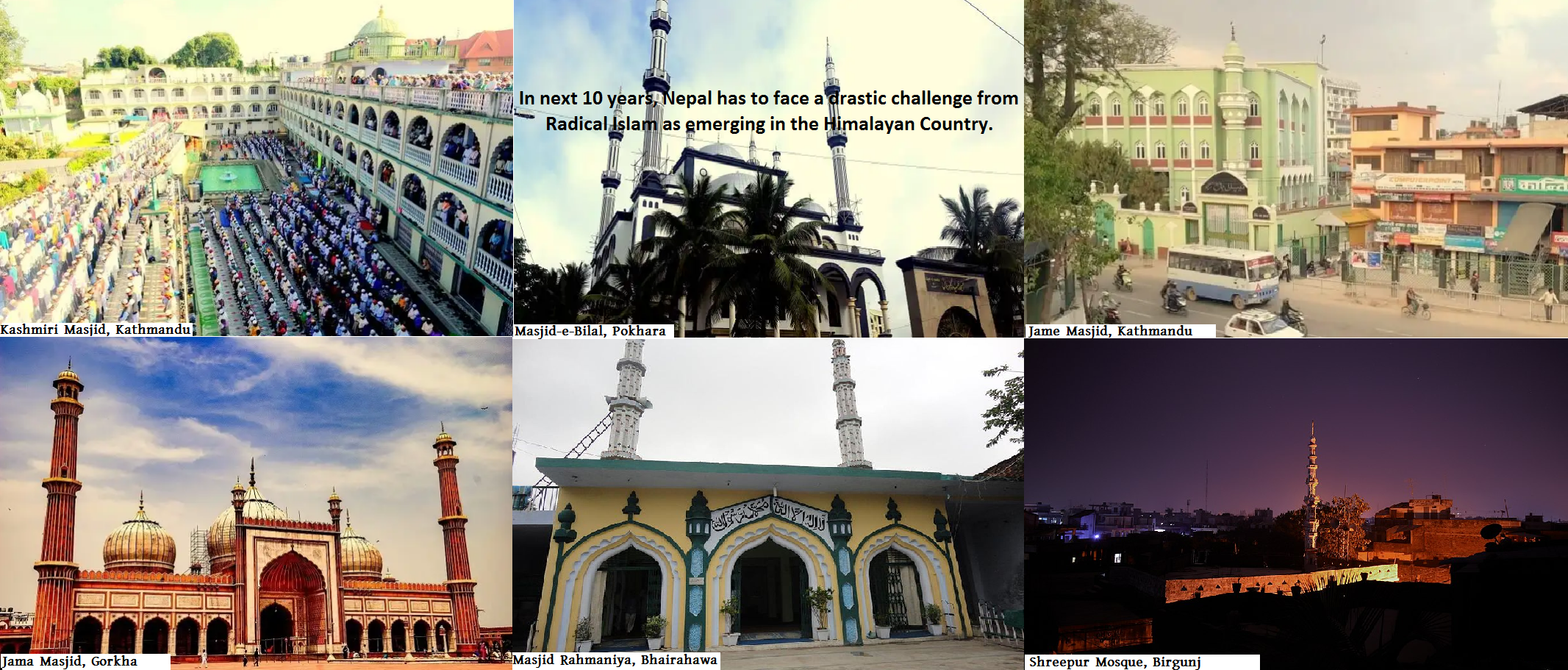
Hindus in Nepal will face a big Islamic challenge in the next 10 years.
Muslims in Nepal are now threatening Hindus with open cow slaughter and beef eating. Mosques are built here and there at random. Islamic conspiracy is looming large in Nepal.
 Upendra Bharti | HENB | New Delhi | Sept 7, 2023:: At the end of August this year, the peace was heavily disturbed in the locality of Dharan in eastern Nepal. Dharan is situated in Sunsari District of Koshi Province which is the third most populous city in Eastern Nepal having 95% population from the Omkar family in its Hindu roots and less than 5% others out of which hardly 2% are Muslims. However, the Muslim population in Nepal has crossed 5% mark (Hinduism-81.34%, Buddhism-9.04%, Islam-4.39%, and Kirat-3.04%, Christanity-1.41% etc. as per 2011 Census) and started to claim their Islamic share in every sphere of life in a motive to grab the social, political and economical power.
Now, only 2% of Muslims in Dharan created a situation for which Nepal administration and police had to impose strict restrictions in the city and outskirts to neutralize communal tension.
It was a frantic end of August. The posts on social media were evident which caused confusion and fear among people, leading to further distress. The situation escalated in Dharan to a point where security forces had to be put on high alert in the city to avoid communal clashes.
What actually happened, some Muslims of Dharan were seen eating bull’s meat in a feast that was live-streamed on social media. The feast was organised after two Muslims from Dharan, who were arrested for slaughtering a bull, were released from police custody. The feast was marked to celebrate their release. Not many were watching the stream. However, soon it became viral with the passing of time.
The video incited a wave of public outrage, particularly among Hindus, who were deeply angered by its content. What angered the Hindus is how one man in the video claimed that there would be no restriction on eating a bull’s meat. The video offended their sentiments due to their devotion to cows and bulls. Demanding action against those who killed a bull, these people started protesting against those who live-streamed the video.
While physical protests were taking place on small scales, a debate ensued on social media whether or not Nepalis could consume a bull. This led many prominent people from both sides to stir up the issue through hateful comments and posts. Some of these individuals have also faced allegations of actively encouraging others to generate and spread these divisive posts, instigating a climate of animosity among people.
In response to it, people from various Hindu organisations on August 24 decided to hold a protest in Dharan on Saturday (August 26) under the slogan “Bhadra Nau Dharan Jau,” which means Let us go to Dharan on Bhadra 9.
After the protest was announced the District Security Committee of Sunsari, issued a notice imposing prohibitory orders in the sub-metropolitan city amidst fear of communal violence taking place in the city. The prohibitory order remained in effect until midnight on Sunday (August 27) which meant the protestors never got into Dharan.
The majority of Hindu protestors were halted at the city’s outskirts, specifically at entry points. According to the police, approximately 1,000 protestors from Jhapa, Morang, Saptari, and Siraha were prevented from progressing at Tarahara alone.
To ensure the safety of the situation, the city police had to deploy about 1,000 security personnel, positioning them in Tarahara and Itahari, along with an additional 500 personnel stationed at other entry points of Dharan.
The whole incident came to the fore as a gross violation of Nepal laws and hurting the majority Hindu sentiments in a challenge by a handful of Muslim people in Nepal.
While Indigenous communities, mainly of Islamic root or allegiance may have historically engaged in the consumption of bulls, it is important to note that Nepal’s laws deem the slaughter of cows or bulls as illegal.
Article 289 of the National Civil Code prohibits the killing of cows or bulls. As stated in the article, individuals who are proven guilty of cow or bull slaughter could be subjected to a maximum imprisonment of three years along with a fine of up to Rs 50,000.
As per Swarajya Magazine, Muslim immigrants from Bihar had triggered communal tensions in Nepal’s Dharan.
Swarajya reports, “A number of residents of Dharan, a prominent city in Sunsari that lies across the border from Araria district of Bihar, told Swarajya over phone that the Muslim youths on the video are suspected to be recent immigrants from Bihar.
“They spoke in a mix of Urdu and the dialect of the Kulhaiya community of the Seemanchal area of Bihar. That shows they are recent immigrants from Bihar,” Santosh Yadav, a prominent businessman of Dharan, told Swarajya.
‘The dialect of the Kulhaiya community is a unique mix of Maithili, Urdu and Kutchi, a language spoken in the Kutch region of Gujarat and in Sindh.
“Their posts were shared widely and fuelled a lot of indignation among Hindus. Angry Hindus rallied together and gave a call for protests across the country.
“The Muslim youth who made the video and posted their opposition to the beef ban on social media are suspected to be residents of Dharan,” said Humkala Pandey, the chief district officer of Sunsari.
“The district authorities went into damage-control mode and convinced Hindu groups which had called for a mass rally in Dharan to call off their protests.
“District authorities had learnt that the making of the video and the posts on social media was a pre-planned conspiracy to create communal trouble in Sunsari.
“The Muslims knew that Hindus would protest. They were planning to attack a Hindu protest rally and that would have triggered a lot of violence. That was the aim of the Muslim side, said a district official.”
“Yadav said that the language spoken by the young men in the video is not usually heard in Sunsari or the entire Madhesh region of Nepal that has a huge number of people who share ethnic and cultural links with people of Bihar and Uttar Pradesh.
“Our enquiries reveal that the young men who made the video are recent immigrants from Bihar. They have gone underground and we are trying to trace them,” Hem Kumar Chhetri, a senior police officer of Sunsari told Swarajya over the phone from Inaruwa, the district headquarters.
“Not content with making the inflammatory video, the Muslim men also posted on social media (Facebook and X) that eating beef is the religious and cultural right of all Muslims and the beef ban in Nepal has to go.”
Now, make a sense of the level of courage and conspiracy of only 2-3% of Muslims in Dharan going against the Hindu majority in such a challenging mood. It would never have been possible without the help and support of the International Islamic lobby including the Muslim people of India living in the adjacent places of the Nepal border and preparing a plan to infiltrate the Himalayan country with a mission of ‘Islamic Nepal’ in the future!
As per a report of the OpIndia there is a huge increase of Mosques and Madrasas along with the Nepal border in Uttar Pradesh. But, it is not a phenomenon in Uttar Pradesh. Such a network of Mosques and Madrasas are active in the Uttarakhand, Bihar, and West Bengal border lying with Nepal to destabilize the Himalayan Country with a spate of Islamic insurgency.
OpIndia reports, “Sashastra Seema Bal in Uttar Pradesh flagged sudden growth in the numbers of mosques and madrasas located in and around 15 km of the border with Nepal. The state of Uttar Pradesh shares 570 km of border with Nepal and has reported a massive increase in the number of mosques in the last two years”.
“ It was reported that the 257 new built mosques in Uttar Pradesh along the border of Nepal are involved in terror-funding activities. There were also reports to suggest that funds for these mosques and madrasas were being sent from Pakistan and Islamic fundamentalist groups like Dawat-e-Islamia.
“The officials have noted that the number of mosques in the border areas of Nepal has increased from 738 in 2018 to 1,000 in 2021 and the number of madrasas has risen from 500 in 2018 to 645 in 2021. The India-Nepal border area in the states of Uttarakhand and Uttar Pradesh has seen 400 mosques and madrasas growing up in the past 10 years. With this, the Muslim population in the areas has also increased in an institutionalized manner.
“As per the report, most of the mosques and madrasas have been recently built in Uttar Pradesh’s Bahraich, Basti, and Gorakhpur areas and the population of Muslims has also grown in these regions. This supports the local’s suspicion that the Muslim settlement is being done in a planned manner there.
“The Sashastra Sena Bal meanwhile has flagged several mosques and madrasas in seven districts of Uttar Pradesh named Maharajganj, Siddharth Nagar, Balrampur, Bahraich, Shravasti, Pilibhit, and Khiri. According to SSB officials, the construction of mosques and madrasas has seen an increase of about 26% in the last three years, indicating demographic changes in the border areas. Moreover, smuggling of counterfeit Indian currency and drug peddling has also increased along the UP-Nepal border.
“The Siddharth Nagar area in Uttar Pradesh was also in the news last year for reporting a 4 times increase in the number of mosques and madrasas since the last 20 years. At present, there are 597 new mosques alone in Siddharth Nagar and 145 of them have no records. Officials have suspicion that these mosques receive regular funding from Pakistan, Dubai and other Gulf countries.
As per a report in Awaz The Voice (via IANS), the Pakistani Intelligence agency, ISI is engaged in funding the mosques, and madrasas on the India-Nepal border ranging Uttarakhand, Uttar Pradesh, Bihar, and even West Bengal.
The report goes on, “The majority of the construction of mosques, madrasas, and mosque-cum-madrasas have been flagged in Uttar Pradesh’s border districts of Maharajganj, Siddharth Nagar, Balrampur, Bahraich, Shravasti, Pilibhit and Khiri, while Kishanganj and Araria in Bihar and Panitanki town of Darjeeling district in West Bengal have seen such rise in last three years,” an official in the central security grid said. In recent years, the Himalayan state has been used by Pakistan-based terror groups as a safe haven and the Indian agencies have substantial evidence as to how the Nepalese banks have also been playing a crucial role in terror funding against India. In 2019, the Uttar Pradesh Police had busted an international terrorism funding racket linked to Nepal’s central bank and they claimed the involvement of Indian nationals who used to bring money from Nepal and use it to fund terrorist activities in the country.”
But, it is not the story of the Indian side of the Nepal border. There is a huge increase in Mosques and Islamic seminaries in Nepal. Nepalgaunj has nearly a dozen mosques in the city. Numbers of Mosques increased in Kathmandu, Birgunj, Bhairahawa, Pokhara, Biratnagar, Kakarvitta, Rautahat, Banke, Kapilvastu, Parsa, Mahottari, Bara, and Sunsari in recent times. With the increase of the Muslim population, the Mosques and Muslim prayer places and seminaries are also increasing pace.
But, it is not the concern of Nepal or India separately. Both countries are affected by the threat of Islamic insurgency in a hidden way of spreading Jihadi doctrines in the mind of local Muslims. It is a common concern in India and Nepal to check communal and subversive forces in order to save India and Nepal’s common culture and heritage in order to save the all-embracing tradition against the Abrahamic monotheism evident in Islam or Christianity.
In the next 10 years, Nepal has to face a drastic challenge from Radical Islam emerging in the Himalayan Country. The incident of Bull slaughter in Dharan and beef eating in a public fest is just a small example of it.
The eminent Hindu interlocutor and Hindu Existence editor, Upananda Brahmachari made a prophecy on Nepal in X, “I don’t know what is in the political mind of the ruling parties in India and Nepal. But, it is sure that Nepal will face a big Islamic challenge in the next 10 years. Only Lord Pashupatinath can save the Hindu entity of Nepal.”
…
__Inputs from Swarajya, OpIndia, Awaz The Voice and IANS.


 Struggle for Hindu Existence
[…] Karnataka Police convene meeting of gym owners following protests against Love Jihad […]
[…] False Claim of Waqf Exposed in Pune, Maharashtra; Row Escalates in Karnataka’s Gokak […]
[…] NHRC seeks urgent report from J&K Police on ‘targeted’ Hindu killings. […]
[…] [Disclaimer: The content in this RSS feed is automatically fetched from external sources. All trademarks, images, and opinions belong…
Well done but to no effect