
Struggle for Hindu Existence
*Hindu Rights to Survive with Dignity & Sovereignty *Join Hindu Freedom Movement to make Bharat Hindu Rashtra within this lifetime *Jai Shri Ram *Jayatu Jayatu Hindu Rashtram *Editor: Upananda Brahmachari.
The Three Criminal Bills are the Second Biggest Legislative Fraud on India.
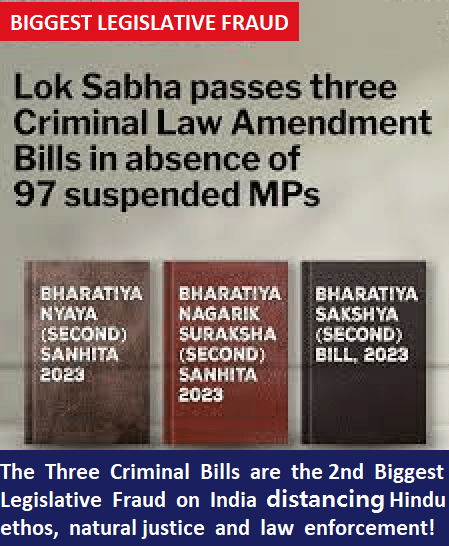
Recently passed Three Criminal Bills are the 2nd Biggest Legislative Fraud on India for many counts.
The Bharatiya Nyaya (Second) Sanhita Bill, the Bharatiya Sakshya (Second) Bill, and the Bharatiya Nagarik Suraksha (Second) Sanhita Bill, 2023 are clone of the Indian Penal Code, 1860, the Indian Evidence Act, 1872 , and the Code of Criminal Procedure, 1973 in its entirety by affixing a Sanskrit title to it. Further, it appears that even the meaning of the Sanskrit title does not bear any relevance to law. An old wine in an old bottle with a new erroneous label.
M Nageswar Rao, Ex IPS.
…
The Lok Sabha on 20th December 2023 passed the Bharatiya Nyaya (Second) Sanhita Bill, the Bharatiya Sakshya (Second) Bill, and the Bharatiya Nagarik Suraksha (Second) Sanhita Bill that respectively seek to replace the Indian Penal Code, 1860, the Indian Evidence Act, 1872 , and the Code of Criminal Procedure, 1973.
…
The three bills were first introduced in Lok Sabha on August 11, 2023 and were referred to a Parliamentary Standing Committee which suggested a few changes. Thereafter, the government withdrew and reintroduced them after incorporating the changes recommended by the Parliamentary Standing Committee. Hence the word “second” within parenthesis in the titles of the Bills.
…
While reading the title of my post the reader may be provoked to wonder what was the first biggest legislative fraud on India. I assure him that he would know that by the time he finishes reading this post.
…
During the discussion on the Bills in the Lok Sabha the Hon’ble Union Home Minister Shri Amit Shah said, “We are about to eradicate all signs of the shackles of our colonial past and of our slavery and create completely Indian criminal laws.”
…
Let us examine the truthfulness of Shah’s assertion by analysing each of the 3 Bills.
…
1. Is the Bharatiya Nyaya (Second) Sanhita Bill, 2023 any different from the Indian Penal Code, 1860?
…
Our ancient Hindu civilisation had its own criminal justice system. The barbaric Islamic invasions not only disrupted the Hindu society in every which way but also implanted into the soil the elements of diverse system in the administration of justice. After the British East India Company had acquired political authority in the aftermath of battle of Plassey in 1757, the administration of justice became one of its important activities. As the system then prevailing was so disparate and given to all sorts of problems, there was an imperative need to codify the criminal laws for their uniform application and dispensation of equitable justice.
…
The British East India Company officials found that even though the penal law and official legal system was essentially Islamic Hanafite law due to the preceding Muslim rule, the Hindu customary laws and practices were ubiquitous since the population was predominantly Hindu. During the course of administration of justice, the British regarded the Mohammedan criminal law as inconsistent, either cruel or too lenient, which was repugnant to natural justice. Therefore, they began inquiry into the Hindu law and practices.
..
Out of several law codes of ancient India, Manu Smriti, Yajnavalkya Smriti, Brihaspati Smriti and Arthashastra are the leading. Manu Smriti marks an epoch in the legal history of India as it contains not only the ordinances relating to law but a complete digest of the then laws, customs and usages observed by the people. It discusses crimes at length and classifies them into several heads such as crimes against property, human body and reputation, society and the king covering almost entire gamut of crimes. While meticulously working out the principles of individualization of punishment, they also laid down differential penalties for different crimes. They prescribed four methods of punishment namely, gentle admonition, severe reproof, fine and corporal punishment which includes imprisonment and capital punishment. They also ordained that these punishments may be inflicted separately or together. However, the type, quantum and severity of punishment must be guided by the (i) nature and gravity of the crime, (ii) time and place of the crime, and (ii) strength, age, sex, avocation and wealth of the offender.
..
The Indian Penal Code, 1860 was the culmination of decades of painstaking study into the sources of prevalent law, their varied practices in different parts of India, and the legislative efforts of several British colonial administrators and jurists. Most notable among them was Sir Barnes Peacock followed by Lord Thomas Babington Macaulay, in that order of their contribution.
..
Is there any who think that the striking resemblance between the principles and contents of the Indian Penal Code, 1860 and those enunciated in the Manu Smriti, Yajnavalkya Smriti, Brihaspati Smriti and Arthashastra is happenstance? Given the long history of plagiarisation of vast body of Hindu knowledge by the Arabs and the Europeans, it certainly is not.
..
Not for nothing, the Indian Penal Code, 1860 is by far the most important and major substantive Indian law. It is so precise and comprehensive, as the Hindu Smritis from which it is derived are, that it has been amended only sparingly since its enactment 173 years ago.
..
And the illiterates castigate it as a colonial law, just because it was enacted by the colonial British in English and therefore want to “Indianise” it. And how are they “Indianising” it?
..
A plain reading of both the Bharatiya Nyaya (Second) Sanhita Bill, 2023 and the Indian Penal Code, 1860 give out the fact that the former is a mere copy-paste of the latter by rearranging the sections by assigning different numbers to them after making a few cosmetic changes and then affixing a Sanskrit title ‘Bharatiya Nyaya Sanhita’, to it.
..
As understood, the Sanskrit word for ‘Penal” is “Danda”, whereas “Nyaya” means Justice. So is that even an appropriate Sanskrit title? So much for “Indianisation”!
..
In view of the above, is there any to accept my gauntlet for a crime-wise and punishment-wise debate on the prescriptions in the Indian Penal Code, 1860 and those in the Bharatiya Nyaya (Second) Sanhita Bill, 2023 to prove that they are not the same?
..
2. Is the Bharatiya Sakshya (Second) Bill, 2023 any different from the Indian Evidence Act, 1872?
..
The law of evidence is an index of the quality of a judicial system. In this respect, the ancient Hindu judicial system was much in advance of any other system of antiquity. In many ancient societies proof by supernatural devices, such as trial by ordeal, was quite common. In England it prevailed till the very close of the middle ages. But the ancient Hindu judicial system prohibited resort to supernatural devices. The real test of any law is that it should enable the courts to discover the truth, and that of ancient Hindu India stood high under this test.
..
The sources of information relating to the law of evidence prevailing in Hindu India emanate from the Hindu Dharmashastras, which were based on the Darsanas, or Schools of Hindu Philosophy. Truth was of integral importance, and in order to ascertain truth and its nature, the Hindu Darsanas enunciate elaborate theories (epistemology) and prescribe valid sources of knowledge (which are called pramãñas) and their ontological relationships.
..
As per Hindu Darsanas (there is no unanimity among them) there are six valid sources of knowledge namely, (i) Pratyakṣa (direct perception), (ii) Śabda (documentary, verbal testimony), (iii) Anumāna (inference), (iv) upamãna (comparison), (v) Arthapatti (postulation), and (vi) Anupalabdhi (absence, non-apprehension).
..
With the all-round destruction caused by the barbaric Islamic invaders, the much acclaimed Hindu judicial system went into disuse in parts of India that came under the Muslim rule. Therefore, when the British took over administration of India, justice dispensation became highly problematic for them. For, without a proper codified rules of evidence, administration of justice is impossible. The colonial British found the rules of evidence of Mohammedan law not satisfactory for dispensation of equitable justice.
..
While the colonial British codified the substantive criminal law as the Indian Penal Code by 1860, it took them another 12 years to codify the law of evidence which comes in the category of adjective law, as the Indian Evidence Act, 1872.
..
Just like the Indian Penal Code, 1860, the Indian Evidence Act, 1872 too was the culmination of decades of painstaking efforts of several British colonial administrators and jurists to produce a set of clear and comprehensive provisions, which could be easily employed to meet the demands of administration of justice. Sir James Fitzjames Stephen played a significant role in it.
..
Interestingly, the Indian Evidence Act, 1872 enunciates 6 types of admissible evidence, namely: (i) Direct, (ii) Oral, (iii) Documentary, (iv) Primary, (v) Secondary, and (vi) Circumstantial, almost conforming to the 6 pramãñas prescribed in the Hindu texts.
..
Is the striking resemblance between the principles and contents of the Indian Evidence Act, 1872 and those stipulated by the Hindu Darsanas and Dharmashastras, a mere coincidence? Given the long history of plagiarisation of vast body of Hindu knowledge by the Arabs and the Europeans, it certainly is not.
..
It is not by chance that the Indian Evidence Act, 1872 is by far the most important and major adjective law. Importantly, it is common for both civil and criminal trials. It is so precise and comprehensive, as the Hindu Darsanas from which it is derived are, that it was scarcely amended since its enactment 161 years ago.
..
And the ignoramuses castigate it as a colonial law, just because it was enacted by the colonial British in English and therefore want to “Indianise” it. And how are they “Indianising” it?
..
A simple reading of both the Bharatiya Sakshya (Second) Bill, 2023 and the Indian Evidence Act, 1872 reveal the fact that the former is a duplicate of the latter with a few cosmetic changes and then affixing a Sanskrit title the Bharatiya Sakshya Adhiniyam, to it.
..
3. Is the Bharatiya Nagarik Suraksha (Second) Sanhita Bill, 2023 any different from the Code of Criminal Procedure, 1973?
..
The Hindu jurisprudence is an ancient system that served as a guiding force to regulate human conduct. The ancient Hindu texts related to law emphasize dharma, the obligation of every person to do the right thing at all times. The Hindu law which is plural, lies in the diverse implementation of this principle in the infinite socio-cultural circumstances of life. “Hindu law teaches that fixed rules might cause injustice. The endless distinctions treat every individual as separate units, linked all the same by a common conceptual bond in a macrocosmic order (rita) or secular truth (satya). Dharma, the appropriate action, must consider all the circumstances with a view to promote the common good. In one sense, the individual is the ultimate agent to determine the ‘law’ in any particular situation, consequently reducing the role for the state as lawmaker.”
..
The colonial British did greatest damage in planting in India their procedural law as the Code of Criminal Procedure which is based on the Anglo-Saxon jurisprudence. Being a square peg in a round hole, it created an obvious tension. The alien jurisprudence has not led to expeditious dispensation of justice, but denial of justice. On the other hand, it also created a class of people with vested interests, whose livelihood depend not on speedy disposal of cases but in prolonging them indefinitely. Consequently, litigation became a trans-generational entanglement with the process becoming a punishment in itself. No wonder, hunger for justice in India far outweighs hunger for food.
..
‘Independent’ India replaced the colonial Code of Criminal Procedure, 1898 with the Code of Criminal Procedure, 1973. Instead of improving, it has caused more damage due, among other things, to separation of Prosecution from Police. Thereafter, the Prosecution system has been completely politicised with coterminous tenurial appointment of lawyers who are ruling party supporters/members as Prosecutors. Most of these lawyers hardly have any practice and their only qualification is that they belong to the ruling party. Their political affiliation, corruption in their appointment and their lack of basic knowledge of criminal trials led to complete collapse of what was left of the criminal justice system with conviction rates nose-diving to the lowest possible levels.
..
With a view to remedy the situation, some states such as Tamil Nadu, Uttar Pradesh, Rajasthan created a new system of Directorate of Prosecution in 1990s and appointed IPS officers as its Directors to reign in the berserk prosecution system. It led to significant improvement in the disposal of cases and rates of conviction.
..
And then came intervention of higher judiciary which declared that only Lawyers or District Judges should be appointed as the Directors of Prosecution. With that, things went back to square one leading to mounting pendency of cases and plummeting rates of conviction. It is said that the disposal of existing pending cases, without any new addition to it, will take more than 300 years to dispose of. Such is the chaos and sad state of affairs created by the Code of Criminal Procedure, 1973.
..
Thus the consequence of British implanting the alien Anglo-Saxon jurisprudence through the Code of Criminal Procedure is complete destruction of Rule of Law and justice delivery which are the bedrocks of democracy and governance. It is not an exaggeration to say that Indians have almost lost faith in the rule of law. Thankfully, the Indian society has not yet collapsed, not because of law, not because of police, not because of courts, but entirely because of the innate goodness of people.
..
Therefore, it was expected of the Central Government that a new Code of Criminal Procedure would be enacted to usher in a system of jurisprudence and a procedural law that facilitates expeditious dispensation of justice. Alas! That was not to be.
..
The Bharatiya Nagarik Suraksha (Second) Sanhita Bill, 2023 is a clone of the Code of Criminal Procedure, 1973 in its entirety by affixing a Sanskrit title Bharatiya Nagarik Suraksha Sanhita, to it. Further, it appears that even the meaning of the Sanskrit title does not bear any relevance to law. An old wine in an old bottle with a new erroneous label.
..
At the beginning of this post I had assured the reader to reveal what was the first biggest legislative fraud on India. The Constitution of India was the first biggest legislative fraud on India. It was drafted by B. N. Rau, who was the Constitutional Advisor. He merely paraphrased the Government of India Act, 1935 by adding a few things from here and there. By falsely attributing its drafting to Ambedkar, the powers-that-be cleverly firewalled for all times to come, any criticism of the Constitution even though Ambedkar himself candidly clarified on 2 September 1953 in Rajya Sabha, “People always keep on saying to me: ‘Oh, you are the maker the Constitution.’ My answer is I was a hack. What I was asked to do, I did much against my will…. But I am quite prepared to say that I shall be the first person to burn it out.”
..
Thus, just as the Constitution of India is an instrument to perpetuate colonialism, the Criminal Bills passed by Lok Sabha only further reinforce it, contrary to the bombastic claims of Union Home Minister Shri Amit Shah.
..
Finally, colonialism is not merely about colonising a geography but significantly it is a state of mind. The modern Hindu mind is so much colonised that it is more colonial than that of the colonisers, notwithstanding its linguistic medium.
..
The colonised Hindu mind has two subsets, namely; the #PseudoSecular Left-Liberals and the #PseudoHindutva RSS-BJP which are two sides of the same colonial coin.
..
____________
..
Writer, Mannem Nageswara Rao is a former-interim Director officer Central Bureau of Investigation (CBI) 2019. He joined CBI in 2016 and is an Indian Police Service (IPS) officer of 1986 batch and Odisha cadre. Devout Hindu Rao is a scholar in Indian history, culture, criminal law and contemporary politics. He is a chemistry post graduate from Osmania University and did his research in Madras IIT.


 Struggle for Hindu Existence
[…] [Disclaimer: The content in this RSS feed is automatically fetched from external sources. All trademarks, images, and opinions belong…
Well done but to no effect
I wholeheartedly support the movement of ABVP
This is a common concern in almost all the states in India, as anti-Hindu, anti-Indian terrorist forces are very active…
In Manipur, India, kukis are training child terrotists, taught them to hate and kill the Indigenous people of Manipur.