
Struggle for Hindu Existence
*Hindu Rights to Survive with Dignity & Sovereignty *Join Hindu Freedom Movement to make Bharat Hindu Rashtra within this lifetime *Jai Shri Ram *Jayatu Jayatu Hindu Rashtram *Editor: Upananda Brahmachari.
ASI hands over Bhojshala survey report to HC, says ‘existing structure was originally a temple’.
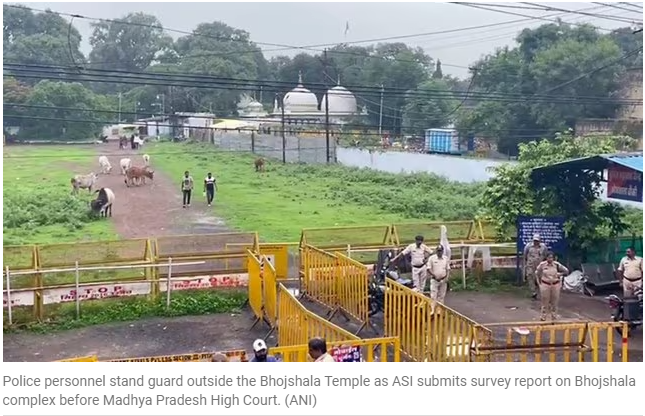
ASI finds Ganesh, Brahma, Narasimha images at Bhojshala complex, tells court that ‘existing structure was made from parts of earlier temples’.
Report submitted to Madhya Pradesh High Court, which had ordered a scientific survey in March last year to reveal the actual nature of Bhojshala in the backdrop of a conflict of Hindu and Muslim sides.
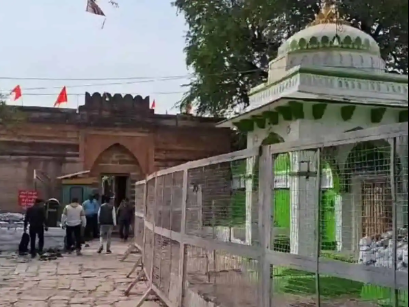 Sumitra Panda | HENB | Bhopal | July 16, 2024:: The Archeological Survey of India (ASI) on Monday submitted its survey report on the disputed Bhojshala temple-cum-Kamal Maula mosque complex in Dhar district to the Madhya Pradesh High Court, stating that the scientific investigation reveals that the “existing structure was made from the parts of earlier temples”.
Using parts of ancient temples dating back to the Paramara dynasty, structure of Kamal Maula Masjid was built in Bhojshala complex. Bhojshala-Kamal Mawla Masjid unearthed many sculptures of Ganesha, Brahma, Narasimha, Bhairav and other Hindu deities. Artifacts of several Hindu deities made of basalt, marble, schist, soft stone, sandstone and limestone have also been found.
The court had in March last year ordered the ASI to conduct the survey, observing that the nature and character of the structure needs to be “demystified and freed from the shackles of confusion”.
Hindus regard the ASI-protected complex as a temple dedicated to Goddess Vagdevi (Saraswati), while Muslims consider it the site of the Kamal Maula mosque. Under an arrangement made in 2003, Hindus perform puja at the complex on Tuesdays while Muslims offer namaz on Fridays.
According to the report, during the survey, ASI found 94 sculptures with intricate carvings, fragments of sculptures and architectural elements of an ancient temple. A number of inscriptions in Sanskrit and the original language have also been found, one of which mentions King Naravarman of the Parma dynasty, the ASI report said. The survey found sculptures of several animals including lions, elephants, horses, dogs, monkeys, snakes, and turtles. Mythical images of various gods and goddesses were found on the walls and pillars of the mosque built later.
The Hindu petitioners moved the court, citing several historical documents and research papers, claimed that before the Kamal Maula Masjid in the Bhojshala complex, there was a temple of Bagdevi Saraswati. The mosque was built by demolishing the ancient structure of the Hindu temple. The temple is claimed to have been demolished in the early 13th century, during the reign of Alauddin Khilji. Later, the Kamal Maula Mosque was built in 1514 during the reign of Mehmud Khilji II. King Naravarman, mentioned in the ASI report, ruled between 1094 and 1133 AD.
On the structure’s nature and age, the ASI report states that the “retrieved architectural remains, sculptural fragments, large slabs of inscriptions with literary texts, Nagakarnika inscriptions on pillars, etc suggest that a large structure associated with literary and educational activities existed at the site”.
“Based on scientific investigations and archaeological remains recovered during the investigations, this pre-existing structure can be dated to the Paramara period,” the report states.
According to the ASI, the Mihrab (a niche in the wall of a mosque) in the western colonnade “is a new construction and therefore it is beautifully decorated. It is made of different material than the entire structure”.
“Walls of the mihrab in the west abut against the platform made of basalt and having mouldings running under it. The material of the platform and the walls of the mihrab are different. Images carved on previous structure, pillars, pilasters, beams, windows, were chopped off to reuse them in the present structure. A number of large inscriptions in Sanskrit and Prakrit were damaged… by chiselling written surfaces,” the report states.
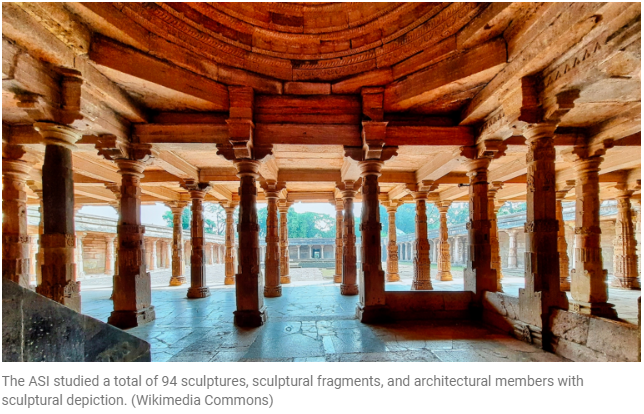
The structure is decorated with 106 pillars and 82 pilasters. “Art and architecture of these pillars and pilasters in colonnades suggest that they were originally part of temples. For their reuse in the existing structure, figures of deities and humans carved on them were mutilated,” the report states.
The ASI studied a total of 94 sculptures, sculptural fragments, and architectural members with sculptural depiction. “Sculptures of four armed deities were carved on windows, pillars and beams used in the existing structure. Images carved on these included Ganesh, Brahma with his consorts, Narasimha, Bhairava, gods and goddesses, human and animal figures. Images of animals in different mediums include lion, elephant, horse, dog, monkey, snake, tortoise, swan, and bird…,” the ASI report states.
Since “human and animal figures are not permitted in mosques, at many places such images have been chiselled out or defaced,” the ASI submitted.
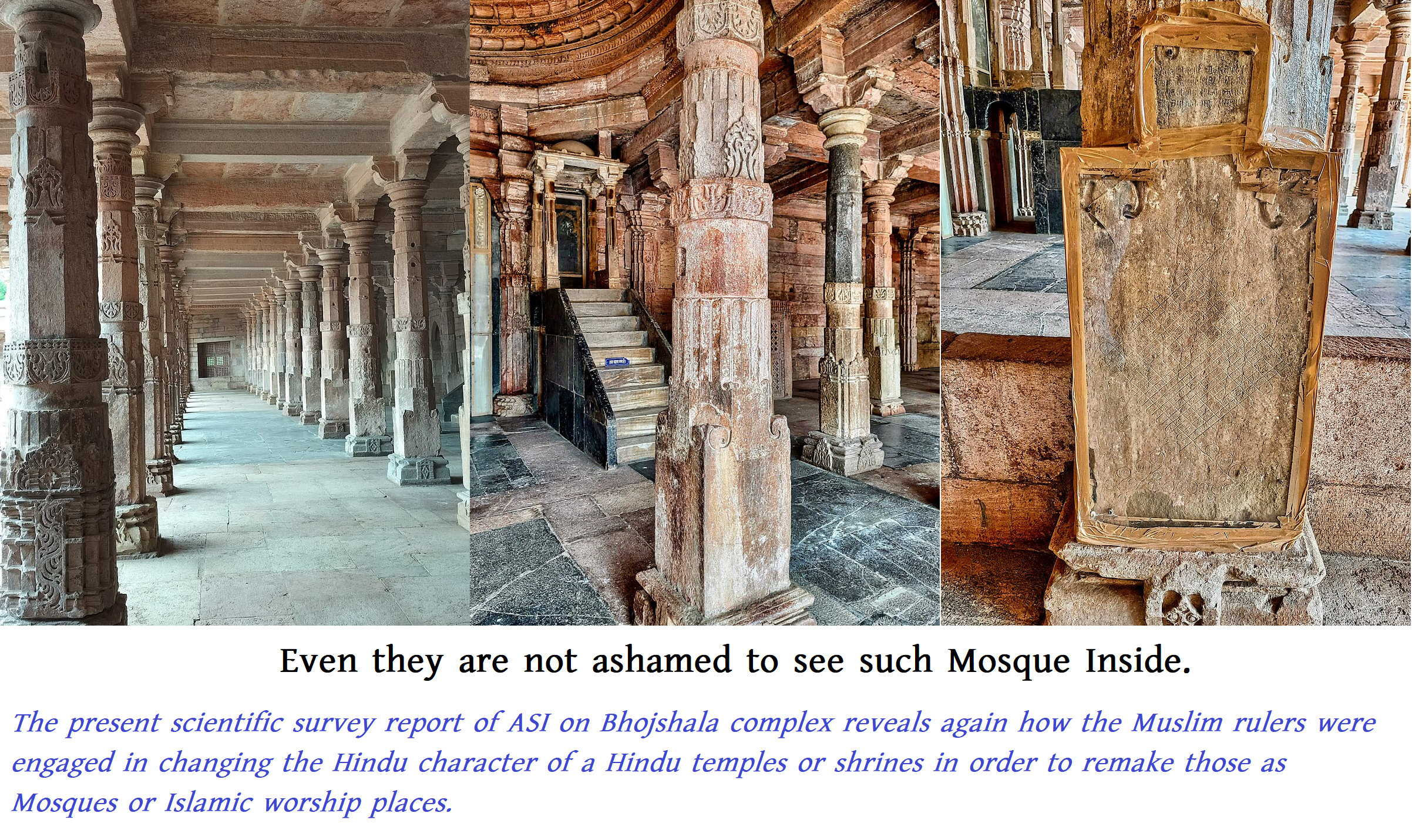
“It is noteworthy that kirtimukha with human, animal and composite faces carved on a number of pillars in western colonnade were not destroyed. Small figures of deities carved on frames of windows fixed in north and south walls of the western colonnade are also comparatively in good state of preservation,” the report states.
The ASI submitted that from the art and architecture of decorated pillars and pilasters, “it can be said that they were part of earlier temples and reused (to make) colonnades of the mosque…”
The report states that while the ASI studied Arabic and Persian inscriptions at the site, the ones in Sanskrit and Prakrit are older, “indicating that users or engravers of the Sanskrit and Prakrit inscriptions occupied the place earlier”.
“Based on scientific investigations, survey and archaeological excavations, study and analysis of retrieved finds, study of architectural remains, sculptures, inscriptions, art and sculptures, it can be said that the existing structure was made from the parts of earlier temples,” the report states.
The present scientific survey report of ASI on Bhojshala complex reveals again how the Muslim rulers were engaged in changing the Hindu character of a Hindu temples or shrines in order to remake those as many Mosques or Islamic worship places with their power ordained in Islamic expansions through intolerance.
The Madhya Pradesh High Court will hear the case on July 22.
SC agrees to consider listing plea against scientific survey
The Supreme Court on Monday agreed to consider listing a plea against a “scientific survey” of Bhojshala.
The petition was filed by Maulana Kamaluddin Welfare Society hallenging the March 11 order of the Madhya Pradesh High Court for a “scientific survey” of the shrine to ascertain it belonged to which community.
The Apex Court has also asked the Madhya Pradesh High Court to not pass any judgement in the case till the matter is heard in the Supreme Court.
.
__Inputs from PTI, Indian Express & Deccan Herald.


 Struggle for Hindu Existence
reconversion to Hinduism should be the primary goal of Hindu society today. Rest of the goals and actions of society…
[…] Hindu temple in Peterborough wins first round fight over sale to mosque […]
Dear Majumder Ji, Namaskar. Please send some donation / contribution for this site to run our activities. Donation link: http://paypal.me/hinduexistence…
[…] Protest against UGC Bill: Ghaziabad police halt Yati Narsinghanand’s yatra to Delhi’s Jantar Man… […]
[…] Tilak Ban at Pune School Sparks Strong Protest by Hindutva Groups Against Ambedkarite Headmaster. […]