


[…] [Disclaimer: The content in this RSS feed is automatically fetched from external sources. All trademarks, images, and opinions belong…

Struggle for Hindu Existence
*Hindu Rights to Survive with Dignity & Sovereignty *Join Hindu Freedom Movement to make Bharat Hindu Rashtra within this lifetime *Jai Shri Ram *Jayatu Jayatu Hindu Rashtram *Editor: Upananda Brahmachari.
Repeal Draconian Waqf Act: Submit Your Views and Suggestions Now!
Joint Parliamentary Committee invites suggestions on Waqf (Amendment) Bill 2024.
Hindus must send opinions-suggestions to repeal dangerous provisions of Draconian Waqf Act 1995.
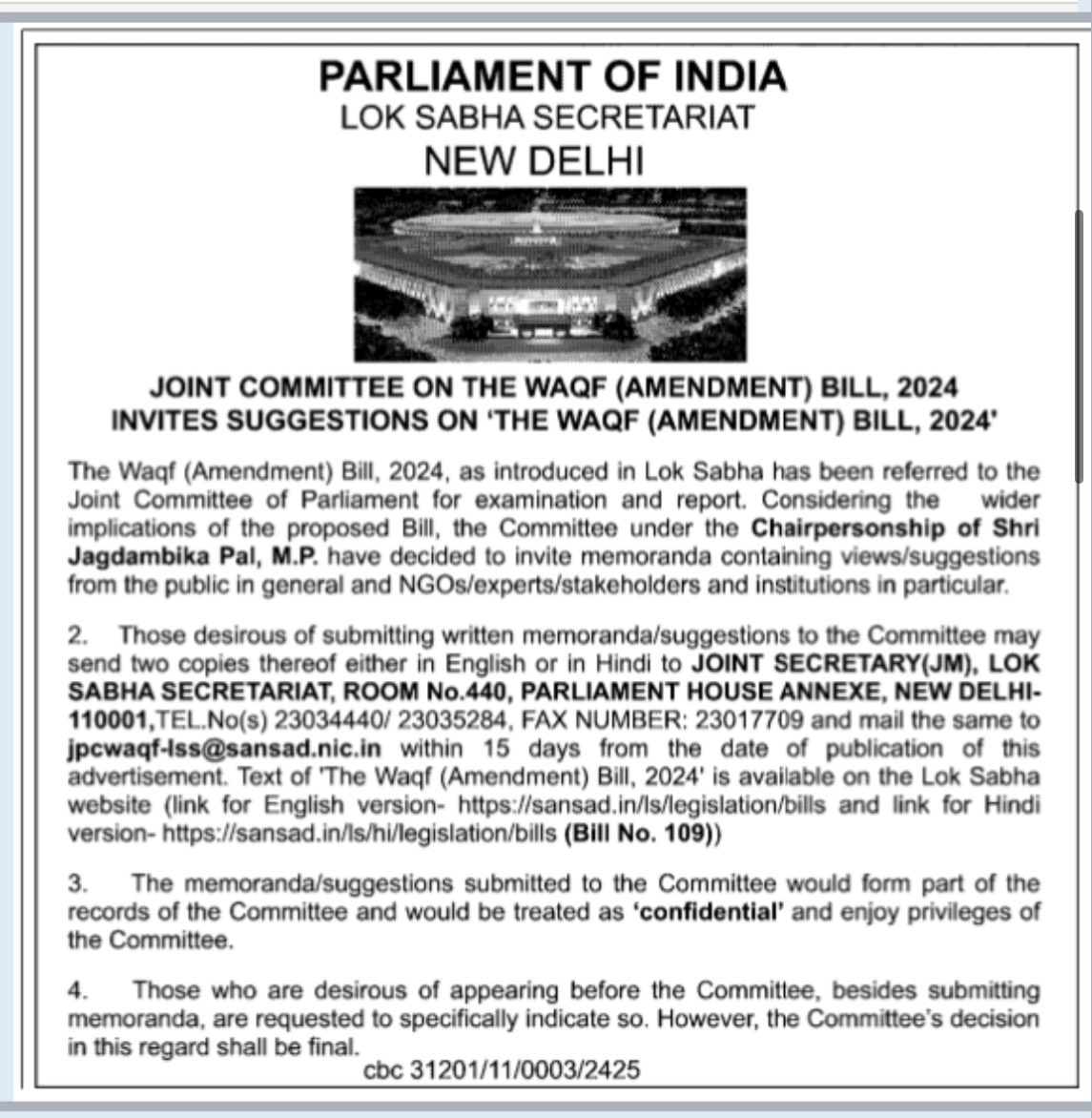 Upananda Brahmachari | HENB | Haridwar | Sept 2, 2024:: On August 30, 2024, the Joint Parliamentary Committee on the Waqf (Amendment) Bill, 2024 convened in New Delhi to solicit input and feedback from diverse stakeholders. Chaired by Lok Sabha MP Jagdambika Pal, the Committee had invited submissions from various stakeholders, including the general public, non-governmental organizations (NGOs), experts, and institutions, to gather comprehensive views and suggestions.
The Joint Parliamentary Committee on the Waqf (Amendment) Bill, 2024 held its inaugural meeting on August 22, 2024. Comprising 31 members, the committee is divided into 21 members from the Lok Sabha and 10 members from the Rajya Sabha, ensuring a representative balance from both houses.
The Waqf (Amendment) Bill, 2024 aims to address the existing shortcomings and enhance the administration and management of waqf properties. Key provisions include:
– Renaming the Waqf Act, 1995 as the Unified Waqf Management, Empowerment, Efficiency, and Development Act, 1995
– Authorizing the Collector or Deputy Collector to perform survey functions
– Expanding the Central Waqf Council and State Waqf Boards to include Muslim women, non-Muslims, and diverse Muslim communities (Shia, Sunni, Bohra, Agakhani, and other backward classes)
– Establishing a separate Waqf Board for Boharas and Aghakhanis
– Reforming the Tribunal structure with two members and allowing High Court appeals within 90 days
These amendments aim to improve the management, representation, and dispute resolution processes related to waqf properties.
The Waqf (Amendment) Bill, 2024 is now available for public access in both Hindi and English on the official Lok Sabha website. Introduced in the Lok Sabha during the Budget Session, the Bill has been referred to the Joint Parliamentary Committee for thorough examination and review.
The draconian Waqf Act of 1995, introduced by the then Congress government, has been criticized for its perceived role in enabling the Muslims for acquisition of large tracts of land by Waqf Boards, leading to concerns about ‘Land Jihad’. As a result, Waqf Boards have become one of the largest landholders in India, after the Indian Railways and Defense Department. This has raised questions about the disproportionate land ownership by Waqf Boards, given the Muslim population in India is below 20%, and its implications for land rights and governance.
The Waqf Act of 1995 has been utilized by Muslims in India to claim ownership of various lands, including those with existing structures, such as entire villages and Hindu temples, regardless of their historical significance or the fact that they predate the arrival of Islam in India.
According to the Ministry of Minority Affairs, Government of India, there are approximately 870,000 Waqf properties in India, spanning an area of 940,000 acres. Data from the Waqf Assets Management System of India reveals that the majority of these properties comprise graveyards, followed by agricultural lands, mosques, Muslim orphanages and commercial establishments such as shops.
Waqf properties are lands or assets donated for religious or charitable purposes in accordance with Islamic law, and are managed by Waqf boards to ensure their proper use and distribution of proceeds for the benefit of the community. Currently, 32 Waqf boards operate across India, each responsible for overseeing and managing Waqf properties within their respective states or Union territories.
Ministry officials cite the high number of disputes surrounding Waqf properties to the sweeping powers granted to state Waqf Boards, enabling them to unilaterally declare a property as a Waqf property. The ministry has emphasized the need for a standardized procedure to identify and determine Waqf properties, ensuring a more transparent and dispute-free process.
According to a ministry source, there have been instances where individuals have been deprived of their properties after they were unilaterally declared as Waqf properties. Although there is a system in place for addressing such disputes through tribunals, many of these tribunals are no longer functional, leaving affected individuals without a viable recourse.
Waqf officers face significant challenges beyond mere name-calling when conducting site inspections, meeting with mutawallis (caretakers), or verifying income generated from properties. The growing public perception of waqf boards as greedy land-grabbers has led to a disturbing trend of physical attacks on officers in recent years, underscoring the need for improved public awareness and understanding.
According to sources, the three-member Waqf tribunals, which are constituted by the states as Waqf is a state subject, have faced challenges in functionality. Initially comprising a single judicial member, the tribunals were expanded to include a land expert and an Islamic law expert in 2013. However, sources reveal that most disputes pertain to property issues, and the scarcity of Islamic scholars in the country has further hindered the tribunals’ effectiveness.
Officials point out that the current system lacks provisions for individuals affected by the identification of a property as Waqf. Although affected parties can contest the declaration in a tribunal, they face significant hurdles: tribunals lack the authority to grant stays, and there is no specified timeline for case disposal. This leaves affected individuals without adequate recourse or timely resolution.
“A further concern is that tribunal decisions are final and binding, with no provision for appeal except through writ jurisdiction in a high court,” a source noted. “The fact that Waqf boards can unilaterally declare private properties as Waqf properties, coupled with the weak and limited process for contesting such declarations, has led to a surge in disputes.”
Ministry sources reveal that two contentious issues are under scrutiny. Firstly, the ‘Waqf by User’ concept, which allows a property to be declared Waqf if used for religious purposes, even without the owner’s explicit grant or consent. Notably, officials highlight that this provision is unique to India, as no other country recognizes ‘Waqf by User’.
Secondly, the government is reviewing the concept of ‘Waqf-alal-aulad’, a type of Waqf that benefits the founder’s family or children, often used as a means of inheritance or succession planning. This practice allows the founder to retain control over the property and its benefits within their family, rather than dedicating it solely for charitable or religious purposes.
Thirdly, the government has opened a channel for public feedback on Waqf matters, including soliciting input from Muslims and non-Muslims who have been adversely affected by the actions of Waqf Mutawallis (managers-caretakers). This move aims to provide a platform for those who have been victimized or exploited by unscrupulous Waqf managers to share their experiences and concerns.
In response to the Joint Parliamentary Committee’s call for input on the Waqf Amendment, a diverse range of stakeholders, including the general public, NGOs, experts, and institutions, submitted their views and suggestions. The committee, chaired by Sri Jagdambika Pal, received good numbers of inputs from various organizations and individuals, providing valuable feedback to inform the amendment process.
Sri Vishnu Gupta, President of Hindu Sena, has submitted a letter to the committee outlining 28 demands for reforming the Waqf system. The key demands include:
1. Designating Waqf as a quasi-public body, rather than a Muslim/minority organization.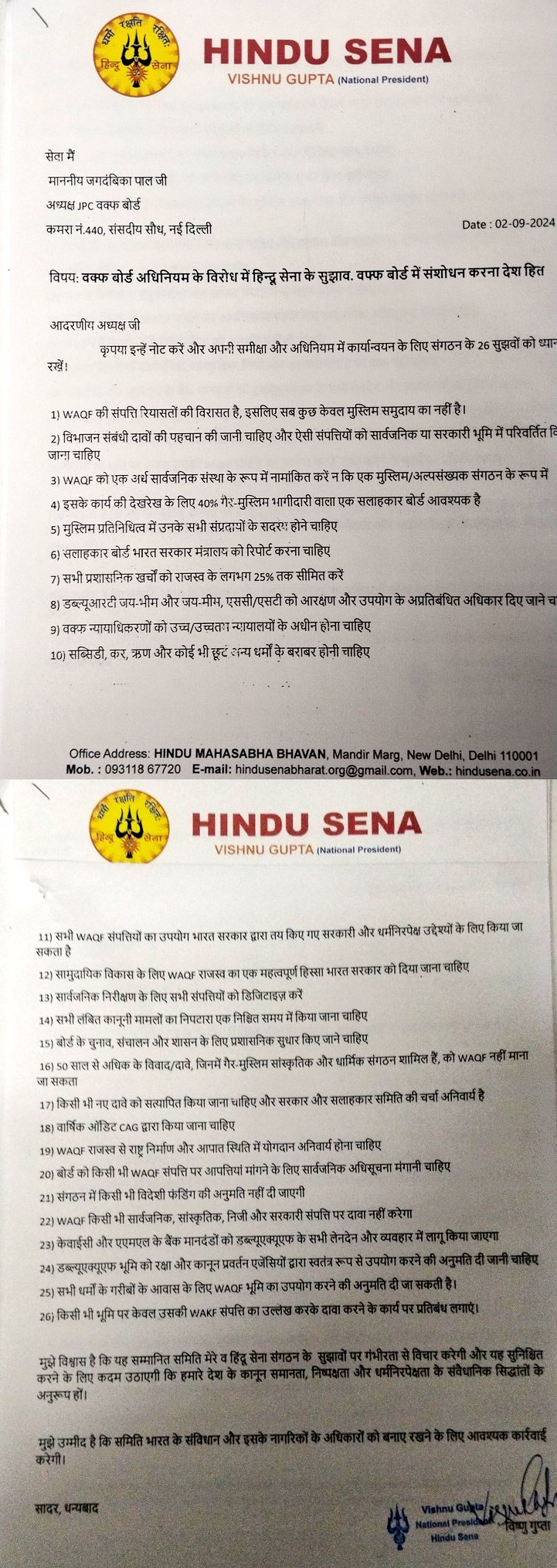
2. Establishing a Waqf advisory board with 40% non-Muslim representation to oversee its work.
3. Ensuring Muslim representation on the Waqf board includes members from all sects.
4. Requiring the Waqf Advisory board to report to a Government of India ministry.
5. Capping Waqf administrative expenses at 25% of revenue.
6. Making Waqf tribunals subordinate to High/Supreme courts.
7. Ensuring Waqf subsidies, taxes, loans, and exemptions are on par with other religions.
8. Allowing Waqf properties to be used for government and secular purposes, as decided by the Government of India.
9. Allocating a significant portion of Waqf revenues to the Indian government for community development.
10. Implementing administrative reforms for election, operation, and governance of the Waqf board.
11. Disallowing disputes/claims over 50 years, including those from non-Muslim cultural and religious organizations.
12. Verifying new Waqf claims through government and advisory committee discussions.
13. Conducting annual audits of Waqf by the Comptroller and Auditor General (CAG).
14. Mandating contributions from Waqf revenues to nation building and emergencies.
15. Requiring public notification seeking objections on any Waqf property.
16. Prohibiting foreign funding in the organization.
17. Preventing Waqf from claiming public, cultural, private, and government properties.
18. Allowing defense and law enforcement agencies to freely use Waqf land.
19. Permitting Waqf land to be used for housing the poor of all religions.
20. Banning the practice of claiming land by merely designating (declaration and usage) it as Wakf property.
Alleging that the Waqf Act of 1995 is “draconian” in nature, devout Hindu lawyer Advocate Amita Sachdeva highlighted its far-reaching and devastating consequences for other religious faiths and their adherents’ rights. She contended that this legislation has created a discriminatory framework that disproportionately empowers Muslim institutions while undermining the interests of other communities.
Taking to HENB, Advocate Sachdeva emphasized that the Act’s provisions have led to:
– Unchecked encroachment on properties belonging to other faiths
– Disregard for the rights of non-Muslim stakeholders
– Unfair distribution of resources and subsidies
– Erosion of the secular fabric of the nation
She urged for a comprehensive review and reform of the Waqf Act to ensure equal treatment and protection for all religious groups, promoting a more inclusive and equitable society.
Sri Ramesh Shinde, national spokesperson of Hindu Janajagruti Samiti, has issued an appeal through a video release, urging concerned citizens to submit their input to the Joint Parliamentary Committee on Waqf Amendment. He emphasized three critical points to highlight in their submissions:
1. The Wakf Board should not receive government land for graveyards, mosques, and madrasas when it already possesses lakhs of acres of land, which should be utilized optimally.
2. Wakf land should be brought under government control and utilized for public welfare initiatives, ensuring its use benefits society at large.
3. The judicial powers vested in the Chairman of the Wakf Board should be abolished, and all cases should be handled by the existing judicial system, ensuring impartiality and fairness.
By emphasizing these points, individuals can contribute to shaping a more accountable and equitable Waqf Amendment that prioritizes public interest and transparency.
Now, all Hindu individuals and organizations must promptly submit their opinions and suggestions to the Joint Parliamentary Committee on Waqf Amendment, advocating for the repeal of the draconian provisions in the Waqf Act 1995.
_____
To get the copy of the bill click here https://sansad.in/ls/legislation/bills (in English) https://sansad.in/ls/hi/legislation/bills (in Hindi).
Write your views/suggestions/objections to:
Sri Jagdambika Pal,
Chairperson, Joint Parliamentary Committee on ‘The Waqf (Amendment) Bill 2024’
C/o. Joint Secretary (JM), Lok Sabha Secretariat, Room No. 440,
Parliament House Annexe, New Delhi- 110001.
Email address: jpcwaqf-lss@sansad.nic.in
_____
37 comments on “Repeal Draconian Waqf Act: Submit Your Views and Suggestions Now!”
Leave a comment

Well done but to no effect
I wholeheartedly support the movement of ABVP
This is a common concern in almost all the states in India, as anti-Hindu, anti-Indian terrorist forces are very active…
In Manipur, India, kukis are training child terrotists, taught them to hate and kill the Indigenous people of Manipur.


 Struggle for Hindu Existence
Agree with the decision to make ammendment in waqf act. I repeal of the draconian provisions in the Waqf Act 1995.
LikeLike
Abolish the waqf act 1995.
LikeLike
Repeal Draconian Waqf act. I agree to the decision to make amendments in Waqf act.
LikeLike
yes,I also agree
LikeLike
first of all first amendment should be that wakf board can directly say that this property is mine and person who is the owner can not even go to the court. Secondly it should return all the hindu temple properties which were converted to mosques, it can keep the property which it get through zakaat, to help poor muslims to build some kind of houses, hospitals etc. but no hindu property can be taken like that by wakf board. It wakf board should consist of hindus also. Moreover it should be dissolve when there is no hindu board then why wakf.
LikeLike
yes I also agree
LikeLike
Subject: Public Suggestions on The Waqf (Amendment) Bill 2024.
To,
Respected Chairperson,
I am not going to discuss on how and what is wrong. You are already having a list of wrong deeds coming from many of my fellow indians and that’s a reason you are here amend the bilk.
So, I come straight to the Point.
Not Only Waqf act but board should also be banned.
Instead of amending the waqf board act; can you not just scrap it. Secular country cannot have such kind of land mafia. By just amending the act you are giving it a secular licence. This can become the biggest clash between our coming future generations. When you know the men is dead, better you burn the body rather than keeping it in open.
If you don’t have the courage to scrap it, I am giving you an alternative method of correcting it. The total land of India including the Pakistan occupied Kashmir and aksai chin you transfer it to Shri Ram Mandir trust. Ram is father of this nation and not Mohandas Karamchand Gandhi.
Now you send out the notification to all the people of India and ask them to come with three below documents.
1 – Property agreement.
2 – Purchase receipt.
3 – Bank Transfer Details.
Central government, state governments, union territories, defence and railways should get their all land and property first.
Then on the basis of above three documents start allotting land and properties to the common people and business houses.
If all three documents are good.. property belong to the said person.
If there are good agreements but no fair value certificate and less Bank amount receipt compare to Properties fair market value…the said property will go in scrutiny.
Those who don’t have any of these documents and are just claiming that it is theirs on the basis of the power they hold, their properties should be freezed.
This exercise will take care of corrupt people and land mafia.
This exercise will also take care of population counting and 100% nrc will be completed via this.
This exercise will also do the digital mapping of land and will help farmers.
This will also bring back all the money and properties looted by our Politicians in last 77 years back to people of this country.
You need to understand. There are solutions to all the problems. The only thing is required is to be open for all methods. And very important thing is that you should have right intent to do
LikeLike
Absolutely . Spot on.
LikeLike
my opinion is give the muslim property to muslim and the property is mosque and the 2024 waqf bill i thought it’s never pass then all good thanks
LikeLike
Waqt Board Should be banned.
How can they claim Property when there is no goverment evidence. This is purely a conspiracy and a act to prevail unrest in country
This people have a Tendency to humilate the government, by not abiding to law.
ALL WAQT BOARD PROPERTIES CLAIMED BY THERE PEOPLE SHOULD HAVE ILLEGAL TITLES.
ONLY AND ONLY GOVERMENT APPROVAL IS MANDATORY.
Waqt board should return all hindu property which they have claimed from all these years, and if they are going to create chaos for this in country they should leave this country.
In Conclusion there should not be a board which exist as waqt board, it should be permanently demolish.
LikeLike
I agree with the government to ament the Waqf act. Post partition of India on religious line there is no justification for such acts in India. Like abolition of kingdoms act ïn past, this act should be repealed immediately and land in hand of WAqf board should be used for the welfare of poor people
LikeLike
I am in favour of this bill. Plz do the needful.
LikeLike
Agree with the decision to make amendment in the Waqf act. I am for repealing the draconian provisions in the Waqf Act 1995.
LikeLike
i am in favour of the bill. please do it. please pass the bill. we don’t need waqf board. need government action.
LikeLike
I agree with the government to ament the Waqf act. Post partition of India on religious line there is no justification for such acts in India. Like abolition of kingdoms act ïn past, this act should be repealed immediately and land in hand of WAqf board should be used for the welfare of poor people
LikeLike
I am in favour of eNill
LikeLike
i agree with the government to amend the waqf act. Jai shree ram
LikeLike
waqf board should be abolished.
the property of Government should be governed by government.
LikeLike
stop waft act in india
LikeLike
waqf board should be deleted from the history of india
LikeLike
I believe the email id given in the end of the article is incorrect.
The correct email id (as I know) is: jpcwaqf-Iss@sansad.nic.in
LikeLiked by 1 person
Yes Sir.
Corrected.
Thanks and regards.
Team Hindu Existence.
LikeLike
I agree with the government to amend the Waqf act. Post partition of India on religious line there is no justification for such acts in India. Must abolish immediately.
LikeLike
I agree with the amendment of waqf act
LikeLike
band kro waqf board ko pehle pakistan diya fir bangla desh diya ab fir aada hindustan in logo ke pass hai kya majak bna rakha itni zamin hai inke pass fir ye minorities hai sare galat kaam ye karte hai nakli currency ye banate hai, hathiyaar ye banate hai ugrawadi jitne hai sare muslim hai, isko khatam kero nhi to jo Yogi g bol rhe hai wahi hoga katenge hum, or santan dharm board banao jisme her mandir ka paisa jma ho or desh ka vikas ho hindu ka vikas ho
LikeLike
Scrap wakf board titally. It is like muhhal badshah . We are not free if it is there in existence . There is no meaning of freedom . Any time they can worship at our place and give notification as wakf property .
Again they behave like separate from goverment body.
Ban wakf and all organisation . They are hidden group using date tree and green coloured Indian map which telles to cover India with islam only . Wakf is a means for mass conversion by claiming wakf property on entire village.
Property of hindu who left Pakistan and Bangladesh are living like beggers , but muslims who left from India acquired peopety of hindu in pakistan and Bangladesh . There should be a joint supreme court but nothing there . Who will do justice ? Justice is to give wakf peoperty to hindu who left their homes due to partition . It is hindu property .
LikeLike
I humble request to Indian government please erase this act from Indian constitution. Quick
otherwise it’s become more dangerous then corona virus
LikeLike
For uniformity for Residents of India Waqf law is a dark horse with killer demigod on it. They do whatever in the name of religious law, then Hindus too need such law to be passed such that all India belongs to Hindus as Muslims were invading society so the victim should be given an opportunity to form his own court as they say Sharia law. We Hindus too have different rules and laws to be maintained, hence we too need a a Sanathani law. So that all Hindus shall be excluded from the Regional court laws and rules.
LikeLike
I request to government please erase this act immediately.
LikeLike
i agree with demand of government to amend this bill or even abolishing it which is the best act to do so.
LikeLike
I demand to abolish Wakf Bill completelely. If one section Indian citizens are given lots of opportunities in the name of minoririty community ,it will an injustice for majority community of India
LikeLike
cancel/close waqf board. All citizens od BHARAT should have same rights.
LikeLike
Subject: Public Suggestions on The Waqf (Amendment) Bill 2024.
I would request JPC Chairman, I demand the complete ban on Waft Board and request the Government amend the Bill.
Sanjeev Kumar Singh
LikeLike
This must be abolish.. there shouldn’t be any such Board. It’s like parallel government.. who are not questionable.
LikeLike
SUB: WAQF AMENDMENT BILL 2024,
HON’BLE MR. CHAIRMAN, WAQF ACT MSUT BE AMENDED TO THE EXTENT THAT IT STAYS WITH IN THE AMBIT ARTICLE 14 OF THE CONSTITUTION OF INDIA. ANY DISPUTE ARISING SHALL BE ADDRESSED IN THE COURTS CONSTITUTED UNDER THE CONSTITUTION. WAQF TRIBUNAL BY NATURE IS NOT A CONSTITUTIONAL ENTITY AND WITH OUT APPROVAL AND VETTING BY A CONSTITUTIONAL OFFICE, ANY OBSERVATION OR ORDER PASSED BY THE TRIBUAL, SHALL NOT STAND OBLIGATORILY BINDING FOR THE STATE GOVERNMENTS TO ENFORCE OR COMPLY.
MR. CHAIRMAN GOVERMENTS IN CENTRE AND STATE SHALL BE BARRED FROM ARBITRARILY ALLOTING LAND TO WAQF BOARD AS IT IS A RELIGIOUS ENTITY AND IN PRINCIPLE STATE SHALL DISTANCE ITSELF FROM RELIGION.
THERE SHOULD BE AN ENQUIRY INTO THE LAND OWNERSHIP OF THE WAQF BOARD, ANY PROPERTY BESTOWED TO THE WAQF BOARD BY ANY GOVERNMENT IN CENTRE OR STATE SHALL BE RESTORED BACK TO THE PEOPLE OF INDIA. WAQF SHALL ONLY HOLD TITLE FOR THE PROPERTY THAT IS WILLED TO WAQF BOARD BY A MUSLIM, AND THAT THE SAID WILL SHALL BE MADE IN ACCORDANCE WITH INDIAN SUCCESSION ACT.
WAQF PROPERTIES SHALL ONLY BE USED FOR COMMON GOOD AND COMMERCIAL GAINS SHOULD NOT BE ALLOWED.
I URGE MY SANATANI BRETHEREN TO STAND UP AND VOICE THEIR VIEWS, LEST YOU GET PUSHED TO OBLIVION LIKE INDONESIA AND PERSIA.
JAI HIND , JAI BHARAT, JAI SHRI RAM
LikeLike
Humne 2 email ID se mail kia tha lekin send nhi hui vo 3 din baad msg aaya waqf board should be banned
LikeLike
I request to the authorities those who are amending Waqf Act please also include this in the new Waqf Amendment 2024 Act, Once the Government of India or the State Government Declared any such important Buildings as Protected Monument in ASI or the State Archeological Site cannot be notify as Waqf property, Recently The Honourable Court stated that the Ancient Monuments Preservation Act takes precedence over the Waqf Act concerning properties declared as ancient monuments. The Court further held that the Waqf Board had no jurisdiction over the property already under guardianship as an ancient monument.
LikeLike