

[…] [Disclaimer: The content in this RSS feed is automatically fetched from external sources. All trademarks, images, and opinions belong…

Struggle for Hindu Existence
*Hindu Rights to Survive with Dignity & Sovereignty *Join Hindu Freedom Movement to make Bharat Hindu Rashtra within this lifetime *Jai Shri Ram *Jayatu Jayatu Hindu Rashtram *Editor: Upananda Brahmachari.
Sambhal Truth Files: Temple Symbols Found At Disputed Shahi Jama Masjid. Unearthing Ancient Temples and Wells all around.
Does Sealed 45-Page Sambhal Mosque Survey Report Confirm Pre-Existence Of Temple At Site?

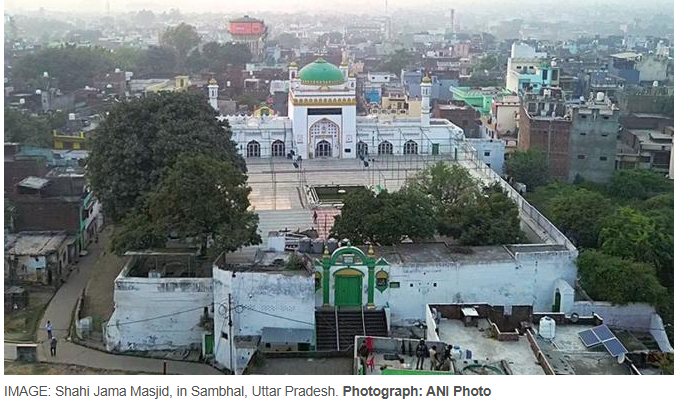
News18.com | New Delhi | Jan 3, 2025:: Does the sealed 45-page Sambhal mosque survey report, supported by over 1,200 photographs and approximately 4.5 hours of video recordings, confirm the pre-existence of a temple at the mosque site? Although the report submitted by the appointed advocate commissioner to a local court in Chandausi, Uttar Pradesh, remains undisclosed, petitioners and sources involved in the survey told News18 that sufficient evidence exists to substantiate the presence of a temple at the mosque site.
“We don’t know the contents of the survey report submitted to the court, but based on the photographs and videography, the existence of an ancient temple at the mosque site cannot be denied,” said Hari Shankar Jain, one of the eight petitioners who filed a claim asserting that the Jama Masjid, a protected monument under the Ancient Monuments Preservation Act, 1904, and listed as a Monument of National Importance by the Archaeological Survey of India (ASI), was constructed over the ruins of a temple dedicated to Lord Kalki.
The petition also alleged that the mosque committee unlawfully occupies the site of the Shri Harihar Temple, a centuries-old Hindu shrine devoted to Lord Kalki. Acting on the petition, the local court ordered a survey on November 19 to determine whether the mosque was indeed built on the ruins of Shri Harihar Temple. The survey, conducted on November 19 and 24, was marred by communal clashes as protesters opposed the ASI team’s inspection of the mosque. The unrest escalated into large-scale violence, resulting in five deaths.
‘Evidences of pre-existing temple’
Jain further stated that the survey uncovered over 50 floral motifs, symbols, and artefacts within the mosque premises, which he claims are indicative of its Hindu origins. He pointed to the presence of two Banyan trees, which hold significant religious importance in Hinduism and are traditionally worshipped. Additionally, Jain mentioned a well located at the site, with half of it situated inside the mosque and the other half outside. The external portion of the well, he alleged, has been covered.
Sources involved in the survey revealed that parts of the old structure have been replaced, and evidence of new construction has been identified in areas where remnants of the original structure exist. Temple elements such as doors, windows, and intricately decorated walls have reportedly been plastered and painted over.
They also pointed out that inside the mosque, a chandelier is suspended from the large dome using a chain attached to a wire. According to the sources, similar chains are traditionally used to hang bells in temples, further suggesting the site’s possible Hindu origins.
Survey report submitted
Court commissioner Ramesh Singh Raghav, appointed as the advocate on the case, told the media after submitting the report: “The survey was conducted according to the directions of the court, and the complete report, including videography, has been submitted to the civil judge, senior division, in a sealed envelope.”
Advocate commissioner Raghav also submitted a three-page cover letter along with the 45-page survey report. The report has 60 pictures taken during the survey and videography content. Raghav also submitted around four and a half hours of videography of the survey on a pen drive. He said that due to the Supreme Court’s order, the report cannot be disclosed.
The claim
The petitioners in the Sambhal mosque case have cited the Baburnama, claiming that Babur’s memoirs confirm the existence of a Harihar temple at the site of Sambhal’s Jama Masjid, which Babur allegedly demolished in 1529. Supporting this assertion, the petitioners referenced an 1875 report by British archaeologist ACL Carlleyle (Tours in the Central Doab and Gorakhpur, 1874-1875 and 1875-1876), which documented observations of the mosque’s pillars. According to Carlleyle, the pillars bore a striking resemblance to those found in old Hindu temples, though they had been concealed beneath plaster. Notably, the removal of plaster from one pillar revealed red columns characteristic of Hindu temple architecture.
The petitioners also pointed to an inscription referenced in Carlleyle’s report, which stated that the mosque was constructed in 1526 by Mir Hindu Beg, a courtier of Babur. This inscription purportedly mentioned that a temple was converted into a mosque. Additionally, an Archaeological Survey of India (ASI) report identified structural features within the mosque that it linked to Hindu temple architecture, adding to the growing controversy surrounding the site.
The petition
The Shahi Jama Masjid in Sambhal drew national attention following a plea filed by advocate Vishnu Shankar Jain on behalf of eight petitioners. The petition claimed that the Jama Masjid, a protected monument under the Ancient Monuments Preservation Act, 1904, and listed as a Monument of National Importance by the Archaeological Survey of India (ASI), was constructed on the ruins of the Shri Harihar Temple, a centuries-old Hindu shrine dedicated to Lord Kalki. It also alleged that the mosque committee unlawfully occupies the temple site.
The petition emphasised Sambhal’s unique importance in Hindu scriptures as the prophesied birthplace of Lord Kalki, the future incarnation of Lord Vishnu. According to the claim, the Shri Harihar Temple was built by Lord Vishwakarma at the dawn of creation and housed a rare idol symbolising both Lord Vishnu and Lord Shiva. The temple, the petition argued, was destroyed in 1526 AD by Mughal Emperor Babur during his invasion of India to assert Islamic dominance.
Petitioners have sought court permission to access the temple site and requested an injunction to prevent interference during their exploration of its remains.
What Muslim side says
Advocate Zafar Ali, representing the Shahi Jama Masjid Committee, rejected the Hindu side’s claims, arguing that there is no credible evidence of a temple ever existing at the mosque site. He pointed out that the petitioners cannot specify when the alleged temple was built and lack historical records or documentation to support their assertions. Ali also dismissed the relevance of the Baburnama and other texts cited by the petitioners, stating that these require judicial scrutiny to determine their authenticity and relevance. He, however, admitted the fact that Sambhal’s historical significance as the capital of Prithviraj Chauhan but said that this does not prove the temple’s existence. He said that no such claims have been made since Independence. “Though some cases were filed back in 1877 and 1879, they were dismissed, with rulings favouring the Jama Masjid,” he added. He said that the temple claim is based on rumours and not on facts.
With the Shahi Jama Masjid controversy unfolding in Sambhal, UP seems to be in for another long-running temple-mosque dispute after Ayodhya’s Ramjanmabhoomi-Babri Masjid, Varanasi’s Gyanvapi, and Mathura’s Shahi Idgah mosque sites.
Courtesy: News18
Sambhal Survey Report: Temple Symbols Found At Disputed Shahi Jama Masjid Site In UP.
India Today | New Delhi | Jan 3, 2025:: A 45-page survey report on the Shahi Jama Masjid area in Sambhal, Uttar Pradesh, has been submitted to the court. The report, based on extensive videography and photography, suggests the presence of temple symbols at the disputed site. Findings include banyan trees, lotus symbols, and evidence of altered construction. The survey was conducted over two days in November.
Courtesy: India Today
Discovery in Sambhal: Unearthing Ancient Temples and Wells
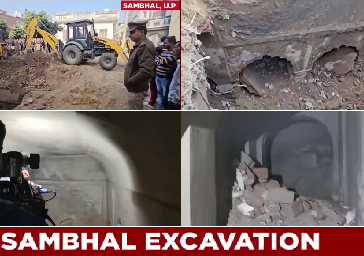
Biswajeet Banerjee and Sajid Khan | Daily Pioneer | New Delhi | Jan 5, 2025:: What began as a routine inspection by district officials to check noise levels from loudspeakers and illegal electricity connections in the Muslim-dominated Khaggu Sarai area of Sambhal has turned into a historic archaeological discovery. On 14 December, a team led by the District Magistrate (DM) and Superintendent of Police (SP) stumbled upon a locked structure. Breaking open its doors revealed not just an abandoned Shiva temple but also a wealth of history hidden beneath layers of soil and silt.
The discovery of the temple, which had been locked for 46 years, has prompted a flurry of activity, including surveys by the Archaeological Survey of India (ASI). Early reports suggest the temple, and other relics unearthed nearby, may date back several centuries, providing invaluable insights into Sambhal’s rich cultural and religious history.
Locked Temple, Unlocked History
DM Dr. Rajendra Pansiya recalled the unexpected nature of the find. “This discovery was purely accidental. We were investigating noise and electricity issues near a mosque, but what we found behind the locked doors was remarkable,” he said. The temple, which had been shut since the 1978 communal riots, housed a Shiva idol and a statue of Hanuman. Nearby, a well contained three additional statues that were uncovered during excavation.
The riots of 1978, which displaced many from the local Hindu community, had led to the temple being abandoned. “Local accounts suggest the temple is over 500 years old,” Dr. Pansiya added. To confirm its antiquity, the district administration reached out to the ASI for carbon dating and further investigation.
The ASI Steps In
Following the DM’s request, a four-member ASI team from Meerut and Delhi conducted an extensive eight-hour survey of the site last week. The team examined the temple, the adjacent well, and five other pilgrimage sites, including Bhadrak Ashram, Swargdeep, and Chakrapani. During their survey, they documented their findings through photography and collected evidence for further analysis.
In addition to the temple, the ASI team identified 19 wells, including the historically significant Chaturmukh Koop, Moksha Koop, and Dharma Koop. The ASI’s investigation aims to establish the historical and cultural significance of these sites.
Dr. Pansiya expressed optimism about the findings. “Once we have the ASI’s report, we will have a clearer picture of the historical importance of these sites. Based on their recommendations, we will prepare a plan for their preservation and development,” he said.
The Stepwell of Laxman Ganj
Adding to the list of discoveries, a 250-foot-deep stepwell, believed to date back to the First War of Independence in 1857, was unearthed in Sambhal’s Laxman Ganj area last week. Named Rani ki Bawdi, the stepwell came to light after the ruins of an ancient Banke Bihari temple were discovered earlier this month.
Kaushal Kishore, the state publicity chief of the Sanatan Sevak Sangh, had written to the DM, pointing out the historical significance of the site. “The stepwell and the ruins are remnants of the royal family of Sahaspur. These finds are a testament to our history,” Kishore said.
The excavation, which involved two bulldozers, also revealed a two-storey structure near the stepwell. Work at the site is ongoing, with authorities halting operations at night due to visibility issues.
“Encroachments on the site have been identified, and notices will be issued to families occupying the land illegally,” Dr. Pansiya said, adding that the administration is committed to restoring and beautifying the area.
The discovery of the ancient stepwell, or Bawdi, in Sambhal has brought to light the rich history of the region, linked to the erstwhile royal family of Sahaspur State in Bilari. Official records list the Bawdi as a pond spanning 400 square metres. However, recent excavations have revealed much more—a well-preserved three-storey structure featuring intricate architecture and significant historical relevance.
“The Bawdi was constructed during the reign of the king of Bilari and is believed to be approximately 150 years old,” Dr. Pansiya said. The structure includes two marble floors and one brick floor, along with a well and four rooms, all part of an elaborate underground complex. Signs of encroachment on the site have also been identified, and the administration plans to address this issue promptly.
The site, once a vital part of the Sahaspur State, served as a rest stop for soldiers and the royal family during their travels. Shipra Gera, a relative of the royal family, recounted the historical importance of the Bawdi. “This place was a strategic stopover for soldiers travelling from Sahaspur (Bilari) to villages under the State’s control, which now fall in the Badaun district. The royal family also used the underground complex during their journeys to escape the scorching summer heat,” she said.
The Bawdi’s corridors were manned by soldiers, and the site served both functional and leisure purposes. The underground chambers provided a cool retreat for the royals, while the stepwell itself ensured a steady water supply for their needs.
As restoration and research continue, the Bawdi and its surrounding structures are set to become a beacon of Sambhal’s historical legacy, offering locals and visitors alike a chance to reconnect with the region’s storied past.
A Shared History Unearthed
The discoveries in Sambhal are a poignant reminder of the region’s layered history, which is often obscured by present-day tensions. The proximity of the temple to the Shahi Jama Masjid, where violence had erupted during a protest against a court-ordered survey, underscores the intertwined histories of communities that have lived together for centuries.
Local historian and archaeologist Dr. Arvind Sharma highlighted the significance of the finds. “These discoveries provide a window into the past, showcasing Sambhal’s role as a cultural and religious hub. The preservation of these sites is not just about protecting relics but also about understanding our shared heritage,” he said.
The district administration, in collaboration with the ASI, is now focused on ensuring that these historical sites are preserved and developed responsibly. Plans include creating tourist-friendly infrastructure while maintaining the integrity of the sites.
The discoveries have sparked excitement and curiosity among locals. “We’ve always heard stories about these places, but seeing them come to light is incredible. It feels like a part of our history has been revived,” said Sunil Kumar, a Sambhal resident.
As excavation and research continue, the findings in Sambhal are expected to shed more light on the region’s past, offering lessons for the present and inspiration for the future.
The accidental unearthing of the Shiva temple and subsequent discoveries serve as a reminder of the hidden treasures that lie buried beneath the surface, waiting to be rediscovered and celebrated.
Courtesy: Daily Pioneer.
One comment on “Sambhal Truth Files: Temple Symbols Found At Disputed Shahi Jama Masjid. Unearthing Ancient Temples and Wells all around.”
Leave a comment

Well done but to no effect
I wholeheartedly support the movement of ABVP
This is a common concern in almost all the states in India, as anti-Hindu, anti-Indian terrorist forces are very active…
In Manipur, India, kukis are training child terrotists, taught them to hate and kill the Indigenous people of Manipur.


 Struggle for Hindu Existence
it’s happening live in many areas. I have seen in Secandrabad, where temple is surrounded by peacefull islmc terrorist, who have identified and kil@d Sadhus/Brahmins, and taking over the temple. This is Begumpet/old airport area. They are renaming all Hindus named areas and calling it after Tippu or hyderali.
LikeLike