
Struggle for Hindu Existence
*Hindu Rights to Survive with Dignity & Sovereignty *Join Hindu Freedom Movement to make Bharat Hindu Rashtra within this lifetime *Jai Shri Ram *Jayatu Jayatu Hindu Rashtram *Editor: Upananda Brahmachari.
Needs a single law for all religious endowments, VHP calls for Wakf Act overhaul.
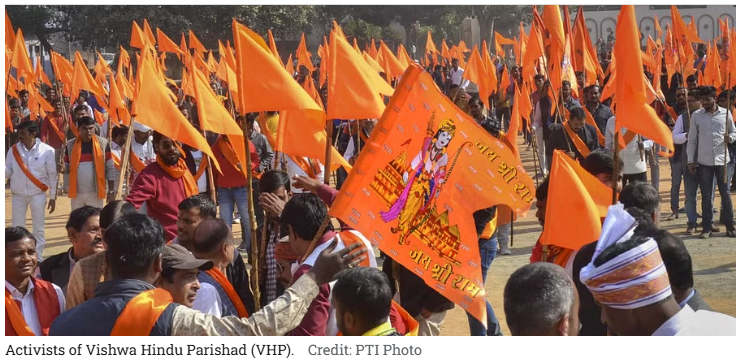
VHP writes to Waqf panel, pitches for 1 law for endowments of religious properties of all religions.
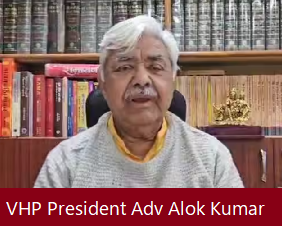
Upendra Bharti | HENB | New Delhi | Jan 22, 2025:: The Vishva Hindu Parishad (VHP) has proposed a significant change to the Waqf (Amendment) Bill, suggesting that instead of having different laws for various religious communities, there should be a single law governing endowments of all religious properties in the country.
In a letter to the Joint Committee of Parliament (JPC), VHP president Alok Kumar emphasized the need for uniformity, citing Article 44 of the Indian Constitution, which advocates for a uniform civil code throughout the country.
“The Article 44 of the Constitution of Bharat provides that ‘the State shall endeavour to secure for the citizens a uniform civil code throughout the territory of India’”, it added.
Alok Kumar, a senior advocate at the Supreme Court of India, drew upon his legal expertise to present his arguments. Citing constitutional provisions and judicial precedents, Kumar made a compelling case for a uniform law governing religious endowments, underscoring the importance of constitutionality and adjudication.
The VHP argued that the current Waqf Act, enacted in 1954, was initially introduced as a private member’s bill and seems to be a relic of the colonial era, favoring only one religious community. They suggested that it’s time to broaden the scope of the Act to cover charities of all religions, with possible exceptions and special provisions to accommodate specific religious needs.
In the letter, the VHP said it has underlined that the Waqf has been “defined as a permanent dedication of any movable or immovable property for any purpose recognised by the Muslim Law as pious, religious or charitable”.
“This dedication is made to Allah, the almighty. Once a property is so dedicated, it becomes the property of the Almighty and vests in him,” the organisation, an affiliate of the Rashtriya Swayamsevak Sangh (RSS), said.
“Similarly, Hindus dedicate properties, movable or immovable, to their deities for the maintenance of the temples and for pious religious and charitable purposes,” it said Likewise, the followers of other religions, including Christianity, Buddhism, Jains and Sikhs, dedicate their properties for purposes recognised in their religion as pious, religious or charitable, it added.
The VHP further said, “It may be reminded that the Waqf Act 1954 was not tabled in Parliament by or on behalf of the government. It was tabled as a private member’s Bill by Mohammad Ahmad Kazmi. It appears that the then ruling party was complicit in the moving of this Bill.” The Bill was referred to the select committee of the Rajya Sabha and “surprisingly”, CC Biswas, the then minister of law and minority affairs, became the chairman of the committee, it added. In its letter to the parliamentary panel, the VHP said, “It appears to be an anachronism of the colonial period where a privileged law was enacted only for the second religious majority of Bharat”.
It is now time that the scope of the Act is enlarged to cover the charities of all religions, it added.
“However, if need be, there may be some exceptions and special provisions, wherever needed, to tailor to the needs, precepts and traditions of a religion as distinguished from other religions,” the VHP added.
The Waqf Amendment Act is currently under review by a joint Parliamentary committee led by MP Jagdambika Pal. The proposed amendments aim to make significant changes to the existing Waqf Act, 1995, including the composition of the Central Waqf Council and State Waqf Boards, which would now include non-Muslim members.
However, the Non-BJP Parties under the I.N.D.I Alliance are opposing the Waqf amendment, citing concerns that it may undermine the rights of Muslims in managing their religious and charitable institutions. They argue that the amendments could lead to a loss of autonomy for Muslim communities in governing their waqf properties.
Some of the key amendments proposed in the Bill include:
– Composition of the Central Waqf Council: The Bill removes the requirement for all members to be Muslims, allowing for non-Muslim members to be included .
– Survey of Waqf Properties: The Bill replaces the Survey Commissioner with the District Collector, granting them powers to conduct surveys of waqf properties .
– Government Property as Waqf: The Bill states that any government property identified as waqf will cease to be so, with the Collector determining ownership in case of uncertainty .
Opposition parties clubbed in I.N.D.I Alliance contend that the proposed amendments constitute an infringement upon Muslim personal law, eroding the community’s autonomy in managing its religious institutions. In contrast, the government asserts that these amendments aim to enhance transparency, accountability, and governance of waqf properties, eliminating the exclusive rights of a single community and mitigating feelings of religious discrimination among other communities.
But, some Hindutvawadi groups are also pushing for a more drastic approach, advocating for the complete repeal of the Waqf Act instead of just amending it. This demand reflects their concerns about the Act’s provisions and its draconian implications for the management of waqf properties.
…
__Inputs from PTI.


 Struggle for Hindu Existence
[…] [Disclaimer: The content in this RSS feed is automatically fetched from external sources. All trademarks, images, and opinions belong…
Well done but to no effect
I wholeheartedly support the movement of ABVP
This is a common concern in almost all the states in India, as anti-Hindu, anti-Indian terrorist forces are very active…
In Manipur, India, kukis are training child terrotists, taught them to hate and kill the Indigenous people of Manipur.