
Struggle for Hindu Existence
*Hindu Rights to Survive with Dignity & Sovereignty *Join Hindu Freedom Movement to make Bharat Hindu Rashtra within this lifetime *Jai Shri Ram *Jayatu Jayatu Hindu Rashtram *Editor: Upananda Brahmachari.
The Dark Reality: How the Nation has tied itself in knots of Waqf.
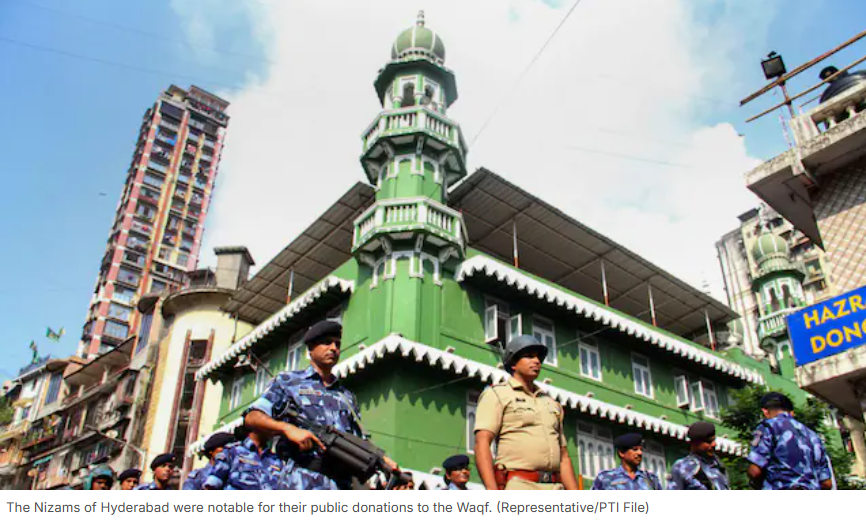
India Lost Its ‘Golden Hour’ To Waqf.
Instead of encouraging Muslims to form viable charitable trusts on modern lines, newly independent India upheld only the waqf model for the community. The Centre stymied a promising beginning made by the erstwhile Bombay State in 1950.
By
The recently enacted Waqf (Amendment) Act raises certain critical questions about the viability of waqf as an institution. While we have gone on strengthening the compliance, monitoring, coordinating and financing mechanism for auqaf (plural of waqf), over the past seven decades, there are apparently few positive indicators. The mechanism itself appears to have become part of the problem, rather than being part of the solution. Was an alternative course possible?
Way back on March 13, 1953, Syed Mohammed Ahmad Kazmi, who represented a curiously named Parliamentary Constituency called Sultanpur District—North cum Faizabad District—South West moved a Private Member’s Bill viz. Muslim Wakfs Bill, 1952 in the 1st Lok Sabha (1952-1957). The aim was to streamline the management of waqf properties, being misused by the mutawallis (nominated caretakers). The Bill had already been publicised to elicit responses from State governments, legislators and members of the public.
Kazmi informed that the only section of the general population that opposed the Bill were the mutawallis or caretakers of waqf properties. Kazmi’s views were supported by M.H. Rahman, representing Moradabad District—Central, who accused the mutawallis of wasting crores of rupees given by people for the noble cause of waqf, and spending large amounts of money to prevent the Bill from being enacted.
As independent India considered its first central law on waqf, Lok Sabha had to countenance a couple of dilemmas. The first was the advisability of enacting a central law when a few states like Delhi, Uttar Pradesh, Bihar and West Bengal already had their waqf boards/legislation. However, in principle, the most important objection came from Bombay State (comprising today’s Maharashtra, Gujarat, and seven Kannada-speaking districts later incorporated in Karnataka). We know its details from the speech of Hari Vinayak Pataskar, the Congress leader representing the Jalgaon constituency.
Pataskar informed that Bombay already had religion-neutral legislation viz. Bombay Public Trusts Act, 1950 (Act XXIX of 1950) which was based on the recommendations of a committee headed by an eminent High Court judge. All possible religious trusts whether Hindu, Jain, Sikh, Muslim or Christian were covered under this Act of 1950, whose constitutional validity had already been upheld by the Bombay High Court. The Act of 1950 had superseded the Mussalman Wakf Act, 1923 in Bombay State.
There is something interesting in the communication of the Bombay government in defence of the Bombay Public Trusts Act, 1950 as read out by Pataskar —
“In enacting this law the Government of Bombay have followed the directive principles contained in article 44 of the Constitution, namely that the State shall endeavour to secure for the citizens a uniform Civil Code throughout the territory of India. The problems concerning control of administration of properties of religious trusts, be they wakfs, temples or any kind of religious trusts, are the same and ought to be dealt with in the same manner consistent with the freedom guaranteed by articles 25 and 26 of the Constitution. The Bombay Public Trusts Act has been upheld by the Bombay High Court as constitutional in its entirety, and it is therefore apparent that none of the freedoms by the Constitution are in the least affected. Moreover, sufficient provision has been made in the Bombay Public Trusts Act of 1950 to see that internal management and even control by the Charity Commissioner on the administration and property etc is effected in accordance with public opinion of the religion concerned.”
It might be remembered that the Bombay Public Trusts Act of 1950 was passed during the Chief Ministerial tenure (1947-52) of Balasaheb Gangadhar Kher, a devoted Congressman and eminent Gandhian. He was succeeded by Morarji Desai, whose government upheld the aforesaid law.
C.C. Biswas, Minister of Law and Minority Affairs, personally favoured legislation that covered all kinds of endowment, though he said it might take another year to place one on the anvil. Maulana Abul Kalam Azad, Minister of Education, Natural Resources and Scientific Research stated that though the government had not taken any such decision yet, the Muslim waqf legislation, if it came about, would not stand in the way of a comprehensive law on endowments, whenever the government might bring it.
The Private Member’s Bill was sent to a 19-member select committee (including nine Muslim members) of the House, as named by the mover, and chaired by the Law Minister viz. C.C. Biswas. The Select Committee redrafted almost the entire Bill; and recommended the legislation to be known as the Wakf Act instead of the Muslim Wakfs Act, on being enacted.
However, shoddily enough, it dismissed Bombay’s Act of 1950 in one sentence. The report finalised on March 4, 1954, stated that the Bombay Public Trusts Act, 1950 — in the opinion of the Committee —did not adequately meet the special problem of waqfs. Therefore, they recommended the Wakf Act be made applicable to Bombay State.
Mohanlal Saksena, a member, in his dissent note opposed the proposed Wakf Act being applied to Bombay. His note informs that some other states like Hyderabad (1948-56) wanted to follow Bombay by enacting the General Public Trusts Act for the management of charitable trusts belonging to all faiths. They were opposed to such sectarian Acts. Amjad Ali on the other hand urged the Centre to apply the proposed Wakf Act to all States without exception.
The Select Committee, by excluding Bombay State from the purview of the proposed legislation, could have set a good precedent. Bombay could have acted as an exemplar for an all-India religion-neutral legislation on charitable trusts at a future date. That hope was dashed in the Committee Room. When the redrafted Bill was referred back to the Lok Sabha and debated on March 12, 1954, Pataskar again opposed the inclusion of Bombay in the ambit of the law. Here Kazmi’s argument was that a multi-member board was better than an individual i.e. Charity Commissioner provided under the Bombay Public Trusts Act, 1950.
This was indeed a specious argument as not until the Constitution (Sixty-fifth Amendment) Act, 1990 did India have a five-member Commission for the Scheduled Castes and Scheduled Tribes (later the Commission was partitioned). The Constitution under Article 338 had provided only a Special Officer for Scheduled Castes and Scheduled Tribes. It was not until 1993 that the Election Commission of India was elevated into a multi-member body under the Election Commission (Condition of Service of Election Commissioners and Transaction of Business) Act, 1991.
As it is said that truth is truth, but power is a greater truth, the Wakf Bill got through. It was debated in Rajya Sabha on April 23, 1954, where V.K. Daghe did refer to Bombay’s Act of 1950 tangentially but did not emphasise the exclusion of Bombay from the purview of the waqf law.
II
The Select Committee’s refusal to exclude Bombay State not only brought a huge portion of western India under the operation of Waqf law but extinguished the hopes of a uniform law for charitable endowments for the whole of India. In 1960, Bombay State was split up into Maharashtra and Gujarat. Both the successor States have now rechristened the Act of 1950 after the names of the respective States. Interestingly, almost 70 years after the aforesaid debates in Parliament, the Supreme Court had to adjudicate on the distinctions of Muslim Trusts governed under the Waqf Act, 1995 and Bombay Public Trusts Act, 1950.
This judgment in Maharashtra State Board of Wakfs v Shaikh Yusuf Bhai Chawla & Ors delivered by a two-judge Bench of the Supreme Court comprising Justices K.M. Joseph and Hrishikesh Roy on October 22, 2022. The litigation, briefly speaking, had its origin when the Maharashtra State Board of Wakf— constituted under the Waqf Act, 1995 in a doubtful manner— tried to register en masse all Muslim charitable bodies registered under the Maharashtra Public Trusts Act, 1950. It published a list on November 13, 2003, of waqf properties, which became controversial, since it covered many entities that were in fact Public Trusts but not waqf. Litigants Shaikh Yusuf Bhai Chawla & Ors, the Trustees of Adamji Peerbhoy Sanatorium (AP Sanatorium), Mumbai filed a case against the Maharashtra State Board of Wakfs against the inclusion of their sanative facility into the category of waqf. The Sanatorium, they argued, was a public trust but not waqf.
The Supreme Court judgment upheld the idea that not all Muslim charitable trusts need to be waqf. In fact, there are marked differences between a waqf and a charitable trust set up by Muslims on modern principles of organisation. Those wrongfully included were given a time window of six months to place their cases before the Waqf Board.
The case revealed that there are a number of Muslim charitable trusts set up on modern principles of organisations. Sadly, by encouraging the waqf route to trusts, the nation has tied itself in knots.
…
Courtesy: News 18.
The writer is the senior journalist, author of the book ‘The Microphone Men: How Orators Created a Modern India’ (2019) and an independent researcher based in New Delhi. The views expressed in the above piece are personal and solely those of the author.


 Struggle for Hindu Existence
[…] NHRC seeks urgent report from J&K Police on ‘targeted’ Hindu killings. […]
[…] [Disclaimer: The content in this RSS feed is automatically fetched from external sources. All trademarks, images, and opinions belong…
Well done but to no effect
I wholeheartedly support the movement of ABVP
This is a common concern in almost all the states in India, as anti-Hindu, anti-Indian terrorist forces are very active…