

[…] NHRC seeks urgent report from J&K Police on ‘targeted’ Hindu killings. […]

Struggle for Hindu Existence
*Hindu Rights to Survive with Dignity & Sovereignty *Join Hindu Freedom Movement to make Bharat Hindu Rashtra within this lifetime *Jai Shri Ram *Jayatu Jayatu Hindu Rashtram *Editor: Upananda Brahmachari.
Hindutva Is A Formidable Force In Bengal as shown in TMC’s Temple Politics.
TMC’s Temple Politics Shows Hindutva Is A Formidable Force In Bengal.
Whether the temple inauguration has helped the TMC change its negative perception among Hindus will be known in the state elections to be held next year.
News18.com | Kolkata | May 20, 2025:: In the land of West Bengal, there was a time when allegiance to political parties was the identity that mattered. While that still remains, the state is now seeing a crucial change – the emergence of religious identity, which has become more noticeable than ever.
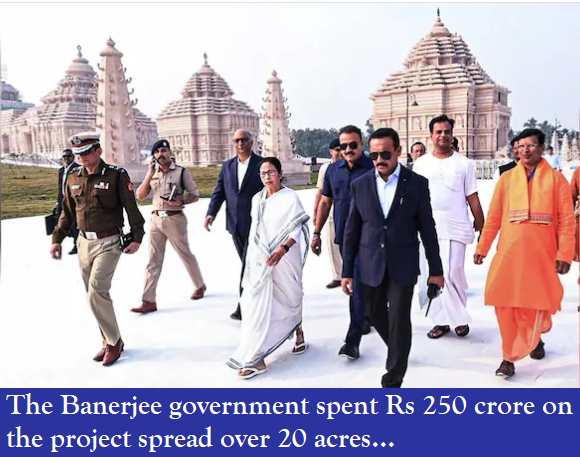
The inauguration of a Lord Jagannath Temple in Digha, East Medinipur, by the ruling Trinamool Congress (TMC) government led by CM Mamata Banerjee only validates it.
Unlike the Ram Temple of Ayodhya, whose construction wasn’t sponsored either by the Uttar Pradesh government or the Centre, the temple in Digha is constructed by the state government. The Banerjee government spent Rs 250 crore on the project spread over 20 acres.
The temple is designed similar to the famous Lord Jagannath Temple of Puri, Odisha. The Puri temple is one of the most important temples in Hinduism, as it is one of the four temples of the Char Dham, a concept popularised by the 8th century philosopher Adi Shankaracharya.
The temple will boost the tourism of Digha, which is already a popular seaside tourist destination. However, it would be naive to believe that was the sole aim of the TMC government.
Before rising to power, Banerjee had tilted towards Left-oriented politics, projecting herself as the main inheritor of the Left-wing politics amid the Communist Party of India (Marxist) or the CPI(M). At that time, the CPM-led Left Front government led by Buddhadeb Bhattacharjee was prioritising the economy of the state by moving away from agriculture and towards industrialisation. A significant section of the Left-minded society didn’t like it. Banerjee hobnobbed with hardline Left parties such as the Socialist Unity Centre of India (Communist) or SUCI(C) and even with extremist Left like the Maoists – a fact accepted by its former MP Kabir Suman. This aided Banerjee’s ride to power in 2011.
As the CPM started losing strength after the 2016 state elections, Banerjee realised that she needed to change her political strategy and adopted soft Hindutva to counter the saffron party. The state government announced renovation of Hindu temples of Tarapith, Tarakeswar and Kalighat. In the 2018 rural body polls, the saffron party emerged as the main Opposition by gaining ground in Junglemahal – a tribal belt comprising four districts of Purulia, Jhargram, Bankura and West Medinipur – and in the districts of North Bengal. It was during this period, ahead of the 2019 Lok Sabha elections, that the Banerjee government announced the plan to build the massive temple in Digha to counter the growing saffron support.
While the Banerjee-led TMC got a scare in the 2019 Lok Sabha polls, as the saffron party got just four seats less than the TMC, votes consolidated in the TMC’s favour in the state elections in 2021 and then in last year’s Lok Sabha elections. Despite these victories, the worry for the ruling party, which has a comfortable lead with a vote share hovering around 45 to 47%, is that the saffron party was able to get a 38% vote share – an indication that it now has a stable vote bank, making it a force to reckon with in Bengal’s politics.
The BJP’s stability in Bengal means the ruling TMC will have to exercise restraint while playing the minority card to avoid counter-Hindu polarisation. In the past, it has been able to check the saffron party’s Hindutva by openly wooing religious minorities, primarily Muslims, who account for around 28-30% of the state population, while portraying the saffron party as an “anti-Bengali party”.
However, with the sudden end of Sheikh Hasina’s rule in neighbouring Bangladesh last August, followed by attacks on minority Hindus, mostly Bengali Hindus, gave the BJP a chance to spread its message of Hindutva in the state.
While the impact can’t be measured now, the issue has the potential to neutralise TMC’s Bengali sub-nationalism – a reason for worry for the ruling party. The Murshidabad incident, where two Hindus were lynched to death, only made things difficult for the ruling party, as its minority appeasement policy was blamed for the violence. Moreover, the impact of last month’s gruesome terror attack in Pahalgam, targeting mostly Hindus, has also been felt in the state. These incidents have only aided the emergence of Hindu identity.
There is a fear in the TMC camp that its Hindu voters, unhappy with the party’s appeasement policy, may move towards the BJP. With state assembly elections only a year away, the ruling TMC knows that the Hindu majority can’t be ignored. The saffron victory in Odisha last year, which ended the 24-year rule of the Biju Janata Dal (BJD), showed that the regionalism card comes with a limit. That’s why Banerjee carried out the inauguration of the Digha temple inauguration on a large scale, televising it through LED screens in all blocks across the state. The move was to send a message to the Hindus — the TMC isn’t an anti-Hindu party.
(Opinions are personal)
..
Courtesy: News 18.
One comment on “Hindutva Is A Formidable Force In Bengal as shown in TMC’s Temple Politics.”
Leave a comment


[…] [Disclaimer: The content in this RSS feed is automatically fetched from external sources. All trademarks, images, and opinions belong…
Well done but to no effect
I wholeheartedly support the movement of ABVP
This is a common concern in almost all the states in India, as anti-Hindu, anti-Indian terrorist forces are very active…


 Struggle for Hindu Existence
Damage has been done. Not going to help TMC
LikeLike