
Struggle for Hindu Existence
*Hindu Rights to Survive with Dignity & Sovereignty *Join Hindu Freedom Movement to make Bharat Hindu Rashtra within this lifetime *Jai Shri Ram *Jayatu Jayatu Hindu Rashtram *Editor: Upananda Brahmachari.
It is not clear whether RSS has any plan to make Bharat as a Cultural, Constitutional and Sovereign Hindu Rashtra.
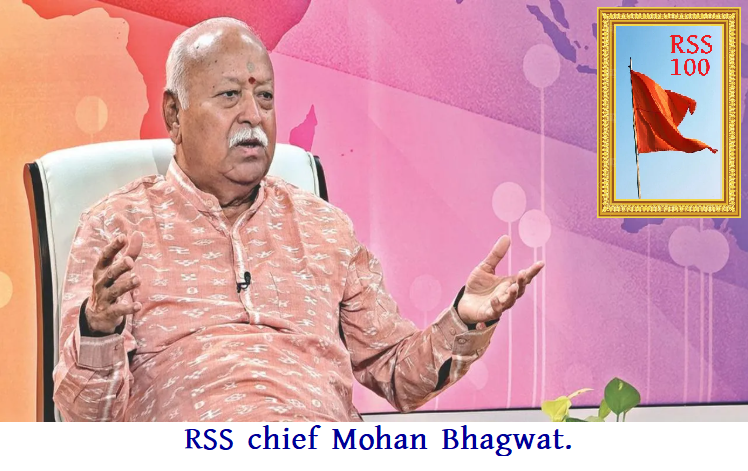
Hindu Society Must Awaken Now. RSS at 100, Sangha Chief Calls for a Dharmic Future of Bharat: Everything has to be done while maintaining the core idea that ‘Hindustan’ is a Hindu Rashtra.
Upendra Bharti | HENB | Nagpur | May 26, 2025:: The Rashtriya Swayamsevak Sangh (RSS) chief, Mohan Bhagwat, has reiterated the organization’s stance that India is a “Hindu Rashtra.” In an interview, Bhagwat emphasized that the concept of a Hindu Rashtra is central to the RSS’s ideology and that everything else is secondary. He also highlighted the importance of strength, both internal and external, for national security and development.
Key Points:
– Hindu Rashtra: Bhagwat emphasized that India is a Hindu Rashtra and that this concept is central to the RSS’s ideology.
– Internal Strength: He stressed the importance of internal strength, citing the need for self-reliance and the ability to defend oneself.
– National Security: Bhagwat emphasized the need for a strong national security apparatus to protect the country from external threats.
– Dharmic Values: He called for the Hindu society to awaken and shape personal, family, social, and professional life based on Dharmic values rooted in Hindutva.
– Invincible India: Referring RSS’ daily prarthana (prayer): ‘Ajayyam cha visvasya dehisa saktim’ — ‘Grant us such strength that globally we are invincible, Bhagwat stressed on national security, military strength and economic resilience.
– Global Role: Bhagwat envisioned a global role for India, with the country providing a path for the world to follow based on Truth, Purity, Compassion, and Austerity.
Implications:
– RSS’s Vision: The RSS’s vision for India is centered around the concept of a Hindu Rashtra, which may have implications for the country’s social and political fabric.
– National Security: The emphasis on national security and self-reliance may lead to a more assertive foreign policy and defense strategy.
– Cultural Identity: The RSS’s emphasis on Dharmic values and Hindutva may shape India’s cultural identity and influence its social and political discourse.
Overall, Bhagwat’s statements provide insight into the RSS’s ideology and vision for India, highlighting the importance of strength, self-reliance, and Dharmic values.
But, it is not clear whether RSS has any plan to make Bharat as a Cultural, Constitutional and Sovereign Hindu Rashtra evading all corruptions and minority (Muslims-Christian) appeasement- Editor, Hindu Existence )
As the RSS (Rashtriya Swayamsevak Sangh) approaches its 100th anniversary on Vijayadashami this year, the organisation stands as a unique, nationwide force rooted in the ideals of dharma, culture, and national unity. In the backdrop of the Akhil Bharatiya Pratinidhi Sabha (ABPS), held from March 21–23, and roughly one and half month before the launch of Operation Sindoor, RSS chief Sarsanghchalak Dr Mohan Bhagwat sat down for an in-depth, in-house conversation with its mouthpiece Organiser. A part of the interview is reproduced
here.
(Interestingly, RSS always expressed the connotation of Hindu so far as a ‘Way of Life’ and not the Dharma, they mean to say Religion. If now RSS supports the standpoint of Hindu as Dharma, way of life and Rashtra all in its true sense and they reinforce themselves in making a Cultural-Constitutional-Sovereign Hindu Rashtra in Bharat, obviously RSS will reach in the horizon of Practical Hindutva in its centenary– Editor, Hindu Existence )
Q: As a Swayamsevak and the Sarsanghchalak, how do you view this 100-year journey of the Sangh?
A: Dr Hedgewar initiated this mission with deep thought and clarity. The challenges before the nation were assessed, and through experience and experimentation, a suitable course of action was developed — one that proved effective. By 1950, there was growing confidence in the Sangh’s methods, and it was clear the work could move forward despite all obstacles.
What followed was a nationwide expansion and the integration of Swayamsevaks into various walks of life. Over the next four decades, their character, actions, and spirit of belonging earned the trust of society.
Q: What were the major milestones in this 100-year journey?
A: Initially, the Sangh had nothing. There was no recognition of its ideology or availability of means of propagation. There was nothing except neglect and opposition in society, not even Karyakartas. If you fed this data into a computer, it would predict a premature death for this entity.
Yet, it endured. During Partition, the RSS played a vital role in protecting Hindus. It survived a govt ban and emerged stronger by 1950. The Emergency of 1975 became a turning point when the Sangh’s constructive role in restoring democracy made society realise its strength. Later, through movements like the Ekatmata Rath Yatra, Kashmir-related awareness campaigns, the Shri Ram Janmabhoomi Andolan, and Vivekananda Sardhshati (150th birth anniversary), along with largescale Sewa (service) work, the Sangh’s credibility spread across all layers of society.
Q: In the Sangh’s centenary year, what is the aim of ‘Panch Parivartan’ (Five Transformations), and how will it be put into action?
A: ‘Panch Parivartan’ is the Sangh’s centenary vision for deep-rooted societal change through everyday behaviour. It’s not about symbolic gestures but reshaping mindsets and habits at the grass roots. The goal is to build a society anchored in unity, discipline, and cultural identity — led by individuals who live these values, not just speak of them.
Samajik Samarasta (Social Harmony) stresses genuine inclusivity. Unity must be lived — temples, cremation grounds, and public resources should be equally accessible to all. Kutumb Prabodhan (Family Enlightenment) Relief for the world lies in our traditional values, found in family customs and national practices.
Family enlightenment means reflecting together, agreeing, and living these values. The family must be re-established as a global model rooted in sanskaras (values).
Paryavaran (Environmental Awareness) focuses on daily habits: saving water, cutting single-use plastic, and planting trees. Swa (Selfhood) Conduct must reflect national selfhood — living our traditions at home in food, dress, language, and worship. Use Swadeshi products until self-reliance is complete. Trade globally, but on our terms, not under pressure. This is true self-based living.
Lastly, Civic Duties underline the importance of lawfulness, constitutional respect, and public decency. Swayamsevaks will lead by example, spreading these changes through Shakhas. When practised consistently, these transformations aim to build a more harmonious, self-aware, and responsible society.
Q: What is the resolve for the next 25 years?
A: The aim is to unite the entire Hindu community and build a strong, self-reliant nation. But the vision goes beyond national boundaries. Since the time of Dr Hedgewar, the goal has also been to shape a world guided by dharmic values. As early as 1920, he urged the Indian National Congress to declare that complete independence for India also meant working to liberate the world from the grip of capitalism. This broader mission — to uplift humanity through an Indian worldview — has been part of the Sangh’s thinking from the very beginning.
Q: The Sangh turns 100 and Bharat will mark 100 years of independence in 2047. How will Bharat become a Vishwaguru, and how should we respond to those trying to divide society?
A: The Sangh’s process already counters these threats. We’ve moved forward by confronting self-oblivion, selfishness, and divisiveness. Today, we have society’s trust. If we continue working with unity and dedication, the impact will be far greater than the sum of individual efforts. If we stay organised and dedicated, what is usually ‘1 + 1 = 2′ will become ‘1 + 1 = 11′. A strong, united Bharat will set an example that the world will follow.In fact, a senior Karyakarta said in 1992 that the world would form its own versions of RSS. After 2047, this global transformation will begin and it won’t take a century, just 20–30 years.
Q: What is your final message to well-wishers, thinkers, and the Hindu society in this centenary year?
A: The Hindu society must awaken now. Leave behind selfishness and divisions. Live a personal, family, social, and professional life rooted in Dharma and Hindutva. That alone will lead to a self-reliant, righteous, and powerful Bharat.
The world is waiting for a new path and Bharat, which means Hindu society, has to provide it as a divine duty. We’ve had agricultural, industrial, and scientific revolutions. Now, we need a Dharmic revolution — I am not talking about religion, but based on human life has to be reorganised based on Truth, Purity, Compassion, and Austerity. Sangh’s work must be understood as a divine responsibility. Let us rise above ‘me and mine’ and live together as an example for the world to follow.
…
_Inputs from TOI.


 Struggle for Hindu Existence
I wholeheartedly support the movement of ABVP
This is a common concern in almost all the states in India, as anti-Hindu, anti-Indian terrorist forces are very active…
In Manipur, India, kukis are training child terrotists, taught them to hate and kill the Indigenous people of Manipur.
[…] FIR Filed after Hindus Object to Group of Muslims Breaking Ramzan Fast on Disputed Land in Pune […]
reconversion to Hinduism should be the primary goal of Hindu society today. Rest of the goals and actions of society…