


i am a Muslim boy and i would like to worship all hindu men for the sin I have committed…

Struggle for Hindu Existence
*Hindu Rights to Survive with Dignity & Sovereignty *Join Hindu Freedom Movement to make Bharat Hindu Rashtra within this lifetime *Jai Shri Ram *Jayatu Jayatu Hindu Rashtram *Editor: Upananda Brahmachari.
Hindutva and Hind Swaraj: Unveiling the Ideological Clash Between Gandhi and Savarkar.
Book Review: Hindutva and Hind Swaraj.
Was Savarkar’s Hindutva A More Practical Approach Than The Gandhian Hind Swaraj?
Upananda Brahmachari
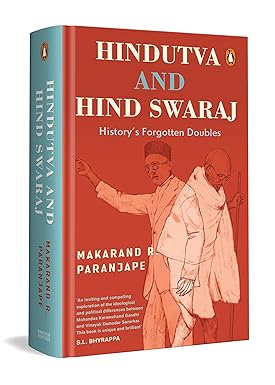 Noted academician and writer Makarand R Paranjape’s latest book, “Hindutva and Hind Swaraj: History’s Forgotten Doubles,” (published by Penguin Random House India- PRHI) offers a thought-provoking exploration of the ideological clash between Mohandas Karamchand Gandhi and Vinayak Damodar Savarkar. The book delves into the complexities of Indian history, politics, and society, highlighting the ongoing struggle between two contrasting ideologies: Hindutva and Hind Swaraj.
Makarand R Paranjape’s book reveals the iconic and ideological rift between M K Gandhi and Vinayak Damodar Savarkar, shedding light on their fundamentally different visions for India’s future.
Key Strengths– Nuanced Analysis: Paranjape provides a nuanced analysis of the historical context and the implications of Gandhi and Savarkar’s ideologies on India’s future.
– Balanced Discourse: The book emphasizes the need for a balanced discourse that acknowledges the complexity and diversity of Indian society.
– Relevance to Contemporary India: The book’s exploration of the rise of Hindutva and its implications for India’s future is particularly relevant in today’s political landscape.
Key Takeaways– Ideological Clash: The book highlights the ongoing struggle between Gandhi’s vision of non-violent resistance and Savarkar’s advocacy of armed rebellion.
– Importance of National Narrative: Paranjape emphasizes the need for a national narrative that acknowledges India’s past and its cultural identity.
– Quest for Truth: The book is a quest for truth, both individually and nationally, and encourages readers to go beyond binaries and adopt a more nuanced approach to India’s ideological divisions.
Savarkar’s Hindutva: A More Practical Approach?
One of the most striking aspects of the book is its portrayal of Savarkar’s Hindutva as a more practical and effective approach to Indian politics. A meticulous reading of the book suggests that Savarkar’s ideology, which prioritizes the interests of the majority Hindu population, may be more relevant to India’s current political landscape. In contrast, Gandhi’s approach is portrayed as overly idealistic and ineffective in addressing the needs of the Hindu majority in the way of appeasement of Muslims to get them in freedom movement.
Makarand R Paranjape’s new release, “Hindutva and Hind Swaraj,” dissects the ideological clash between Gandhi and Savarkar, highlighting their contrasting views. While Savarkar advocated for politicizing and militarizing Hindus, Gandhi’s advice to Hindu-Sikh women facing rape during the Partition, as documented in “Freedom at Midnight” by Dominique Lapierre and Larry Collins (Vikas, 1997, p-479), was to endure immense suffering as sacrifice.
The Roadway: From Swaraj to Hind Swaraj
The book “Hindutva and Hind Swaraj” by Makarand R Paranjape explores the ideological clash between M K Gandhi and Vinayak Damodar Savarkar, focusing on their differing visions for India’s freedom struggle. However, the question of whether Gandhi took the concept of “Swaraj” from Bal Gangadhar Tilak and twisted it for appeasement purposes isn’t directly addressed rightly in the book.
Actually, “Swaraj” was popularized by Tilak during the Swadeshi Movement of 1905, where he proclaimed, “Swaraj is my birthright, and I shall have it.” This concept emphasized self-rule and political freedom from British colonial rule. Gandhi later built upon this idea in his book “Hind Swaraj” (1909), interpreting Swaraj as not just political freedom but also individual self-rule, moral discipline, and spiritual growth.
Key Differences in Interpretation
– Tilak’s View: Focused on political independence and self-governance, with an emphasis on collective action and national identity.
– Gandhi’s View: Encompassed a broader vision of Swaraj, including individual self-discipline, moral integrity, and economic self-sufficiency, with a focus on non-violent resistance.
Incidentally, the concept of “Swaraj,” was also delivered by Dadabhai Naoroji in 1906, during the Calcutta Session of Congress.
While the book “Hindutva and Hind Swaraj” explores the ideological differences between Gandhi and Savarkar, the specific question about Gandhi’s potential appropriation and twisting of Tilak’s concept of Swaraj for appeasement purposes isn’t directly addressed.
Conclusion
“Hindutva and Hind Swaraj” is a thought-provoking book that offers a nuanced exploration of India’s ideological landscape. Paranjape’s writing is engaging, and the book is well-structured, making it accessible to a wide range of readers. The book is priced at Rs 799, but it’s available online at Amazon for a lower price of Rs 620, as well as in offline stores.
Overall, “Hindutva and Hind Swaraj” is a valuable contribution to the ongoing debate about India’s identity and its future. While it may lean towards a more sympathetic portrayal of Savarkar’s ideology, it is a must-read for anyone interested in understanding the complexities of Indian history, politics, and society.
____
One comment on “Hindutva and Hind Swaraj: Unveiling the Ideological Clash Between Gandhi and Savarkar.”
Leave a comment

if you just work on eliminating Mjids and Madirasas, all cruelty will come to halt. No need to do anything…
Yes I agree. I am Muslim but I say Jai Sree Ram.
IDOLATRY "The God who made the world and everything in it, being Lord of heaven and earth, does not live…
its a revange for peaceful world. Its not just in india but all over world against islm. balooch heros, Israel…


 Struggle for Hindu Existence
Pingback: 19th September 2025 – STOP HINDU HATE ADVOCACY NETWORK