
Struggle for Hindu Existence
*Hindu Rights to Survive with Dignity & Sovereignty *Join Hindu Freedom Movement to make Bharat Hindu Rashtra within this lifetime *Jai Shri Ram *Jayatu Jayatu Hindu Rashtram *Editor: Upananda Brahmachari.
The Taj Mahal’s Hidden Past: A New Film Sparks Debate On Hindu Legacy Of It.
The Taj Story: A Cinematic Reexamination For Taj Mahal’s Hindu Legacy.
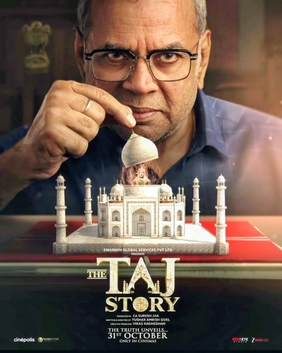 Upananda Brahmachari | HENB | New Delhi | Oct 18, 2025:: The leftist historians made a havoc on Indian History by suppressing the Hindu glory of India to support the Islamic invaders, only to denounce the Sanatan pride for Indian culture and heritage. This trend has been changing gradually through the rewriting of Indian History by nationalist historians, and its effect has percolated into various spheres of life, including the film industry. Now, a new Bollywood film, “The Taj Story,” is set to spark controversy with its claims about the Taj Mahal’s origins. The movie, starring Paresh Rawal, suggests that the iconic monument was once a Hindu temple dedicated to Lord Shiva.
The Claim: A Historical Debate
The film’s premise is based on the theory of P.N. Oak, a lawyer and devoted researcher on history who claimed that the Taj Mahal was originally a Shiva temple named Tejo Mahalaya. Oak’s theory, first introduced in his 1965 book “Taj Mahal is a Rajput Palace,” argues that Shah Jahan repurposed a 4th-century Hindu palace to build the Taj Mahal.
Interestingly, the book “Hindu Temples: What Happened to Them” presents a comprehensive account of the plight of Hindu temples during Islamic invasions and Muslim rule in India. Written by Sita Ram Goel, Arun Shourie, Harsh Narain, Jay Dubashi, and Ram Swarup, the two-volume book meticulously documents the destruction and desecration of Hindu, Jain, and Buddhist temples. The first volume includes a list of 2,000 mosques allegedly built on top of Hindu temples, sourced from Muslim historians’ accounts and inscriptions found on mosques. The second volume deals with the excerpts from medieval histories and chronicles and from inscriptions concerning the destruction of Hindu, Jain and Buddhist temples by ‘the Islamised invaders’.
The authors claim that the material presented in the book is merely “the tip of an iceberg,” suggesting that the true extent of temple destruction may be far greater. This theory is echoed in the controversy surrounding the Taj Mahal, with some historians arguing that it was originally a Hindu temple dedicated to Lord Shiva. According to this theory, the monument was later converted into a mausoleum by Shah Jahan, following the same pattern of Islamic capture and temple destruction.
Evidence and Counterarguments
Proponents of the theory point to architectural elements like the trishul pinnacle, lotus motifs, and 108 sacred Kalash as evidence of Hindu origins. However, historians like Giles Tillotson have disputed Oak’s claims, citing the architectural techniques used in the Taj Mahal that did not exist in pre-Mughal India.
Key Arguments:
– P.N. Oak’s Claims: Oak argued that the Taj Mahal was a Shiva temple built in the 4th century by Raja Paramardi Dev and was later taken over by Shah Jahan.
– Architectural Elements: Proponents point to Hindu symbols like the trishul (trident) pinnacle, lotus, and doura (dhatura) flowers motifs, and the 108 sacred Kalash (pot) as evidence of Hindu origins.
– Sealed Rooms: Some claim that 22 sealed rooms in the Taj Mahal contain Hindu idols and inscriptions.
Counterarguments:
– Historical Records: Most historians agree that the Taj Mahal was built by Shah Jahan as a mausoleum for his wife Mumtaz Mahal between 1632 and 1653.
– Architectural Style: The Taj Mahal’s design is characteristic of Mughal architecture, blending Persian, Islamic, and Indian styles.
– Archaeological Survey of India (ASI): The ASI has repeatedly stated that there is no evidence to support the claim that the Taj Mahal was once a Hindu temple.
The debate surrounding the Taj Mahal’s origins is complex, with both sides presenting their arguments. While some believe that the monument has Hindu roots, others argue that it is a masterpiece of Mughal architecture.
The Sealed Rooms: Purpose and Significance
Located beneath the main mausoleum, the 22 rooms are believed to be part of the foundation, designed for structural stability and protection from water damage. However, others claim these rooms might contain inscriptions, artifacts, or architectural secrets from the Mughal era or even evidence of a Hindu temple ¹ ².
Legal Battles and Controversies
In 2022, a petition sought court permission to open the rooms, citing the “Hindu temple” theory. However, the Indian judiciary dismissed the plea, emphasizing the need for historical and archaeological expertise. BJP youth leader Rajneesh Singh’s similar petition was also dismissed, with the court upholding the Archaeological Survey of India’s (ASI) stance on preserving the monument’s integrity.
Oak also petitioned the Supreme Court in 2000 to “re-establish the truth and cultural heritage of our country”, but his petition was dismissed as “misconceived”. Oak died in 2007 but, by then, his theory had spread among the Hindu Right-wing, with many adding their own ideas to it.
Though Oak’s petition was rejected by the apex court, series of petitions were made in the court of laws ¹ ² ³ ⁴ ⁵ ⁶ to reclaim Taj Mahal as a Hindu structure and a Temple of Bhagawan Shiva.
Stephen Knapp’s Presentation: Unveiling the Truth
Stephen Knapp, an author and researcher, has extensively studied the Taj Mahal’s history. Through his photographs and writings, Knapp presents evidence of the monument’s alleged Hindu origins. His work highlights:
– Vedic Influence: Knapp showcases architectural elements and designs that suggest Vedic influence, such as the trishul pinnacle and sacred symbols like “OM”.
– Sealed Chambers: Knapp’s photographs depict sealed doors and windows, fueling speculation about the contents of the 22 rooms.
– Historical Accounts: Knapp references historical texts and accounts that describe the Taj Mahal as a pre-existing Hindu temple palace.
The Film’s Impact
“The Taj Story” has already generated significant attention, with its teaser sparking outrage among some and curiosity among others. The film’s director, Tushar Amrish Goel, claims that the movie aims to “uncover the mystery” behind the monument.
A Broader Conversation
The controversy surrounding “The Taj Story” highlights the complex and often contentious nature of India’s history. As the film’s release date approaches, it remains to be seen how audiences will respond to its claims about the Taj Mahal’s origins.
Key Facts:
- *Film*: The Taj Story
- *Release Date:* October 31, 2025
- *Genre:* Historical Drama, Courtroom Drama
- *Cast:* Paresh Rawal, Zakir Hussain, Amruta Khanvilkar, Namit Das, Sneha Wagh, and others
- *Production:* Swarnim Global Services Pvt. Ltd
- *Plot:* The film explores the Taj Mahal’s origins, fueling controversy with its teaser suggesting the monument was once a temple
As the debate surrounding the Taj Mahal’s origins continues, “The Taj Story” promises to be a thought-provoking and potentially incendiary film that will likely spark important conversations about India’s history and cultural heritage.
…
_Agency Inputs.


 Struggle for Hindu Existence
[…] NHRC seeks urgent report from J&K Police on ‘targeted’ Hindu killings. […]
[…] [Disclaimer: The content in this RSS feed is automatically fetched from external sources. All trademarks, images, and opinions belong…
Well done but to no effect
I wholeheartedly support the movement of ABVP
This is a common concern in almost all the states in India, as anti-Hindu, anti-Indian terrorist forces are very active…