
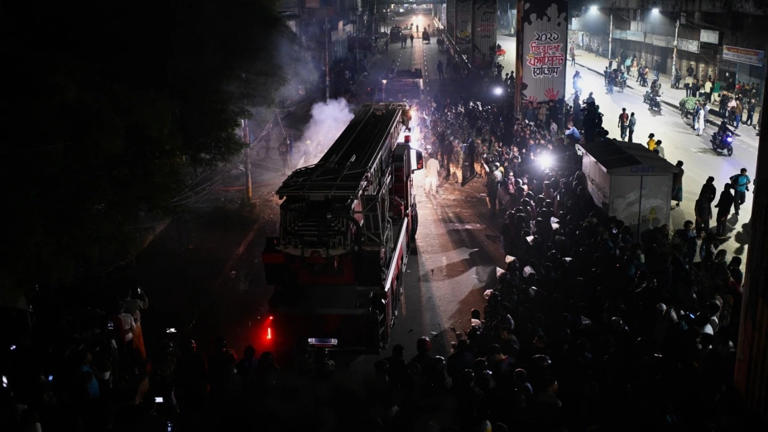
Bangladesh Engulfed in Violence as Blasphemy Lynching of Hindu Garment Worker Follows Assassination of Anti-India Firebrand Leader, Triggering Nationwide Turmoil.
Upananda Brahmachari | HENB | New Delhi | Dec 19, 2025:: Bangladesh continues to reel under intense turmoil marked by communal violence, political upheaval, and escalating anti-India sentiment, following the lynching of a Hindu man over alleged blasphemy and the assassination of radical youth leader Sharif Osman Hadi. The situation has further deteriorated after Indian authorities shut down visa offices across Bangladesh, triggering sharp reactions from agitators already mobilised on the streets.
Blasphemy Lynching
On Thursday night, a gruesome incident was reported from the Dubalia Para area of Bhaluka Upazila in Mymensingh district, where Dipu Chandra Das, a Hindu garment factory worker, was lynched by a mob. Police said Das, who lived in the locality as a tenant, was accused by locals of making derogatory remarks about Islamic Prophet Muhammad. Around 9 pm, he was beaten to death, his body tied to a tree, and later set on fire.
Lynching of Dipu Chandra Das.
Warning: Horrible Graphics inside. Viewers Discretion.
This can be only be happened in a Muslim country and this could be done only by filthy Muslims.
Watch in Instagram: https://www.instagram.com/reel/DScBNy2kwFT/
This Islam is a scar on society. An enemy of civilization. Be careful.
Courtesy: Arnab Goswami.
Police arrived after the violence, brought the situation under control, and recovered the body. It was sent to Mymensingh Medical College Hospital for post-mortem examination. Officials confirmed that no case has been registered so far, as authorities are still trying to trace the victim’s family members. Legal proceedings are expected to begin once a formal complaint is filed.
The lynching occurred amid widespread unrest following the death of Sharif Osman Hadi—also referred to as Osman Hadi or Sharif Usman Hadi—a controversial leader of Bangladesh’s July 2024 so-called ‘pro-democracy’ uprising. Hadi died in a Singapore hospital after succumbing to gunshot injuries sustained during an assassination attempt last week.
In the name of a pro-democratic student movement, Bangladesh adopted a pro-Islamist power center, violating all democratic norms by selecting Prof. Yunus as the interim chief with the help of radical Islamist forces.
Hadi’s Mysterious Assassination
Sharif Osman Hadi was assassinated last week in what authorities have described as a targeted attack by unidentified assailants. He sustained critical gunshot injuries during the incident and was later flown to Singapore for advanced medical treatment. Despite intensive care, Hadi succumbed to his injuries, with his death confirmed by hospital officials. The identity of the attackers and the precise motive behind the assassination remain unknown, and investigations are ongoing amid heightened political tensions across Bangladesh.
While his supporters have hailed him as a symbol of resistance, Hadi was widely known for his extreme anti-India political ideology. He had a documented record of delivering inflammatory speeches calling for the separation of India’s North-Eastern region—the Seven Sister States—from India, advocating their merger into what he termed a “Greater Bangladesh.” These statements had long raised alarm among Indian authorities and regional security observers.
Bangladesh on Boil
Following confirmation of Hadi’s death, thousands of protesters flooded the streets of Dhaka late Thursday night and early Friday, demanding justice. The demonstrations rapidly turned violent and spread across the country. Media houses, political party offices, and properties linked to the former ruling Awami League were attacked, with mobs clashing with police in several locations.
India Today correspondent Ashutosh Mishra, reporting from the ground, described the situation as catastrophic, stating that “the whole nation is now burning.” His report highlighted systematic attacks on Awami League assets and media organisations, and pointed to a near-total breakdown of law and order. Mishra also reported that officers at the Assistant High Commission of India in Chittagong were stone-pelted by aggressive crowds.
Anti-India rhetoric intensified further after Indian authorities temporarily shut down visa offices in Bangladesh, citing security concerns amid the unrest. The decision triggered immediate anger among agitators, who termed the move “retaliatory” and used it to rally more supporters. Protesters chanted slogans condemning India, burned effigies, and accused New Delhi of “interfering in Bangladesh’s internal affairs.” Several demonstrations explicitly referenced the visa shutdown, with agitators warning of “stronger resistance” if restrictions continued.
Attack on Indian Missions
In the southwestern city of Rajshahi, protesters attempted to march toward the office of a regional Indian diplomat but were stopped by police. Videos circulating on social media showed stone-pelting incidents near the Indian Assistant High Commission. In Dhaka earlier in the week, hundreds of demonstrators gathered near Indian diplomatic premises, including the residence of India’s deputy high commissioner, forcing police to use tear gas to disperse the crowd.
As Bangladesh grapples with a volatile mix of communal violence, political radicalisation, diplomatic tensions, and rising anti-India mobilisation, security agencies appear overwhelmed. With the February 2026 elections approaching, the unfolding crisis has heightened concerns over minority safety, diplomatic security, and broader regional stability in South Asia.
India’s Strategic Responsibility Amid Bangladesh’s Crisis
Amid approach toward Dhaka to address the deepening communal and democratic crisis. Observers argue that India, while respecting Bangladesh’s sovereignty, should use all available diplomatic, regional, and multilateral channels to help curb the spiral of violence and protect minority communities from continued assaults by radical elements. With the interim Yunus government increasingly viewed as ineffective in safeguarding democratic norms and public order, there is a widening belief that India should work toward building a broader regional consensus—through South Asian and international partners—to prevent Bangladesh from sliding further under the influence of fundamentalist jihadi groups and to support stability, pluralism, and democratic governance in the neighbouring country.
…
_Inputs from TOI & India Today.


 Struggle for Hindu Existence
[…] NHRC seeks urgent report from J&K Police on ‘targeted’ Hindu killings. […]
[…] [Disclaimer: The content in this RSS feed is automatically fetched from external sources. All trademarks, images, and opinions belong…
Well done but to no effect
I wholeheartedly support the movement of ABVP
This is a common concern in almost all the states in India, as anti-Hindu, anti-Indian terrorist forces are very active…