
Struggle for Hindu Existence
*Hindu Rights to Survive with Dignity & Sovereignty *Join Hindu Freedom Movement to make Bharat Hindu Rashtra within this lifetime *Jai Shri Ram *Jayatu Jayatu Hindu Rashtram *Editor: Upananda Brahmachari.
Faith, Power, and Politics: How the Ram Temple Era Reshaped Bengal’s Political Narrative.
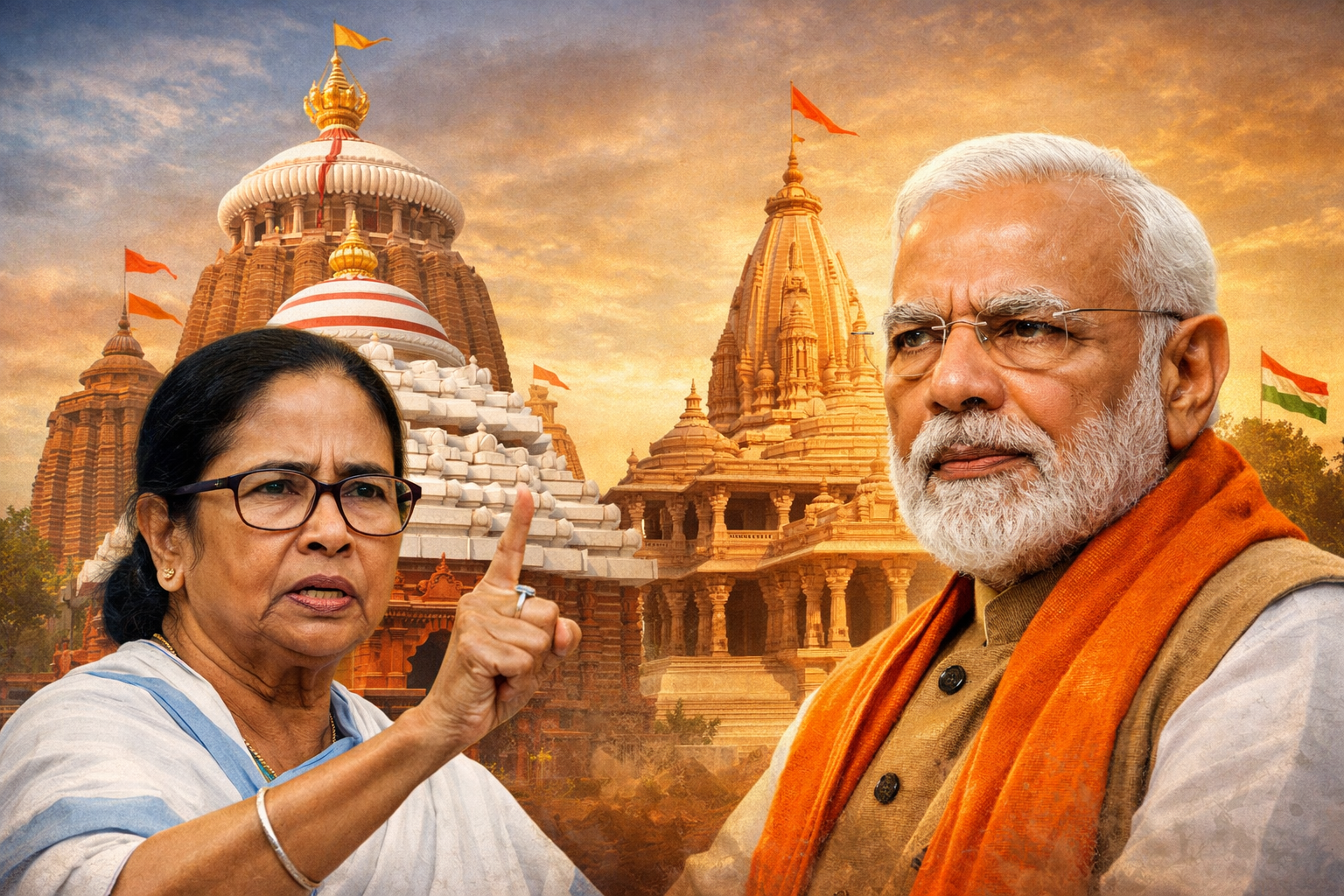
Mamata Banerjee on the Chariot of Soft Hindutva: Fear of Hindu Vote Fragmentation in Bengal as BJP Sharpens Identity Politics.
by Susmit Bhattacharya
“Jai Mahakal.” In the months to come, this chant may echo not only from Ujjain or the hills of Darjeeling, but also from Siliguri, the nerve centre of North Bengal. West Bengal Chief Minister Mamata Banerjee has announced the construction of what she describes as the largest Mahakal temple in the state. The foundation stone is set to be laid in the second week of January, barely a year ahead of the next Assembly elections.
The announcement has come at a politically charged moment. Bengal’s public discourse is once again resonating with references to Beldanga Babri, religious identity and historical grievance. In this atmosphere, Mamata Banerjee’s move appears less like a routine cultural project and more like a carefully calibrated political signal.
Interestingly, the temple politics of Mamata Banerjee and the mosque politics of Humayun Kabir in Bengal have evolved against the backdrop of the construction and completion of the Ayodhya Ram Temple, where Prime Minister Narendra Modi attended every major event and occasion.
A Mandate That Warned, Not Just Won
Despite her emphatic victory in the 2021 Assembly elections, Mamata Banerjee is acutely aware that the electoral ground beneath Bengal has shifted. The Trinamool Congress secured 215 seats and returned to power comfortably, yet the BJP emerged as the principal challenger with 77 seats and a vote share of 38 percent. The Left and Congress, once dominant forces, were reduced to the margins, with a significant section of their voters migrating towards the BJP.
The mandate was decisive, but it also revealed a new bipolar reality in Bengal politics—one where the BJP is no longer an outsider but a sustained challenger.
The real concern for Mamata today is not Muslim consolidation—she remains confident of that—but the possible dispersal of Hindu votes, especially amid controversies like the statements of expelled TMC MLA and Beldanga Babri propagator Humayun Kabir, which the BJP has weaponized to paint TMC as “anti-Hindu.”
The Anxiety Over Hindu Vote Dispersal
What worries the Trinamool leadership today is not the erosion of Muslim support, which remains largely intact, but the possibility of Hindu votes slipping away in a fragmented manner. Statements and controversies involving leaders such as expelled MLA Humayun Kabir have provided the BJP with ammunition to revive its charge of minority appeasement. In a polarised environment, even isolated remarks can acquire disproportionate political weight.
This fear of gradual Hindu vote consolidation behind the BJP has become a silent but powerful driver of Trinamool’s recent political recalibration.
The recent lynching of Dipu Chandra Das in Bangladesh has added fuel to Hindutva narratives. Reports of violence against Hindus have intensified political mobilisation in Bengal, strengthening Hindutva politics as driven by the BJP and the Sangh Parivar.
From Welfare Politics to Cultural Assertion
Over the past year, Mamata Banerjee’s political strategy has undergone a noticeable shift. While the emphasis on welfare schemes remains, it is now accompanied by a heightened assertion of cultural and religious symbolism. The inauguration of the Jagannath Temple at Digha and the provision of a whopping grant of more than one lakh rupees to each Sarbajanin Durga Puja committee—an initiative in which Mamata herself played a central role—marked a turning point.
The BJP stayed away from the event, while senior leaders organised parallel religious programmes nearby, underscoring how religious space itself has become contested terrain in Bengal’s evolving political battle.
Law, Order and the Search for Narrative Reset
The shift became more pronounced after the RG Kar Medical College rape-murder case, which brought the issues of law and order and women’s safety into sharp focus. The BJP mounted fierce protests, projecting the incident as evidence of administrative failure.
Facing public outrage and political pressure, Mamata intensified her engagement with Bengal’s religious calendar. Durga Puja grants to local clubs were increased, and the Gangasagar Mela was placed under close administrative supervision, with ministers assigned specific responsibilities to ensure a smooth pilgrimage.
It was during this phase that political observers began to argue that Mamata Banerjee was attempting to counter the BJP’s Hindutva narrative not by rejecting it, but by reshaping it.
Jai Jagannath in Digha, Jai Mahakal in Siliguri, Jai Ma Durga in New Town and the Message of “Soft Hindutva”
The announcement of the Mahakal temple in Siliguri fits neatly into this evolving strategy. Significantly, it was made while Mamata was laying the foundation stone of Durga Angan- another Durga-related project in New Town, reinforcing the message of cultural continuity. While a Mahakal temple already exists in Darjeeling, the Siliguri project is being positioned as a landmark of religious and cultural significance.
Responding to criticism, Mamata remarked that she visits all religious places and that her secularism is questioned only when she participates in Muslim festivals. The statement reflects her attempt to redefine secularism as equal engagement rather than ideological distance.
The construction of a Jagannath Temple in Digha, the announcement of a Mahakal Temple in Siliguri, and the laying of the foundation stone for a Durga Angan in New Town together point to a discernible political shift. These initiatives suggest that West Bengal Chief Minister Mamata Banerjee has increasingly adopted elements of soft Hindutva as part of her broader political strategy.
The Electoral Arithmetic Behind the Balancing Act
The numbers explain the delicacy of Mamata Banerjee’s approach. Muslim voters play a decisive role in 70 to 100 Assembly seats, particularly in districts such as Murshidabad, Malda and North 24 Parganas, where their population exceeds 50 percent. These voters, once the backbone of the Left, have largely consolidated behind the Trinamool Congress.
Any visible retreat from secular positioning risks unsettling this support base, even as ignoring Hindu sentiment could strengthen the BJP’s appeal.
The numbers explain why Mamata’s balancing act is so delicate:
Muslim voters influence outcomes in 70–100 Assembly seats
In districts like Murshidabad, Malda, and North 24 Parganas, Muslim population exceeds 50%
These voters, once loyal to the Left, now form the backbone of TMC’s electoral strength
Any visible tilt away from secularism risks erosion here—but any perceived neglect of Hindu sentiments risks further consolidation behind the BJP.
BJP’s Counter-Mobilisation and the Identity Pitch
Sensing opportunity, the BJP has intensified its organisational and ideological push in the state. Union Home Minister Amit Shah’s recent three-day tour of Bengal underlines the central leadership’s focus. The party is attempting to mobilise the Matua community while sharpening its emphasis on Hindu identity, illegal infiltration, border security and violence against Hindus in Bangladesh.
Unlike Mamata’s new narrative of ‘inclusive symbolism’ (read ‘soft Hindutva’), the BJP’s narrative remains more direct, sharper, and ideologically explicit. The BJP has intensified its attacks on Mamata to expose what it describes as her real motive behind temple-centric politics in Bengal—an attempt to wash away the legacy of appeasement politics in favour of Muslims.
Bengal at a Cultural and Political Crossroads
What is unfolding in Bengal goes far beyond temple construction or festival management. It reflects a deeper struggle over political language and cultural legitimacy. Mamata Banerjee’s soft Hindutva is an attempt to retain Hindu voters without alienating minorities, and to neutralise the BJP’s most potent charge without surrendering the idea of secular governance.
As the state moves towards the 2026 Assembly elections, it is increasingly clear that the battle will not be fought on governance and welfare alone. Identity, symbolism and cultural assertion will shape the outcome. And as “Jai Mahakal” prepares to find a new echo in Siliguri, Bengal stands at a crossroads where faith and politics are becoming inseparably intertwined.
Now, the BJP’s call for change has penetrated the mindset of many ordinary Bengali Hindus, who feel tormented by what they perceive as an upsurge of jihadi forces in West Bengal—an issue that is no longer accepted by a large section of the state’s population.
…
___


 Struggle for Hindu Existence
[…] Karnataka Police convene meeting of gym owners following protests against Love Jihad […]
[…] False Claim of Waqf Exposed in Pune, Maharashtra; Row Escalates in Karnataka’s Gokak […]
[…] NHRC seeks urgent report from J&K Police on ‘targeted’ Hindu killings. […]
[…] [Disclaimer: The content in this RSS feed is automatically fetched from external sources. All trademarks, images, and opinions belong…
Well done but to no effect