*Hindu Rights to Survive with Dignity & Sovereignty *Join Hindu Freedom Movement to make Bharat Hindu Rashtra within this lifetime *Jai Shri Ram *Jayatu Jayatu Hindu Rashtram *Editor: Upananda Brahmachari.
PM Modi Writes: Somnath Swabhiman Parv- 1,000 Years of Unbroken Faith.
1026–2026 | A Millennium After Somnath’s Trial by Fire: From Islamic Massacre to Hindu’s Moral Victory.
by Upananda Brahmachari
By the shores of the Arabian Sea stands a temple that time, tyranny, and terror could not erase.
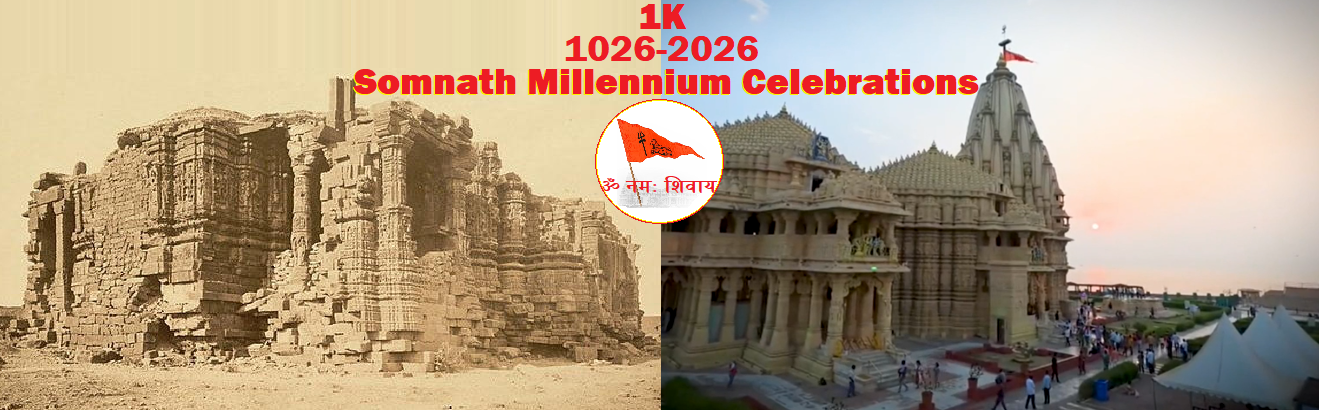
January 1026 marked one of the darkest yet most defining chapters in India’s civilisational memory. A thousand years later, the story of the Somnath Temple is no longer told only as a tale of destruction—but as a testament to unyielding faith, sacrifice, and rebirth.
Three Days That Shook a Civilisation
In the first week of January 1026, the ancient Somnath Temple—one of Hinduism’s most revered Jyotirlingas—became the focal point of a brutal invasion led by Sultan Mahmud of Ghazni. Contemporary chroniclers recount that the assault was not a swift raid, but a prolonged and ferocious siege that unfolded over three harrowing days: January 6, 7, and 8.
According to historian Nazim Muhammad, author of The Life and Times of Sultan Mahmud of Ghazna, Mahmud reached Somnath on Thursday, January 6. The temple complex stood adjacent to a fortified coastal stronghold, defended not by a professional army alone but by Brahmins, ascetics, and thousands of devotees who had gathered to protect their deity.
From the fort’s ramparts, defenders are said to have mocked the invading forces, placing their faith in Someshwar—Lord Shiva himself—to punish the aggressors. Ironically, while common worshippers prepared to die for the shrine, the fort’s commander reportedly fled to a nearby island, returning only after the invader had departed.
January 7: Faith Turns into Fury
By Friday, January 7, the siege intensified. Mahmud’s army launched a full-scale assault on the fortifications. Nazim Muhammad records that the Hindu defenders fought with a desperate courage bordering on the extraordinary. Waves of arrows, hand-to-hand combat, and relentless pressure forced them from the walls.
By afternoon—coinciding with the Juma prayers—Mahmud’s soldiers briefly breached the defences and announced their apparent victory by raising the Islamic call to prayer. But the conquest was far from complete.
Inside the temple, the defenders regrouped. They prostrated themselves before the sacred idol, invoked divine blessings, and then launched a sudden and ferocious counter-attack. The unexpected assault caught the invaders off guard. By nightfall, Mahmud’s troops were driven back from positions they had just seized.
For a moment, Somnath stood undefeated.
January 8: The Last Stand
Saturday, January 8, brought the final and decisive onslaught. This time, Mahmud attacked with tighter coordination and overwhelming force. The outer defences collapsed, pushing the defenders back to the temple gates.
What followed, Nazim Muhammad describes as a “dreadful melee.”
Group after group of Hindu warriors entered the sanctum, bowed before the deity, and charged into battle—fully aware that death awaited them. It was not a retreat, but a ritual of sacrifice.
Despite their devotion, the defenders were ultimately overpowered. Contemporary estimates cited by the chronicler claim that more than 50,000 devotees were killed in and around the temple complex. Those who attempted to escape by sea were hunted down by guards stationed along the coast—many were slain, others drowned.
Somnath fell—but not in silence.
Desecration and Destruction
After securing the fort, Mahmud entered the temple. The sacred idol was smashed with pickaxes, fires were lit to break it apart, and the shrine was looted of immense wealth—said to be worth nearly 20 million dinars. The structure was then set ablaze.
What was intended to be a demonstration of conquest became, over time, a symbol of something far greater: resistance that refused to be forgotten.
From Ruins to Renewal: Somnath Through the Ages
Over the centuries, Somnath was attacked and destroyed multiple times—but it was also rebuilt again and again. Each reconstruction stood as a quiet defiance against the idea that faith could be annihilated by force.
After India’s Independence, the temple’s revival became a matter of national resolve. In 1947, Sardar Vallabhbhai Patel, deeply moved during a visit to the ruins, announced that Somnath would rise again. Though Patel did not live to see it completed, the rebuilt temple was inaugurated on May 11, 1951, in the presence of President Dr Rajendra Prasad.
The reconstruction, however, was not without controversy. Former Prime Minister Jawaharlal Nehru’s reported reservations about the project continue to spark political debate, resurfacing sharply as the millennium commemoration approaches.
2026: A Thousand Years On
As India marks 1,000 years since the first assault on Somnath, the narrative is shifting decisively—from victimhood to victory of spirit.
Prime Minister Narendra Modi will participate in the Somnath Swabhiman Parv on January 11, 2026, a major event commemorating a millennium of unbroken faith. Year-long observances, spiritual programmes, and social initiatives are planned at the Somnath Temple in Veraval, Gujarat, between January 8 and 11.
In a blog marking the occasion—widely republished by national media—the Prime Minister described Somnath as the ultimate symbol of India’s civilisational resilience.
He noted that while the aggressors of history have faded into obscurity, Somnath continues to inspire generations.
“Somnath is a song of hope,” he wrote, “reminding us that while hatred may destroy for a moment, faith has the power to create for eternity.”
Beyond a Temple
For many, Somnath today represents more than a place of worship. It has become a metaphor for India itself—wounded, rebuilt, and rising.
Resonating on the temple’s repeated resurrection, the Prime Minister wrote that if Somnath could reclaim its glory after centuries of assault, India too could reclaim its civilisational confidence and global leadership.
A thousand years after blood soaked the stones of Somnath, the temple still stands—unbroken, unbowed, and undefeated.
Modi’s Message: Somnath as the Eternal Soul of India
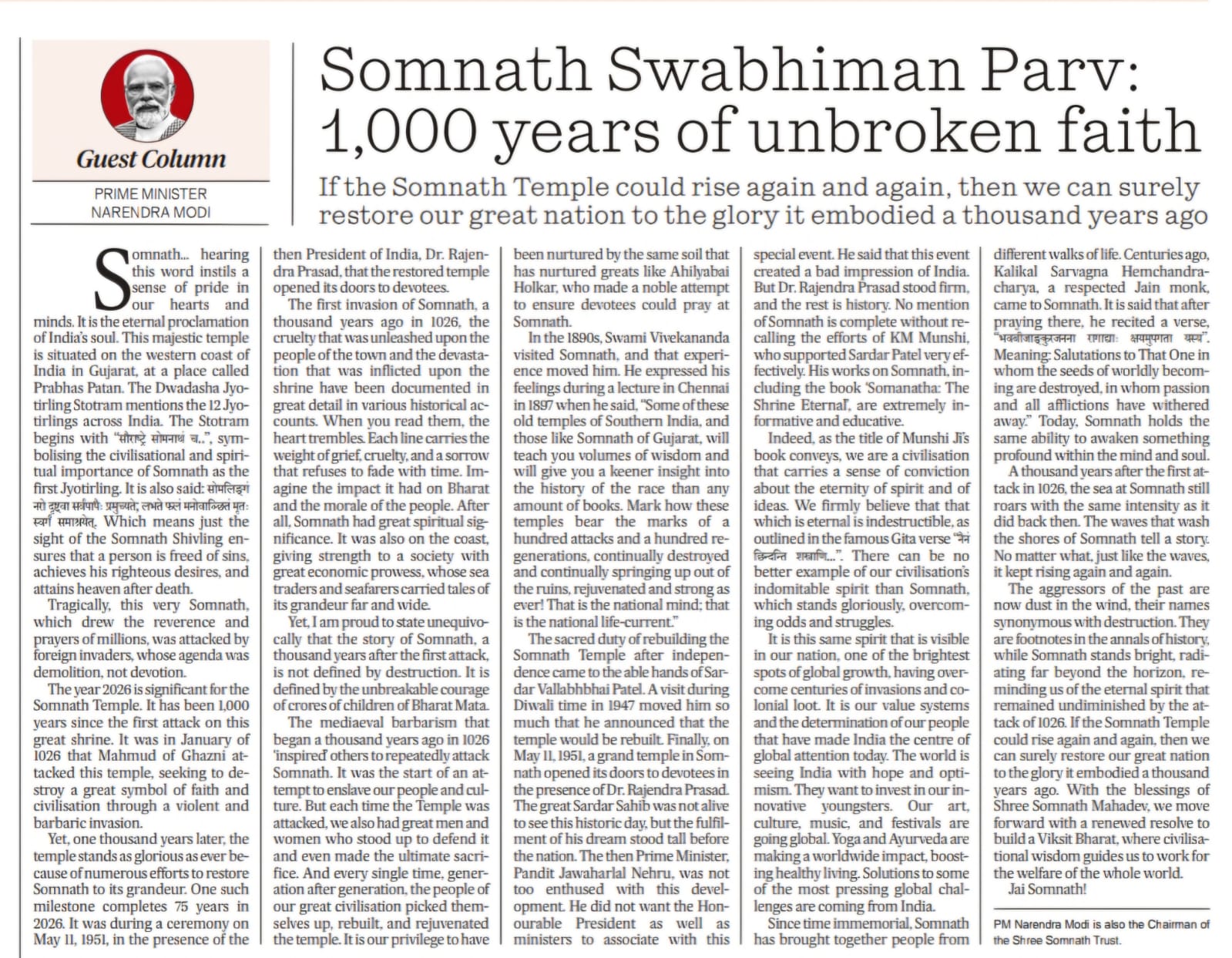
In a blog post released to mark the millennium since the first assault on Somnath, Prime Minister Narendra Modi described the temple as a living testament to India’s indomitable civilisational spirit. The memorial article, published under the headline “Somnath Swabhiman Parv: 1,000 Years of Unbroken Faith,” was widely republished by leading national media outlets, including The Times of India and The New Indian Express, underscoring its national significance.
In the piece, Modi wrote that Somnath stands as one of the most powerful symbols of resilience in world history—rebuilt repeatedly after destruction, yet never erased from the collective consciousness of the nation.
“There can be no better example of our civilisation’s indomitable spirit than Somnath,” the Prime Minister wrote, “which stands gloriously today after overcoming centuries of odds, destruction, and struggle.”
Reflecting on the events of 1026, Modi noted that while invaders sought to annihilate India’s faith through violence and desecration, their actions ultimately failed to break the spiritual resolve of the people.
“The aggressors who attacked Somnath are now dust in the wind—remembered only in footnotes of history,” he observed, “but Somnath continues to radiate hope, strength, and continuity.”
Emphasising the idea of regeneration over revenge, Modi described Somnath as a lesson for the modern world:
“Somnath is a song of hope. It tells us that hate and fanaticism may destroy for a moment, but faith, conviction, and goodness have the power to create for eternity.”
The Prime Minister also recalled the historic role played by Sardar Vallabhbhai Patel in restoring the temple after Independence, calling the reconstruction of Somnath a foundational act of national self-respect. He noted that the same civilisational energy that rebuilt Somnath now fuels India’s rise on the global stage—through culture, innovation, spirituality, and economic growth.
Drawing a parallel between the temple’s revival and India’s future, Modi wrote that if Somnath could rise repeatedly after centuries of assault, India too could reclaim and surpass its ancient glory.
“With the blessings of Shree Somnath Mahadev,” he concluded, “we move forward with renewed resolve to build a Viksit Bharat, where civilisational wisdom guides us to work for the welfare of the entire world.”



 Struggle for Hindu Existence
[…] [Disclaimer: The content in this RSS feed is automatically fetched from external sources. All trademarks, images, and opinions belong…
Well done but to no effect
I wholeheartedly support the movement of ABVP
This is a common concern in almost all the states in India, as anti-Hindu, anti-Indian terrorist forces are very active…
In Manipur, India, kukis are training child terrotists, taught them to hate and kill the Indigenous people of Manipur.