
Struggle for Hindu Existence
*Hindu Rights to Survive with Dignity & Sovereignty *Join Hindu Freedom Movement to make Bharat Hindu Rashtra within this lifetime *Jai Shri Ram *Jayatu Jayatu Hindu Rashtram *Editor: Upananda Brahmachari.
OUP apologises over ‘unverified’ content on Shivaji Maharaj in book published 2 decades ago.
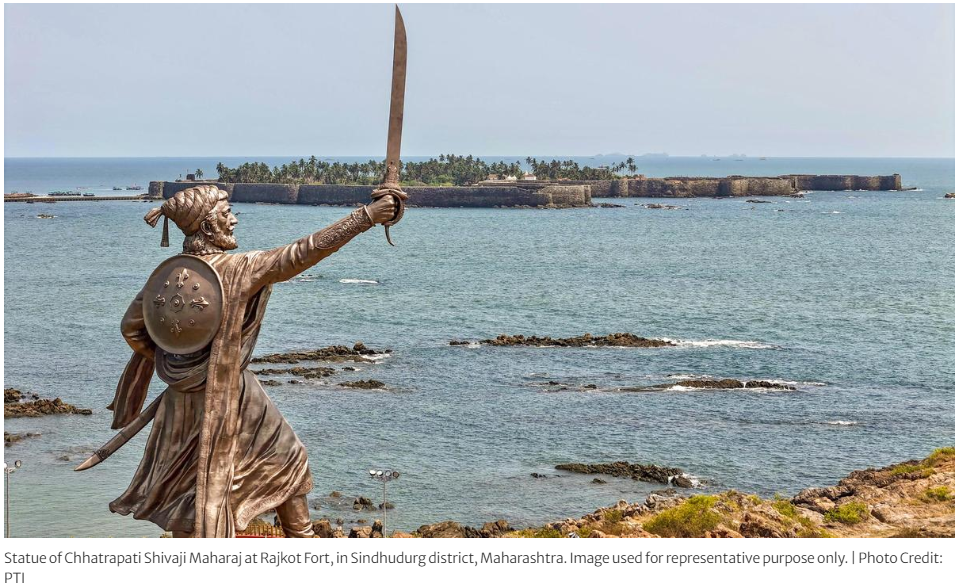
Oxford University Press Issues Apology Over Shivaji Maharaj Content, Closing a Two-Decade-Old Controversy. OUP Must Stop Its Further Edition Without Correction.
Upananda Brahmachari | HENB | New Delhi | Jan 8, 2026:: More than twenty years after the publication of a controversial academic work on Chhatrapati Shivaji Maharaj, Oxford University Press (OUP) India has formally apologised for including what it has now acknowledged were “unverified statements” about the iconic Maratha ruler. The apology marks the legal and symbolic closure of a dispute that had once sparked intense public outrage, street protests, and a wider debate on academic freedom versus cultural sensitivity in India.
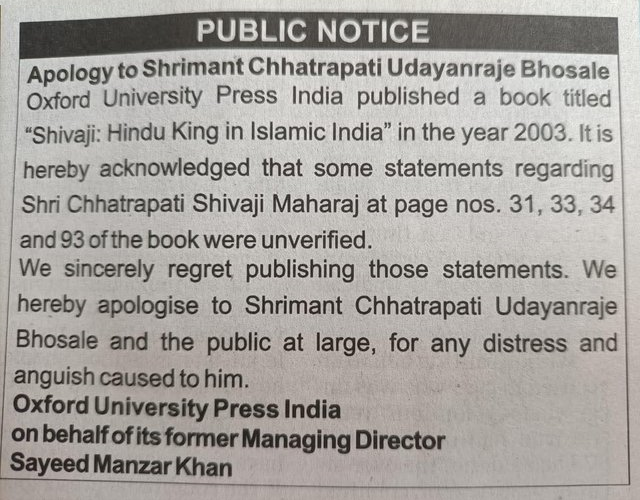
In a public notice published in a national newspaper, OUP India expressed regret over certain passages in the book “Shivaji: Hindu King in Islamic India”, authored by American academic James Laine and released in 2003. According to the notice, statements appearing on pages 31, 33, 34 and 93 of the book were found to be unverified. The publisher tendered an unconditional apology to Chhatrapati Udayanraje Bhosale, the 13th descendant of Shivaji Maharaj, and to “the public at large for any distress and anguish caused.”
Roots of a Major Controversy
The book had triggered a major backlash soon after its release. In January 2004, anger over its contents spilled onto the streets of Pune, when over 150 activists linked to the Sambhaji Brigade vandalised the historic Bhandarkar Oriental Research Institute (BORI). The protesters alleged that the institute had assisted the author and accused the book of making objectionable references to Shivaji Maharaj, a revered figure in Maharashtra and across India.
The incident shook the academic community, raised serious concerns about the safety of scholars and institutions, and forced a national conversation on the limits of historical interpretation. In response to the unrest, the Maharashtra government banned the book, effectively removing it from circulation in the state.
Legal Battle and Court Intervention
Chhatrapati Udayanraje Bhosale subsequently filed a complaint in 2005, leading to criminal defamation proceedings against OUP India’s then Managing Director, Sayeed Manzar Khan, and others associated with the publication. The case remained pending for years, symbolising the long shadow cast by the controversy.
A turning point came in December 2025, when the Bombay High Court’s Kolhapur bench heard the matter. During the proceedings on December 17, OUP India’s counsel informed the court that the publisher was willing to issue a nationwide apology acknowledging the disputed content. Accepting this submission, the court directed the issuance of the apology and subsequently quashed the criminal proceedings.
The Apology and Its Significance
In its notice, OUP clarified that the apology was being issued on behalf of its former Managing Director, Sayeed Manzar Khan. The publisher reiterated its regret and emphasised that it had no intention of causing hurt or misrepresenting a historical figure of such immense national importance.
For many observers, the apology is significant not only as a legal resolution but also as an acknowledgment of the deep emotional and cultural reverence associated with Shivaji Maharaj. The Maratha king is widely celebrated as a symbol of resistance, good governance, and Hindu pride, especially in Maharashtra. Any perceived slight against his legacy often provokes strong reactions, cutting across political and social lines.
A Broader Debate Rekindled
While the apology brings formal closure to the case, it also revives broader questions about how Indian history is researched, written, and published—particularly by foreign scholars and international publishing houses. The episode underscores the responsibility of academic publishers to rigorously verify sensitive content and to remain mindful of the cultural contexts in which their works circulate.
Two decades after the book first ignited controversy, OUP India’s apology stands as a reminder that historical scholarship does not exist in a vacuum—and that words on a page can resonate far beyond academia, shaping public sentiment, law, and legacy.
Conjecture vand Confusion
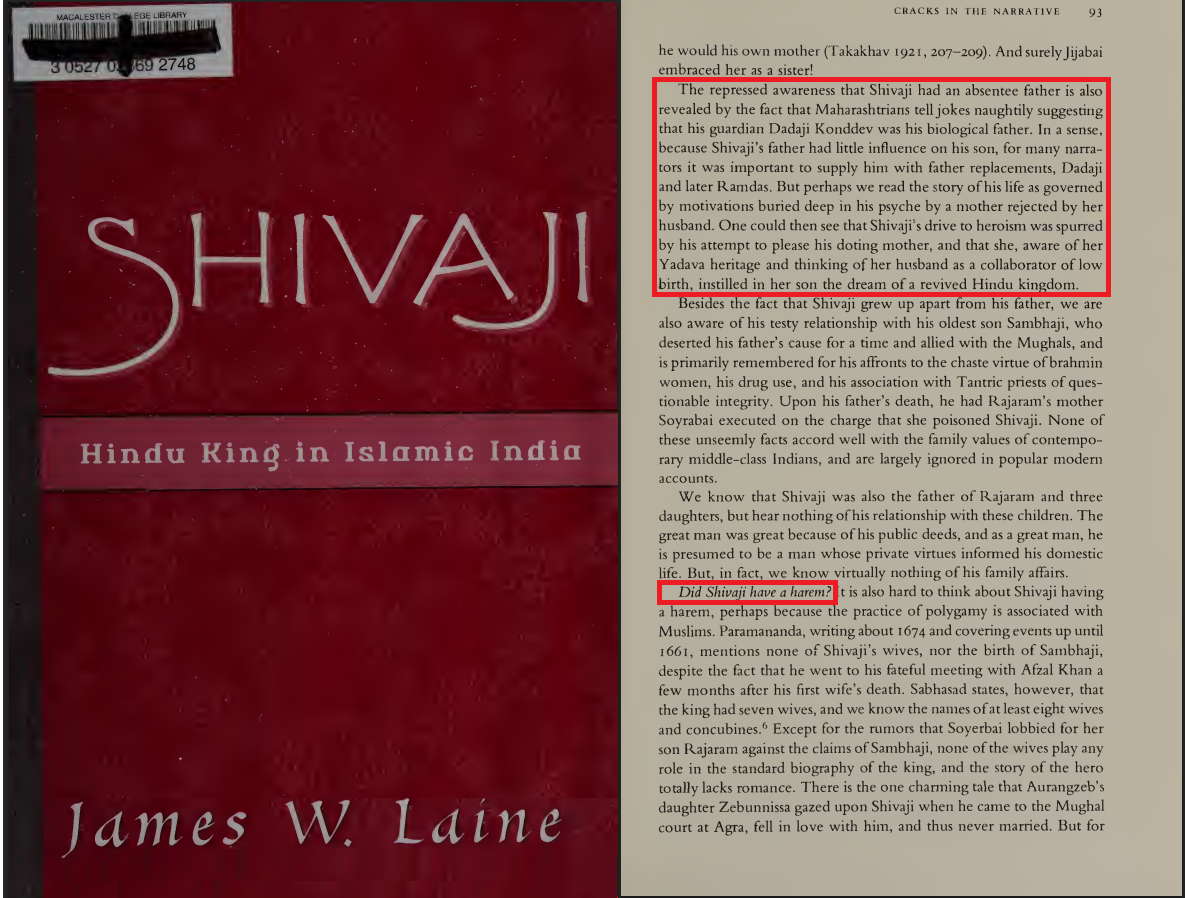
1. Anecdote About Shivaji’s Parentage (Page 93)
The most talked-about passage — and the one that still gets cited — appears around page 93:
- James Laine’s book included a paragraph noting that in Maharashtrian popular lore, people sometimes tell “naughty jokes” suggesting that Dadaji Konddev (a trusted guardian and mentor of young Shivaji) might have been Shivaji’s real biological father.
- Laine presented this as anecdote or folk humour rather than a fact, as part of a discussion about how stories and myths evolve in historical memory.
- Not only that, the writer Laine tried to equate Shivaji with other Muslim rulers regarding whether the former kept a harem for sexual pleasure.
This reference to jokes about parentage outraged many because it was seen as mocking Shivaji’s lineage and family honour — especially a revered maternal figure in Marathi culture — even though Laine framed it academically.
2. Reference to Shivaji’s Relationship with His Father ( Pages 31, 33, 34)
Although the exact text of pages 31, 33, and 34 is rarely available online, scholarly reviews and detailed summaries of Laine’s book indicate these pages were part of a chapter that explores:
- The complexity of Shivaji’s early life, especially the relationship between Shivaji and his father Shahaji, who was often away due to political obligations.
- Laine discussed how this absence influenced folklore and interpretation of Shivaji’s motivations.
- Alongside academic analysis, Laine quoted or referred to rumours and narrative fragments from Marathi traditions (for example, how people recall or joke about Shivaji’s upbringing), not as historical fact but as evidence of how stories circulate.
It appears that these kinds of interpretations and speculative statements—especially when presented without clear contextual support—are what OUP later described as “unverified”, considering the writer’s unfair means.
Stop Further Edition
After formally admitting that key portions of James Laine’s book on Chhatrapati Shivaji Maharaj contained unverified and distressing material, will Oxford University Press dare to republish the book only after purging all conjectures, insinuations, and culturally offensive narratives—and will it have the moral courage to permanently attach its public apology as an addendum to any future edition sold in India or abroad?
OUP must stop further edition or sale of the impugned book without permanently appending its court-mandated public apology as an inseparable addendum and making necessary exclusions from pages 31, 33, 34, and 93.
…
_Agency Inputs.


 Struggle for Hindu Existence
[…] NHRC seeks urgent report from J&K Police on ‘targeted’ Hindu killings. […]
[…] [Disclaimer: The content in this RSS feed is automatically fetched from external sources. All trademarks, images, and opinions belong…
Well done but to no effect
I wholeheartedly support the movement of ABVP
This is a common concern in almost all the states in India, as anti-Hindu, anti-Indian terrorist forces are very active…