
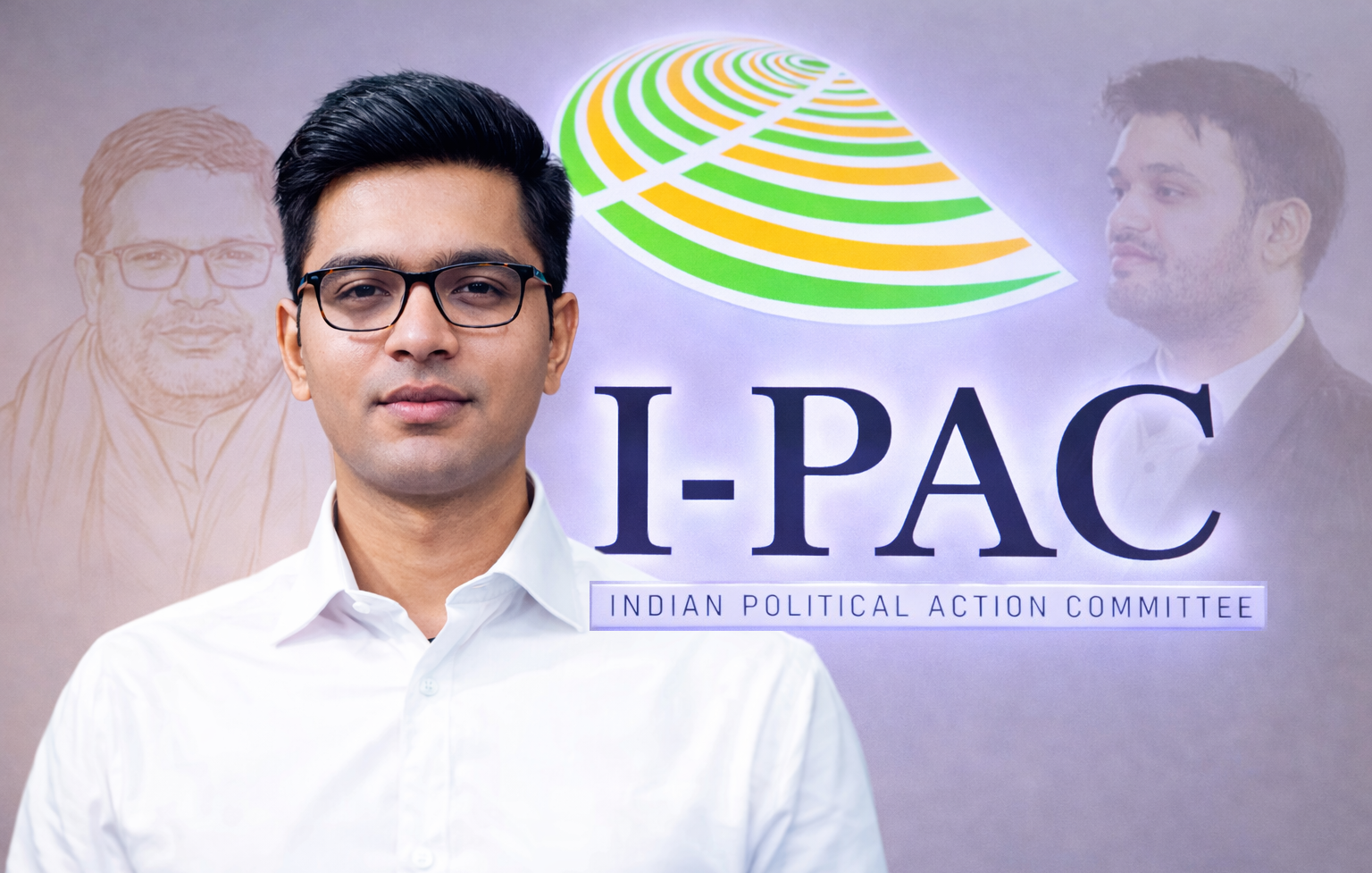
Inside I-PAC: From Electoral Mastermind to Power Broker — History, Influence, Deterrence and the Battle for India’s Democracy.
Right-wing critics allege that I-PAC has consistently operated against Hindutva-centric politics, aiding regional parties through minority-focused messaging and social coalition engineering, which they claim undermines Hindu political consolidation.
Susmita Bhattacharia | HENB | Kolkata | Jan 10, 2025:: West Bengal’s already combustible political climate flared further on Monday after the Enforcement Directorate (ED) conducted simultaneous raids at the Loudon Street residence and Salt Lake office of Pratik Jain, the head of the Indian Political Action Committee (I-PAC), in connection with an alleged coal smuggling case dating back several years.
What began as a routine financial probe soon escalated into a full-blown political confrontation involving the state’s highest constitutional authority, raising fresh questions about investigative autonomy, political consultancy firms, and the unseen architecture of modern Indian elections.
A Raid That Turned Political
According to ED sources, the searches were part of a larger investigation into alleged financial irregularities linked to the coal smuggling network that has previously ensnared several Trinamool Congress (TMC) affiliates. Central armed forces accompanied ED officials during the early-morning operation.
By noon, the situation took a dramatic turn when Chief Minister Mamata Banerjee, accompanied by Kolkata Police Commissioner Manoj Verma, arrived unannounced at Pratik Jain’s residence. Emerging from the premises holding documents and hard disks, Banerjee addressed waiting journalists, asserting that Jain was a “party worker” and alleging that the ED was attempting to seize sensitive political material, including TMC’s candidate lists and internal party documents, under the pretext of an investigation.
Shortly thereafter, the Chief Minister proceeded directly to I-PAC’s Salt Lake office, where ED searches were also underway.
The spectacle triggered sharp reactions across the political spectrum.
Opposition Cry Foul
Leader of the Opposition Suvendu Adhikari accused Mamata Banerjee of obstructing a central investigation, demanding judicial scrutiny and alleging a pattern of interference in past cases involving central agencies.
“The Chief Minister has no authority to enter a premises under ED search,” Adhikari said, calling the incident “a constitutional breakdown.”
The ED, for its part, has not yet issued a detailed public statement clarifying whether any material was seized or whether the Chief Minister’s presence impeded proceedings.
I-PAC: From Campaign Innovator to Political Lightning Rod
At the heart of the controversy lies I-PAC (Indian Political Action Committee)—arguably the most influential political consultancy firm India has produced.
Origins and Rise
I-PAC emerged in the mid-2010s as part of the ecosystem built by Prashant Kishor (PK), a former UN professional who introduced large-scale data analytics, voter profiling, and micro-targeting into Indian electioneering. The firm gained national prominence after its role in:
- YSR Congress Party’s landslide victory in Andhra Pradesh (2019)
- TMC’s decisive win against the BJP in West Bengal (2021)
- DMK’s return to power in Tamil Nadu (2021)
Media analyses by The Quint and The Indian Express credited I-PAC with transforming Indian campaigns from personality-driven mobilization to professionally managed, data-intensive operations.
The Shift After Prashant Kishor
However, the I-PAC narrative altered significantly after Kishor formally distanced himself from the organization in late 2024 to focus on his political outfit, Jan Suraj, in Bihar. The party’s crushing defeat in the 2025 Bihar Assembly elections severely dented PK’s aura as an infallible election strategist.
Political analysts now view that defeat as a turning point, suggesting that data-centric strategies may have diminishing returns when divorced from grassroots credibility.
Allegations, Data, and the Right-Wing Critique
Parallel to I-PAC’s electoral success, right-leaning commentators and BJP-affiliated grassroots workers have, for years, raised serious allegations—claims that remain unproven but politically potent.
These allegations include:
- Unauthorized collection of sensitive voter data, including financial details, social media behavior, welfare scheme beneficiaries, and political preferences.
- Bypassing the Election Commission, which is legally mandated to control voter data.
- Outsourcing or transferring data abroad, allegedly to facilities in Malaysia.
- Foreign influence, with claims that data reached UN-affiliated or US-linked institutions, facilitating international monitoring of Indian political sentiment.
Critics argue that such practices amount to digital voter manipulation rather than democratic mobilization. Various media outlets have noted the opacity surrounding political consultancies’ funding, data sources, and accountability mechanisms, though none have conclusively established illegality.
Importantly, neither I-PAC nor Prashant Kishor has been convicted or formally charged in relation to these allegations.
Post-PK I-PAC: Power Shift and New Accusations
Political insiders claim that following Kishor’s exit, Abhishek Banerjee, TMC’s national general secretary and MP from Diamond Harbour, emerged as a key power broker influencing I-PAC’s direction, alongside Pratik Jain.
Unverified allegations circulating within political circles suggest that I-PAC has evolved beyond consultancy into:
- A policy-shaping unit within TMC
- A vote strategy command center
- A liaison with business and political stakeholders, with some alleging coercive fundraising practices
The ED’s coal-smuggling probe is now being viewed by critics as potentially intersecting with this alleged ecosystem of influence and finance, though official confirmation is awaited.
The Ideological Fault Line
Beyond legality, the controversy underscores a deeper ideological battle.
Right-wing critics allege that I-PAC has consistently operated against Hindutva-centric politics, aiding regional parties through minority-focused messaging and social coalition engineering, which they claim undermines Hindu political consolidation. Supporters counter that such strategies merely reflect India’s pluralistic electorate and represent modern political professionalism, not ideological sabotage.
Democracy at a Crossroads
The I-PAC debate ultimately raises unsettling questions:
- Does data-driven politics enhance democracy or hollow it out?
- Who regulates political consultants operating in electoral grey zones?
- Where does campaign strategy end and voter manipulation begin?
- Can investigative agencies function independently amid intense political pressure?
As the ED probe unfolds, the Loudon Street episode may well become a defining moment—not just for I-PAC or the TMC, but for how India confronts the invisible machinery shaping electoral outcomes in the digital age.
For now, the evidence remains under scrutiny, the allegations fiercely contested, and the political temperature unmistakably high.
…
_Views are Personal.
Writer can be contacted at bhattacharias@gmail.com


 Struggle for Hindu Existence
[…] Tilak Ban at Pune School Sparks Strong Protest by Hindutva Groups Against Ambedkarite Headmaster. […]
wholeheartedly support the decision
[…] Hinduphobia Escalated from the Farragut Preschool Holi Event: Christian Mentality Exposed in the USA… […]
[…] [Disclaimer: The content in this RSS feed is automatically fetched from external sources. All trademarks, images, and opinions belong…
[…] [Disclaimer: The content in this RSS feed is automatically fetched from external sources. All trademarks, images, and opinions belong…