
Struggle for Hindu Existence
*Hindu Rights to Survive with Dignity & Sovereignty *Join Hindu Freedom Movement to make Bharat Hindu Rashtra within this lifetime *Jai Shri Ram *Jayatu Jayatu Hindu Rashtram *Editor: Upananda Brahmachari.
We Believe in Peace, But Self-Defence Is a Right of Hindus Within Hindutva: Devkinandan Thakur.
Sanatan Dharma, Self-Defence and the Hindutva Reliance : Devkinandan Thakur’s Rebuttal Against Mani Shankar Aiyar Spark Nationwide Debate.
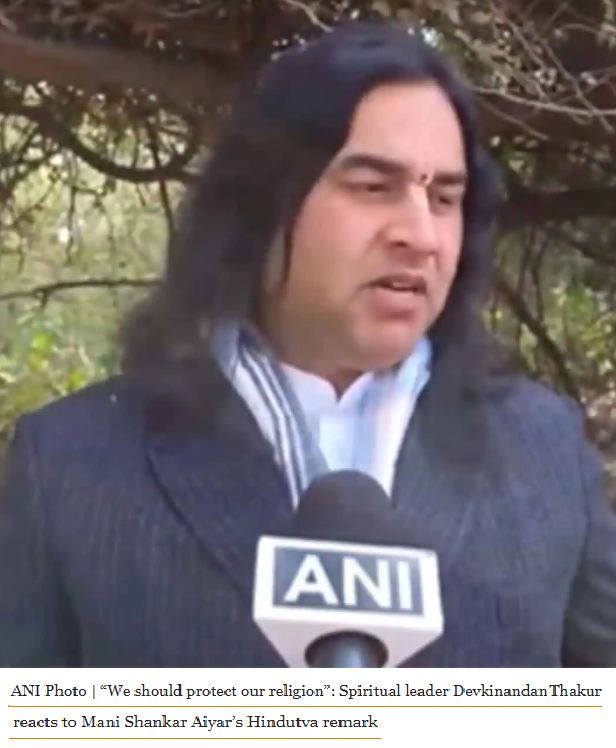 Upananda Brahmachari | HENB | New Delhi | Jan 13, 2026:: Amid an intensifying national discourse on Sanatan Dharma, Hindutva, and religious identity, spiritual leader and storyteller Devkinandan Thakur has emerged at the centre of multiple controversies, making a series of forceful statements that have resonated widely across political, religious, and social platforms. From calls for Hindu self-defence to demands for equal religious space at Aligarh Muslim University (AMU), and sharp reactions to Congress leader Mani Shankar Aiyar’s remarks on Hindutva, Thakur’s comments have reignited an already polarised debate.
“Hindus Believe in Peace, But Self-Defence Is a Right”
Speaking to the media in Mathura, Devkinandan Thakur asserted that Hindus are inherently non-violent but cannot remain passive when their existence, faith, or dignity is threatened. Drawing from Hindu scriptures and epics, he said war has always been the last resort in Sanatan tradition.
“We believe in ‘Sarve bhavantu sukhinah’—may all be happy. But excessive tolerance has cost Hindus their existence in Afghanistan, Pakistan, and Bangladesh,” he said, adding that Hindus are now becoming vigilant about their security.
Citing the Ramayana and Mahabharata, Thakur said even Lord Krishna sought peace before war, but when injustice crossed all limits, conflict became inevitable. “Hindus have never gone to seize anyone’s land. But if someone touches our Gau Mata, our mother, or the honour of our sisters and daughters, silence is not an option,” he said.
He further argued that Sanatan Dharma is not just a religion but a civilisational ethos that teaches humanity how to live. “An attack on Hindutva is an attack on humanity itself. Our principle is ‘live and let live,’ but if we are not allowed to live, then ‘Dharma rakshati rakshitah’—Dharma protects those who protect Dharma—becomes the only path,” he remarked, urging society to awaken against what he described as attacks on temples and traditions. His remarks have since gone viral, with supporters viewing them as a call for unity and self-defence.
The world remains silent on Bangladesh Hindu genocide
The continuous attacks on Hindus in Bangladesh and the brutal murder of eight Hindus in the last 25 days have escalated the situation. Renowned spiritual leader Devkinandan Thakur Ji Maharaj has given a very sharp and emotional statement on this issue. He not only questioned the safety of Hindus but also strongly criticized those who call him a “hate-monger.”
Devkinandan Thakur sarcastically said, “You people call me ‘Devkinandan, the purveyor of hatred.’ If talking about applying a tilak (religious mark), and pleading to save our children and temples is hatred, then yes, we are spreading hatred.” He questioned whether those who are burning Hindus alive, shooting them, and committing atrocities against our daughters are giving a “message of peace.”Devkinandan Thakur sharply asked why those who preach to others remain silent when Sanatani Hindus are being killed daily in Bangladesh. He said, “Temples are being set on fire there, girls are being abducted from their homes, but the world is sitting with its mouth taped shut. Shouldn’t a campaign be launched against those murderers?”
Military action should be taken if a Hindu is killed
Taking a strong stance, Devkinandan Thakur said that the situation has gone too far. He demanded that if even one Hindu is killed in Bangladesh, there should be a military intervention. It should be the government’s responsibility to protect every single Hindu.
My priority: Hindus and the Sanatan Nation
Finally, he clarified that he doesn’t care how the world views him. Reiterating his resolve, Maharaj Ji said, “I don’t care what anyone says about me. My pain is for my own people. My first priority is my Sanatani brother, my Hindu, and my Sanatan Nation.”
Temple at AMU: Demand Triggers Fresh Controversy
In another statement that stirred sharp reactions, Devkinandan Thakur demanded the construction of a temple at Aligarh Muslim University, arguing that religious equality must be upheld in institutions funded by public money. Speaking at a religious discourse in Khurja, Uttar Pradesh, he referred to an alleged incident where a Hindu employee was reportedly discouraged from wearing a tilak on campus.
“AMU runs on government funds. If there is a mosque there, then a temple should also be there,” he said. Questioning what he called selective secularism, Thakur added, “If people can wear skullcaps, why can’t Hindus wear a tilak? If I can’t read the Ramayana here, then you can’t read the Quran either.”
Declaring that “India belongs to my Ram and my Krishna,” Thakur framed the issue as one of equal rights rather than confrontation, though critics have accused him of inflaming communal sensitivities.
This controversy followed closely on the heels of another flashpoint involving Thakur’s remarks on actor Shah Rukh Khan and the persecution of Hindu minorities in Bangladesh. He had demanded that Khan, co-owner of IPL franchise Kolkata Knight Riders, distance himself from Bangladeshi player Mustafizur Rahman in protest against alleged atrocities. After the BCCI directed KKR to release the player, Thakur welcomed the move but again criticised Shah Rukh Khan for not issuing a public statement on the situation in Bangladesh.
Clash Over Hindutva After Mani Shankar Aiyar’s Remarks
Devkinandan Thakur also strongly reacted to Congress leader Mani Shankar Aiyar’s controversial comments on Hindutva, made during ‘The Debate 2026’ hosted by the Calcutta Debating Society. Aiyar described Hindutva as “Hinduism in paranoia” and drew a sharp distinction between Hinduism as a spiritual tradition and Hindutva as a political ideology, invoking Mahatma Gandhi, Swami Vivekananda, and Vinayak Damodar Savarkar to argue that Hinduism does not require Hindutva for its survival.
Responding to these remarks, Thakur said, “Our scriptures tell us to protect our religion. A Hindu is not afraid of anyone. All parties must ensure that Hindus, our mothers, daughters, and Gau Mata feel safe. Today, Hindus are awakening. Hindus believe in peace; however, self-defence is a right of Hindus embedded in Hindutva.
BJP leaders joined the criticism of Aiyar, accusing him and the Congress of holding a “colonial mindset” and being “Hindu virodhi.” BJP spokesperson Narayanan Thirupathy called Aiyar a “British agent” and asserted that Hindutva is inclusive and that Hinduism is a way of life, not merely a religion. BJP MLA Bhavana Bohra also attacked Aiyar’s remarks, contrasting what she called the Congress era of “talks” with the current government’s approach of “decisive responses.”
A Debate Far From Settled, But Hindutva Reliance Asserted
With prominent figures such as Mani Shankar Aiyar, Swapan Dasgupta, J. Sai Deepak, Sudhanshu Trivedi, Agnimitra Paul, Mahua Moitra, Ruchika Sharma, Ashutosh, and others participating in the recent Calcutta debate arranged by Calcutta Debating Circle (CDC), the controversy has underscored the deep ideological divide over the meaning of Hinduism and Hindutva in contemporary India.
As Devkinandan Thakur’s statements continue to draw both strong support and sharp criticism, they reflect a broader churn within Indian society—where questions of faith, identity, self-defence, and secularism are increasingly intersecting with politics. Whether viewed as a call for protection of religious rights or as rhetoric that risks deepening divisions, the debate ignited by these remarks shows no sign of fading anytime soon.
As the controversy continues to ripple through political, academic, and social spheres, the larger debate over Hinduism and Hindutva remains unresolved. Yet, beyond the immediate outrage and counter-outrage, a deeper trend is becoming increasingly visible: the growing reliance on Hindutva as a framework of cultural assertion, civilisational continuity, and self-preservation—not only within India but also among Hindu communities abroad. From concerns over religious freedom and identity in minority situations across South Asia to debates in Western academic and policy circles, Hindutva is being invoked by its supporters as a response to perceived historical marginalisation, cultural misrepresentation, and security anxieties. Whether embraced as a protective ideology or criticised as politicisation of faith, its expanding resonance signals that Hindutva is no longer confined to domestic political discourse but has emerged as a global reference point in conversations around Hindu identity, rights, and resilience—ensuring that the debate, far from ending, is likely to deepen both at home and internationally.
…
_Agency Inputs including ANI.


 Struggle for Hindu Existence
[…] NHRC seeks urgent report from J&K Police on ‘targeted’ Hindu killings. […]
[…] [Disclaimer: The content in this RSS feed is automatically fetched from external sources. All trademarks, images, and opinions belong…
Well done but to no effect
I wholeheartedly support the movement of ABVP
This is a common concern in almost all the states in India, as anti-Hindu, anti-Indian terrorist forces are very active…