
Struggle for Hindu Existence
*Hindu Rights to Survive with Dignity & Sovereignty *Join Hindu Freedom Movement to make Bharat Hindu Rashtra within this lifetime *Jai Shri Ram *Jayatu Jayatu Hindu Rashtram *Editor: Upananda Brahmachari.
Grand Mamankam- Kumbh Mela in Kerala: A Call for Hindutva, Spirutiality, Peace, and Prosperity.
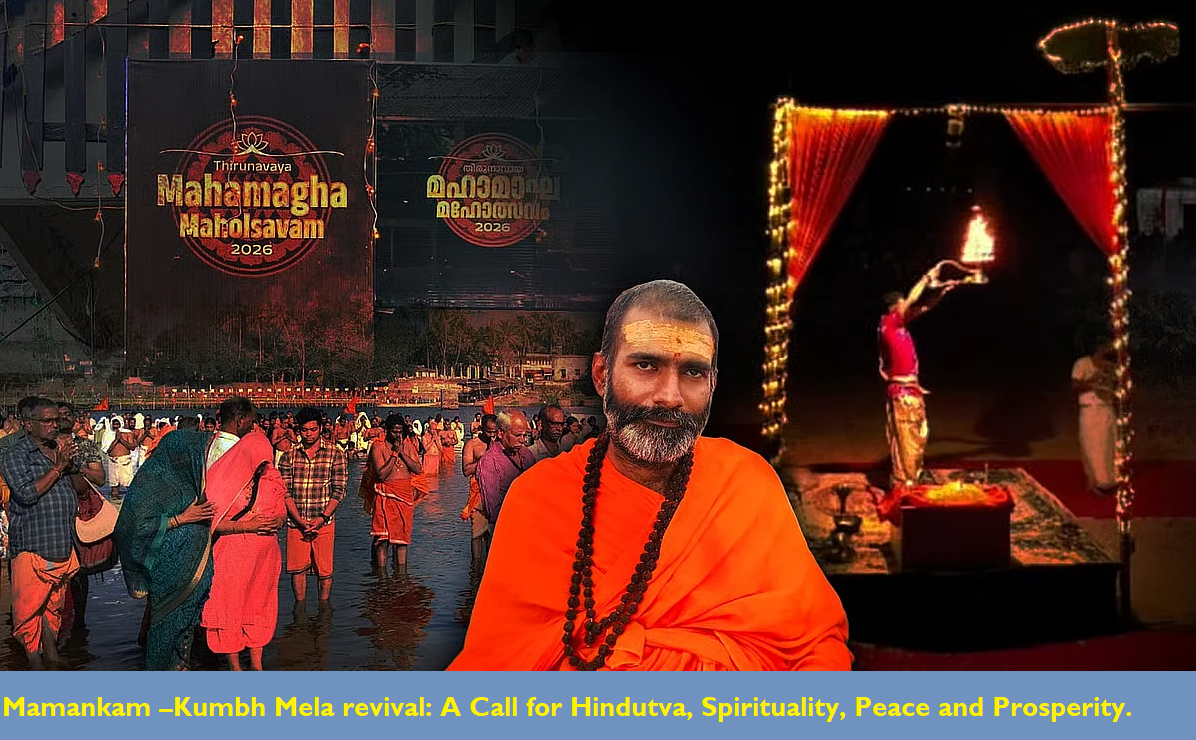
Kerala’s ‘Kumbh Mela’: Mamankam Revival Signals Cultural Reassertion of Hindutva in the South.
~by B Upendran.
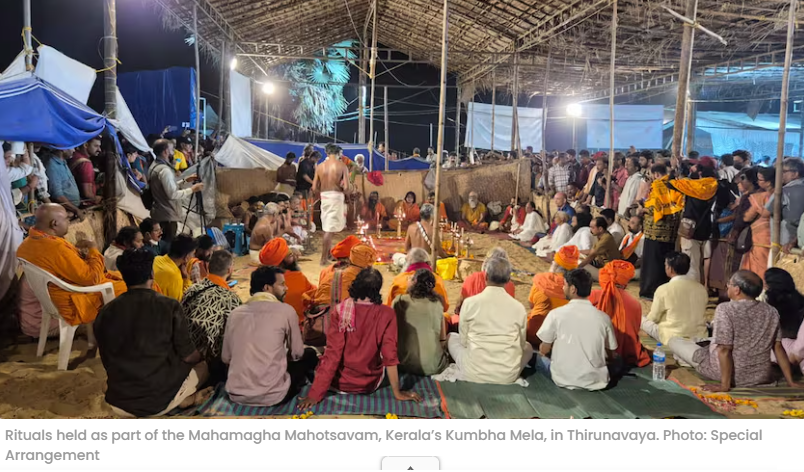
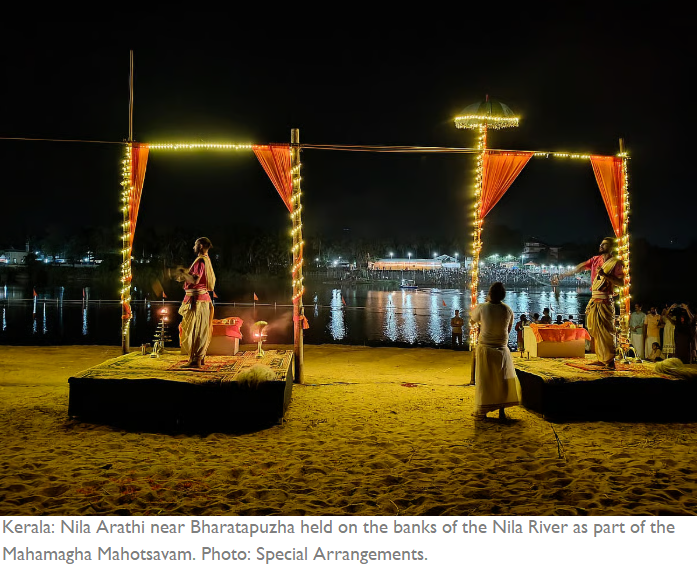 As evening descends on the banks of the Bharathapuzha—known affectionately as the Nila—the quiet historic sands of Thirunavaya are transformed into a scene of intense religious fervour. Fire-lit aartis reminiscent of Varanasi’s ghats illuminate the river, Sanskrit chants echo across temporary bridges, and saffron flags dominate the landscape. For the thousands gathered, the setting evokes the spiritual atmosphere of the Ganga, despite being deep within Kerala.
This transformation forms the centrepiece of the Mahamagha Mahotsavam, a large-scale religious congregation that began on January 19 and concluded this week. Projected by its organisers as the “Kumbh Mela of Kerala,” the event marks a deliberate revival—and reinterpretation—of Mamankam, the medieval assembly once held at this very site. The initiative is led by the Sri Panch Dasnam Juna Akhada of Varanasi, India’s oldest and most influential Shaivite monastic order, with the patronage of Mata Amritanandamayi and the participation of multiple sanyasi lineages.
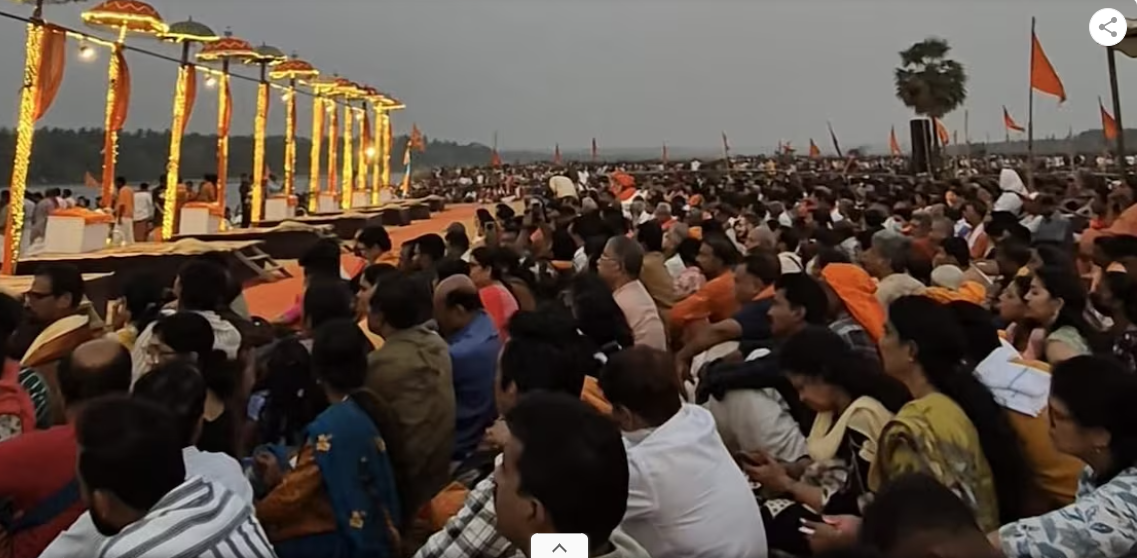
While historians question the historical continuity of this revival, supporters view it as a long-overdue cultural resurgence aimed at restoring Hindu civilisational consciousness in Kerala and the wider South.
From Medieval Power Arena to Modern Spiritual Mobilisation
Historically, Mamankam was not merely a religious festival. Held once every twelve years in Thirunavaya—now part of Malappuram district—it functioned as a political and ceremonial arena in medieval Malabar. Presided over initially by the Chera Perumals, Mamankam became the focal point of regional sovereignty after the decline of the Chera Empire in the 12th century.
The right to serve as Rakshapurusha, or protector of the festival, symbolised supreme authority over Kerala. This right passed from the Valluvakonathiri of Valluvanadu to the Zamorin of Kozhikode, triggering violent confrontations that made Mamankam infamous. Suicide squads from Valluvanadu repeatedly attempted to assassinate the Zamorin during the festival, turning ritual into a battlefield.
The final Mamankam took place in 1755, and the Mysorean invasion led by Hyder Ali in 1766 is widely believed to have ended the centuries-old tradition.
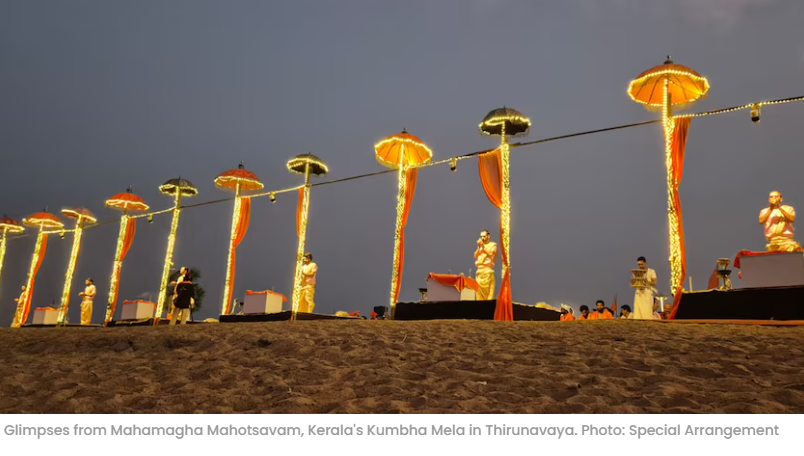
Reimagining Mamankam Through a Hindutva Lens
The present revival departs sharply from Mamankam’s historical form. Instead of political rivalry, the Mahamagha Mahotsavam foregrounds spiritual unity, mass participation, and pan-Hindu symbolism. Organisers trace the origins of the Mahamagha ritual to the yajna performed by Parashurama on the banks of the Bharathapuzha, portraying Thirunavaya as an ancient sacred geography central to Hindu civilisation.
The reimagining gained momentum when Swami Anandavanam Bharati of the Juna Akhada—appointed Mahamandaleshwar for South India during the Prayagraj Kumbh—took charge of reviving the ritual. Under his leadership, the event was conceptualised as Kerala’s equivalent of the Kumbh Mela, integrating northern akhada traditions with local spiritual lineages.
Massive Turnout, Visible Religious Assertion
The response surpassed expectations. Organisers estimate that between three and five lakh devotees attended daily, with nearly seven lakh visiting on peak days. The crowds included large numbers of women and children, underscoring the event’s mass appeal.
Over 300 monks participated in the concluding Amrutha Snanam, while monks, ascetics, and representatives from several Kerala royal families attended ceremonies throughout the festival. Spiritual figures from diverse traditions—ranging from Adi Shankaracharya and Sree Narayana Guru to Chattampi Swamikal and Ayya Vaikunda Swamikal-inspired streams—were collectively honoured as guiding lights, reinforcing claims of inclusivity within the Hindu fold.
Political Undercurrents Beneath Spiritual Revival
The scale of the Mahamagha Mahotsavam has sparked political debate. Both the ruling CPM and the opposition Congress kept an official distance, with no senior leaders or elected representatives attending the event. Observers see this absence as reflective of a growing disconnect between Kerala’s mainstream political parties and rising public expressions of Hindu religiosity.
In contrast, BJP leaders and Sangh Parivar organisations were visibly present. Sevabharati volunteers managed logistics, crowd control, and sanitation, reinforcing the organisational depth of Hindutva-linked networks. BJP leaders described the event as a corrective to what they allege has been a systematic erosion of Kerala’s Hindu cultural identity.
Economic and Social Impact
Organisers estimate that the festival generated economic activity worth ₹50 crore to ₹100 crore in Malappuram district, benefiting transport operators, traders, and local service providers. The event was largely funded through public donations, with devotees contributing through rituals, yajnas, offerings, and guru dakshina.
Notably, local residents—many from Muslim households—extended logistical support, providing land, parking, and services. Several visitors from non-Hindu backgrounds described the festival as a moment of shared curiosity and coexistence.
Cultural Regeneration or Historical Recasting?
For critics and historians, the revival represents a selective reconstruction of the past that downplays Mamankam’s political and violent legacy. For supporters, however, the Mahamagha Mahotsavam is less about historical exactitude and more about cultural regeneration—an assertion of Hindu civilisational presence in a state long dominated by Left politics and strong minority mobilisation.
With organisers already announcing plans for a significantly larger Maha Kumbh Mela in Thirunavaya in 2028, the revival of Mamankam has clearly moved beyond ritual remembrance. It has emerged as a symbol of Hindutva’s expanding cultural footprint in South India—reshaping memory, reclaiming sacred geography, and redefining the contours of public religiosity in Kerala.
South–North Spiritual Alignment
The revival of the Mahamagha Mahotsavam at Thirunavaya has come to symbolise a growing South–North spiritual alignment within the broader Hindu civilisational framework. By bringing the Juna Akhada of Varanasi—an institution central to the Kumbh Mela tradition—into Kerala’s sacred landscape, the organisers have consciously bridged regional spiritual geographies that have long evolved independently. Northern Shaivite monastic lineages, akhada-based ascetic traditions and Kashi-style rituals are being woven together with Kerala’s indigenous spiritual streams rooted in Adi Shankaracharya, Sree Narayana Guru and other reformist legacies. Proponents view this convergence as a re-integration of Hindu society across linguistic and regional boundaries, reinforcing a pan-Indian Sanatan Hindu identity. Critics, however, interpret the alignment as an ideological recalibration that privileges a homogenised religious narrative over local historical distinctiveness, highlighting the ongoing tension between spiritual unity and regional diversity within contemporary Hindu practice.
Mamankam–Kumbh Mela: A Call for Peace and Prosperity
Reimagined in the present as a Kumbh Mela, the revival of Mamankam is being projected not merely as a religious congregation but as a symbolic call for peace, harmony and collective prosperity. Where the medieval assembly once echoed with rivalry and bloodshed born of political ambition, the contemporary gathering seeks to replace conflict with spiritual convergence and shared purpose. Through mass participation, inclusive rituals and an emphasis on cultural continuity, the organisers frame the Mahamagha Mahotsavam as a reaffirmation of Sanatan values rooted in coexistence, social balance and moral renewal. Supporters argue that by transforming a historically contested space into a platform for devotion and dialogue, the Mamankam–Kumbh Mela aspires to heal historical ruptures and inspire a future anchored in peace, cultural confidence and material well-being for the region and beyond.
Read also: Prayers, holy dip mark Mahamagha finale (via TNIE)
..
Pic Courtesy: Newslaundry & OnManorama.


 Struggle for Hindu Existence
reconversion to Hinduism should be the primary goal of Hindu society today. Rest of the goals and actions of society…
[…] Hindu temple in Peterborough wins first round fight over sale to mosque […]
Dear Majumder Ji, Namaskar. Please send some donation / contribution for this site to run our activities. Donation link: http://paypal.me/hinduexistence…
[…] Protest against UGC Bill: Ghaziabad police halt Yati Narsinghanand’s yatra to Delhi’s Jantar Man… […]
[…] Tilak Ban at Pune School Sparks Strong Protest by Hindutva Groups Against Ambedkarite Headmaster. […]