
The Pew Report & Hindu Concern: Muslim Population Growth Outpaces Other Major Religions, Reshaping Global and Indian Demographics.
Upendra Bharti | HENB | New Delhi | Feb 16, 2026:: There was once a phrase economists used—sometimes critically, sometimes wryly—to describe India’s modest economic expansion in the decades following Independence. They called it the “Hindu rate of growth,” implying gradualism and stability rather than rapid transformation. Though the term has long disappeared from economic discourse, recent demographic data gives it an unexpected new resonance—this time in literal, population terms.
According to the Pew Research Center’s major global study, “How the Global Religious Landscape Changed From 2010 to 2020,” the growth trajectory of the world’s Hindu population closely mirrors overall global population growth. During that same period, however, the Muslim population expanded at a significantly faster rate—outpacing not only Hindus but also Christians, and even exceeding the combined numerical increase of both groups.
The Big Picture: A Decade of Uneven Growth
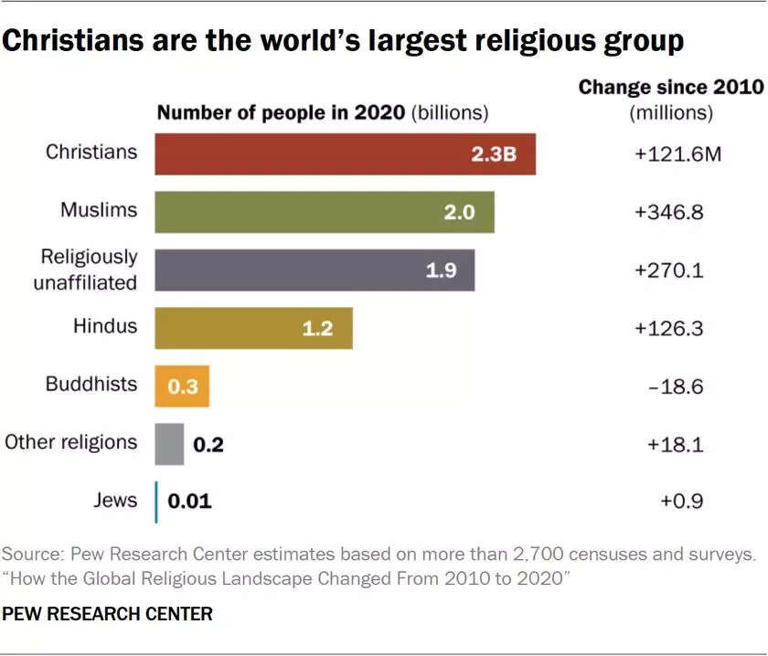
Between 2010 and 2020, the global Hindu population grew from approximately 1.07 billion to around 1.2 billion—an increase of about 126 million people. This growth rate was almost identical to that of the global population as a whole, leaving Hinduism’s share of the world population largely stable at roughly 15 percent.
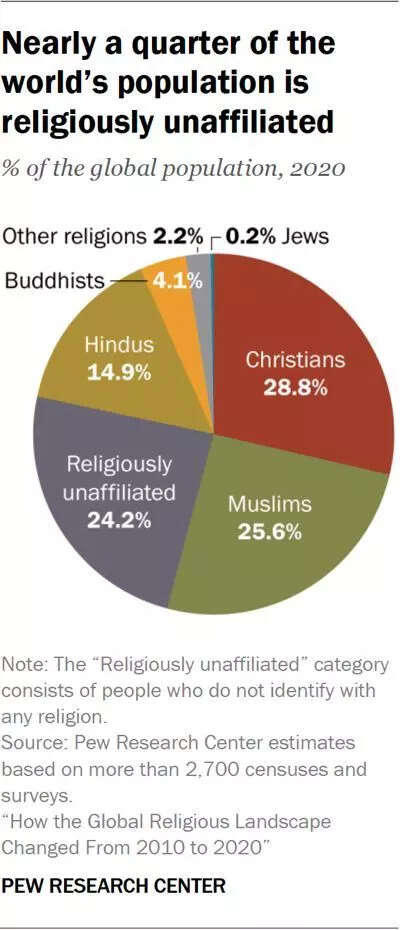
Christianity, the world’s largest religion, saw an increase of approximately 121.6 million adherents during the same decade. However, due to differing regional fertility patterns and population dynamics, Christianity’s overall share of the global population slightly declined.
By contrast, Islam experienced a markedly higher surge. The global Muslim population increased by approximately 346.8 million between 2010 and 2020—far surpassing the growth seen among Christians and Hindus individually, and even exceeding their combined numerical gains. As a result, Muslims increased their share of the world’s population more than any other major religious group during that period.
Demographers attribute this accelerated growth largely to higher fertility rates in many Muslim-majority countries and relatively younger age structures. This differential growth pattern is gradually reshaping the global religious landscape.
A Religion Defined by Geography
One of the most striking features of Hinduism’s demographic profile is its geographic concentration. Approximately 99 percent of Hindus live in the Asia-Pacific region, and nearly 95 percent reside in India alone. Nepal accounts for most of the remainder.
This makes Hinduism the most geographically concentrated of the world’s major religions. Unlike Islam and Christianity, which are widely distributed across continents, Hinduism’s global demographic trajectory is overwhelmingly tied to India’s population trends.
By comparison, Muslims and Christians are far more geographically dispersed, with significant populations across Africa, the Middle East, Europe, Asia, and the Americas. This broader distribution contributes to more varied demographic momentum across regions.
Growth Driven Primarily by Birth Rates
The Pew study indicates that Hindu population change is driven overwhelmingly by natural increase—births minus deaths—rather than by large-scale religious switching. Rates of conversion into or out of Hinduism remain relatively low compared with some other religious traditions.
Islam’s growth, similarly, is primarily attributable to higher fertility rates and younger median ages in many Muslim-majority regions. In demographic terms, Muslim populations globally tend to have a lower median age than the global average, which contributes to sustained population momentum.
Hindu’s Majority Status and Regional Shifts in India
Globally, about 97 percent of Hindus live in countries where they form the majority religious group—primarily India and Nepal. This is the highest majority concentration among major world religions.
Within India, however, religious demographics vary significantly by state and district. Certain regions—including parts of Jammu and Kashmir and several states in the Northeast—have distinct religious compositions in which Hindus are not the majority community. In states such as West Bengal and Assam, district-level demographic patterns reflect considerable religious diversity.
Population growth differentials—driven largely by fertility rates, migration patterns, and age structures—have contributed to gradual shifts in some regional demographic balances over recent decades. While national-level data show overall demographic stability, subnational variations remain an area of active academic and policy analysis.
Though Hindus constitute the national majority in India still now, regional variations tell a more complex story.
Hindus are not the majority in Jammu and Kashmir and in several states of the North-Eastern region, including Nagaland, Mizoram, Meghalaya, and parts of Manipur and Arunachal Pradesh. In Kerala, Hindus form a plurality rather than an overwhelming majority.
At the district level, demographic balances are even more distinct. In West Bengal, districts such as Malda, Murshidabad, and North Dinajpur (Uttar Dinajpur) have Muslim-majority populations. In Assam, districts including Dhubri, Barpeta, Goalpara, Hailakandi, and Karimganj reflect similar demographic compositions.
These patterns are shaped by a combination of historical settlement trends, fertility differentials, and migration flows. However, from the writer’s perspective, such regional changes are part of a broader demographic transformation that warrants closer examination beyond national averages.
Age Structure and Demographic Momentum
India’s median age is approximately 28 years, significantly younger than that of many Western nations. Because India is home to the vast majority of Hindus worldwide, the global Hindu population reflects this relatively youthful profile.
At the same time, India’s total fertility rate has declined substantially over the past half century and is now approaching replacement level. This suggests that while overall Hindu population numbers may continue to grow due to demographic momentum, growth rates are likely to moderate over time.
In contrast, many Muslim-majority countries continue to record comparatively higher fertility rates, contributing to faster population expansion globally.
Conversion and Proselytization Concerns
Another dimension of demographic change, particularly in India and Nepal, involves religious conversion. Various Hindu groups have raised concerns about active proselytization efforts targeting economically vulnerable populations, especially tribal communities. They argue that organized missionary initiatives—both Christian and Islamic—operate extensively in certain regions.
Missionary and religious organizations maintain that their activities fall within constitutional protections of religious freedom and include education, healthcare, and social welfare services. However, critics contend that economic disparities and social vulnerabilities may influence religious affiliation shifts in specific areas.
Global demographic research, including Pew’s analysis, generally finds that Hindu population change is driven primarily by natural increase rather than large-scale religious switching. Nevertheless, localized conversion debates continue to influence public discourse in parts of India.
A Changing Religious Landscape and Emerging Demographic Equation
The decade from 2010 to 2020 highlights a significant demographic trend: Islam is growing at a faster pace than other major world religions. The increase of nearly 347 million Muslims during that period exceeds the combined growth of Christians and Hindus, marking a notable shift in the global religious balance.
While Hinduism’s growth remains steady and aligned with overall world population trends, and Christianity continues to expand in absolute numbers despite proportional decline, Islam’s comparatively rapid expansion is reshaping both global and regional demographics.
Demographers caution that long-term projections depend on future fertility patterns, educational attainment, urbanization, and socioeconomic change. Nevertheless, current trends indicate that differential growth rates among major religions will continue to influence the global demographic landscape in the decades ahead. The decadal population growth pattern signals a long-term demographic transformation—globally and within India’s regional contexts. As fertility trends, migration flows, and socio-economic transitions continue to evolve, the relative growth rates of major religious communities will increasingly shape the religious composition of the 21st century.
In that sense, the modern “Hindu rate of growth” reflects demographic stability. The Muslim growth rate, by contrast, reflects acceleration—one that is increasingly central to discussions of global and Indian population change in the 21st century.
If the earlier “Hindu rate of growth” implied economic restraint, today’s demographic data suggests something different: stability on one side, acceleration on the other. And it is this widening differential that may define the next chapter of global and Indian demographic change.
This high rate of Muslim population growth is a matter of concern for non-Muslims as a whole. Hindus, Christians, Buddhists, Jains, Sikhs, Parsis, Jews, and others must consider it collectively. Everybody should be alert to this ‘Population Jihad’.


 Struggle for Hindu Existence
Pingback: 19th February 2026 – STOP HINDU HATE ADVOCACY NETWORK