
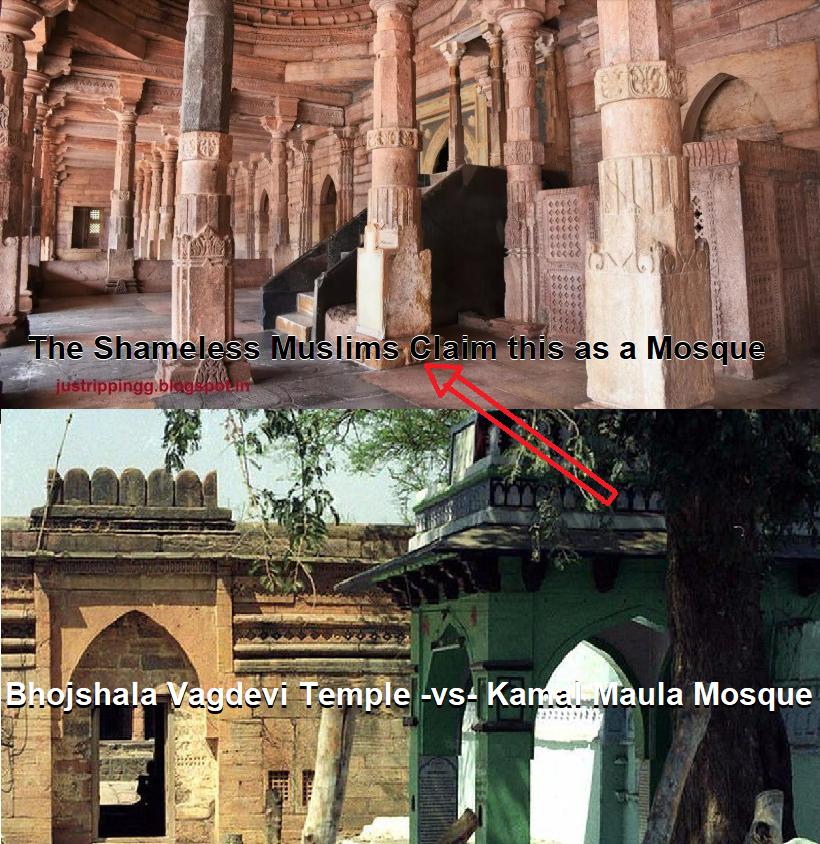
ASI Flags Pre-Existing Structure At MP’s Bhojshala; Hindu Front Claims Evidence Of Ancient Temple Under Kamal Maula Mosque.
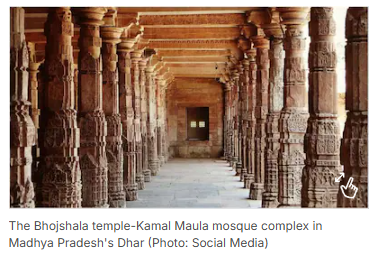 Upendra Bharti | HENB | Indore | Feb 24, 2026:: The long-standing dispute over the Bhojshala–Kamal Maula Mosque complex in Madhya Pradesh’s Dhar district has entered a crucial phase after the Archaeological Survey of India (ASI) concluded in its scientific survey report that the existing structure incorporates architectural and sculptural elements from earlier temples.
The findings were placed before the Indore bench of the Madhya Pradesh High Court during recent hearings in the case. The bench comprising Justice Vijay Kumar Shukla and Justice Alok Awasthi directed that copies of the ASI report be made available to all parties and granted two weeks for filing objections, suggestions, opinions and recommendations. The matter is scheduled for further hearing on March 16.
What the ASI Report Says
According to the ASI’s 2,000-page report prepared in 10 volumes, the existing structure at the Bhojshala complex was constructed centuries after an earlier monumental structure, “without much attention to symmetry, design, or uniformity.”
The report states that, based on “scientific investigations, survey and excavation, study and analysis of retrieved finds, study of architectural remains, inscriptions, art and sculptures,” it can be concluded that the present structure was built using parts of earlier temples that were dismantled.
The 98-day scientific survey, conducted under court supervision, involved excavation, documentation and analysis of architectural fragments, inscriptions and sculptural remains. The ASI team, led by Additional Director General Alok Tripathi, included experts such as Zulfiqar Ali, Bhuvan Vikram, Gautami Bhattacharya, Manoj Kumar Kurmi, Izhar Alam Hashmi, Aftab Hussain, Shambhoo Nath Yadav and Niraj Kumar Mishra.
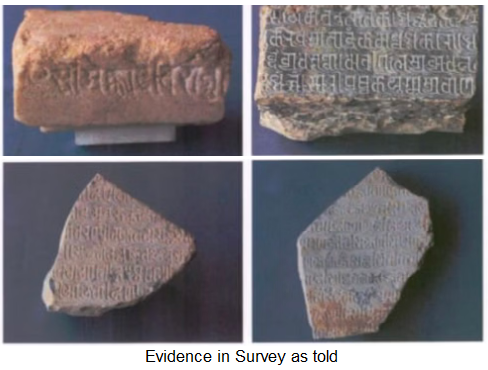
In a chapter titled “Brief findings of the survey,” the report notes that retrieved architectural remains, sculptural fragments, large slabs of inscriptions containing literary texts, and Nagakarnika inscriptions on pillars indicate the existence of a significant pre-existing structure associated with literary and educational activities. The findings suggest that this earlier structure dates back to the Paramara period.
The report also hints that the site may have been a temple dedicated to Goddess Saraswati (Vagdevi), traditionally associated with learning.
Sculptures and Architectural Evidence
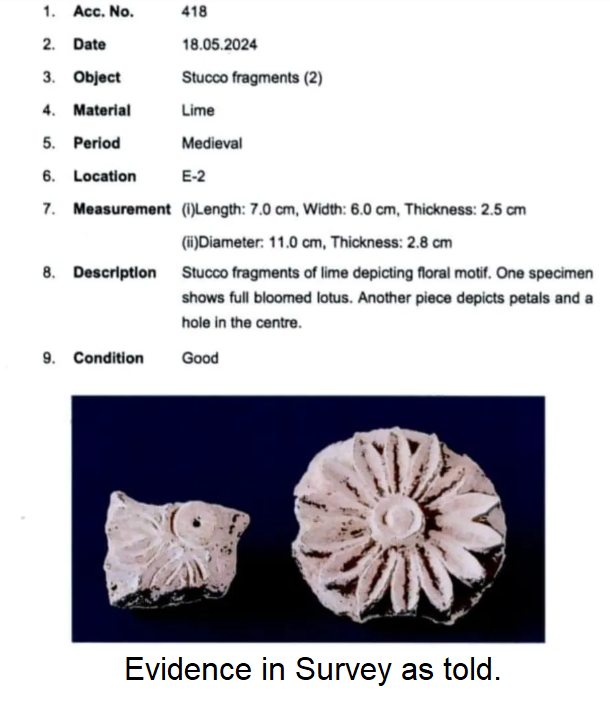
The ASI documented a total of 94 sculptures and sculptural fragments at the site, many of which were reportedly chiselled out or defaced. Sculptures of four-armed deities were found carved on windows, pillars and beams currently used in the existing structure.
The carved images include depictions identified as Ganesh, Brahma with his consorts, Narasimha, Bhairava, as well as various gods, goddesses, human figures and animals. Animal motifs include lion, elephant, horse, dog, monkey, snake, tortoise, swan and birds. The report also describes mythical and composite motifs such as kirtimukhas (human-faced, lion-faced and composite-faced forms) and vyalas of different shapes.
Some Unique Evidences
According to the report, the ASI report was released just a day ago, which has sparked enthusiasm among the community. An indefinite protest is underway demanding the complete handover of Bhojshala to Hindus and the reinstatement of Goddess Saraswati’s worship there. Bhoj Utsav Committee President Suresh Jalodia, Patron Ashok Jain, General Manager Hemant Dauraya, General Secretary Sumit Chaudhary, Vishwas Pandey, Mohan Rathore, Nikhil Joshi, and other officials were present during the meeting.
Learn what Gopal Sharma said?
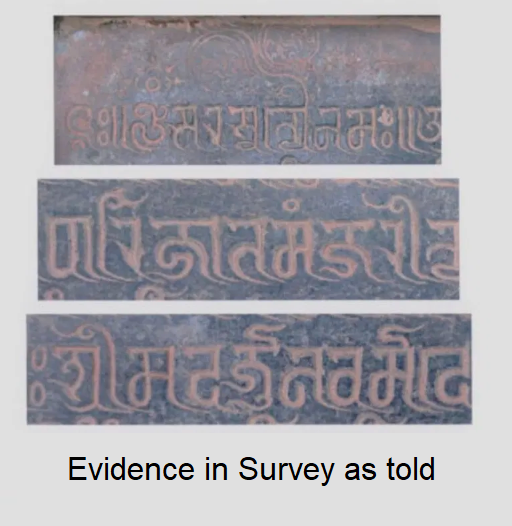
Advocate Shreesh Dubey, Bhojshala Mukti Yagna coordinator, Gopal Sharma, stated that the survey report clearly established that Bhojshala’s original form is that of Saraswati Kanthabharana. Excavations at the Bhojshala complex revealed strong evidence of a multi-story structure. Two pillars were found, inscribed with “Om Saraswatiye Namah.” This evidence is not just one or two, but numerous. Gopal Sharma was present at the Bhojshala during the ASI survey, observing every detail with the ASI survey team from morning until evening.
“Part of the Temples”
According to Advocate Dubey, the ASI prepared a 2,189-page survey report after a 98-day survey. Numerous evidence, including the pillars, their art, and architecture, revealed that these pillars were originally part of a temple, but were later encroached upon and damaged and reused in the construction of the mosque. A total of 188 pillars, 106 on each side and 82 on the other, are found in the existing structure. Their architecture confirms that these pillars were originally part of temples. To repurpose them for the current structure, the figures of gods and humans carved on them were defaced. Many human and animal figures, which are not permitted in mosques, were damaged using a chisel-like object. Numerous inscriptions written in Sanskrit and Prakrit languages have been discovered, highlighting the historical, literary, and educational significance of Bhojshala.
“Descriptions Found in Texts”
According to coordinator Sharma, an inscription was also found that mentions King Naravarman of the Parmar dynasty. Naravarman ruled between 1094-1133 AD. In the western area of the complex, several pillars are adorned with ornamental figures depicting Kirtimukhas, human, crocodile, and mixed faces. Kirtimukhas hold great significance in Sanatan architecture. Kirtimukhas are associated with Lord Shiva. Detailed descriptions of them are found in texts such as the Skanda Purana, Shiva Purana, Padma Purana, and Vastu Shilpa. Small figures of deities carved on window frames in the walls were found, their condition is still good and clear.
30 Coins Also Found
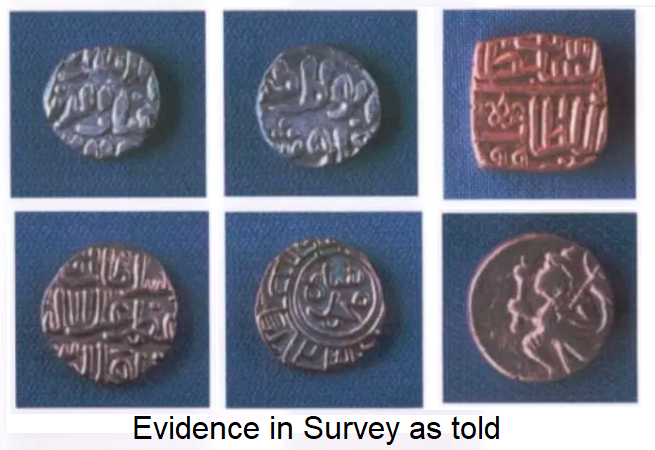
According to Advocate Dubey, 94 sculptures with intricate carvings were found. In addition, several articles were found, which confirm Bhojshala’s status as a temple. These artifacts were crafted from marble, soft stone, sandstone, and limestone. The engraved images included those of Lord Ganesha, Brahma, Narasimha, Bhairava, deities, humans, and creatures revered in Sanatan Dharma. Other creatures, including lions, elephants, horses, dogs, monkeys, snakes, tortoises, swans, and birds, were also found. Thirty coins were made of silver, copper, and other metals and date back to the Parmar period.
‘Center of Sanatan Faith’
According to Gopal Sharma, although the survey is still incomplete, as a large area has been left out, where even greater evidence is available. However, this 2,189-page report is sufficient to prove that the complex is a major center of Sanatan Dharma and has been for centuries. Now is the time to reclaim this glory and re-establish a magnificent, magnificent, and divine temple of Maa Vagdevi Saraswati, so that the entire world can see the Bhojshala of Raja Bhoj’s time.
Legal Background and Court Proceedings
The Bhojshala complex is regarded by many Hindus as a temple dedicated to Goddess Saraswati, while the Muslim community considers the structure to be the Kamal Maula Mosque, where Friday prayers have historically been offered. The monument remains protected under the ASI.
The ASI report was earlier submitted in a sealed cover to the High Court. Following directions from the Supreme Court of India, the report was unsealed and copies were supplied to stakeholders to enable them to file objections before the matter proceeds toward final adjudication.
During the latest hearing, the High Court noted that all parties had received the report and directed them to respond within two weeks.
Intervention applications have also been filed by individuals who offer Friday prayers at the mosque, contending that factual issues should first be adjudicated by a competent civil court.
Hindu Front Welcomes Findings
The Hindu Front for Justice, one of the petitioners, has welcomed the ASI’s findings. State vice-president Ashish Goyal said the survey establishes that the structure dates back to the Paramara dynasty and was built during the time of Raja Bhoj and his forefathers, placing it at approximately 950 to 1,000 years old.
“It should not matter whether the report has been opened now or earlier. What should matter is what the religious character of Bhojshala would be. This is the issue on which the Hindu community has been struggling for years,” he said.
Advocate Vinay Joshi, counsel for the organisation, stated that the extensive report refers to coins, inscriptions, sculptural remains and symbols linked to Sanatan Dharma traditions. However, he acknowledged that the final determination regarding the nature of the complex would depend on the court’s verdict.
Another petitioner, Bhoj Utsav Samiti convenor Ashok Jain, said, “We had filed the petition with the notion that if the place was a mosque, it should be given to them and if it is a temple it should come to us. Now the court has given two weeks for all to reply. We will take appropriate steps after the next hearing.”
Jain further claimed that the report establishes that materials and remains from the original Bhojshala structure were reused in later constructions after being dismantled.
A Sensitive and Long-Running Dispute
The Bhojshala–Kamal Maula Mosque dispute has remained socially and legally sensitive for decades, with competing religious claims over the character of the site. The ASI’s findings have now become central to arguments before the High Court as it moves toward a substantive hearing on the matter.
With objections and counter-submissions expected in the coming weeks, the next phase of proceedings is likely to determine how the archaeological findings are weighed in deciding the future status of the monument.
…
_Agency Inputs.


 Struggle for Hindu Existence
[…] False Claim of Waqf Exposed in Pune, Maharashtra; Row Escalates in Karnataka’s Gokak […]
[…] NHRC seeks urgent report from J&K Police on ‘targeted’ Hindu killings. […]
[…] [Disclaimer: The content in this RSS feed is automatically fetched from external sources. All trademarks, images, and opinions belong…
Well done but to no effect
I wholeheartedly support the movement of ABVP