
Struggle for Hindu Existence
*Hindu Rights to Survive with Dignity & Sovereignty *Join Hindu Freedom Movement to make Bharat Hindu Rashtra within this lifetime *Jai Shri Ram *Jayatu Jayatu Hindu Rashtram *Editor: Upananda Brahmachari.
Hindu Population in Various Countries by 2050 and the Indian Context.
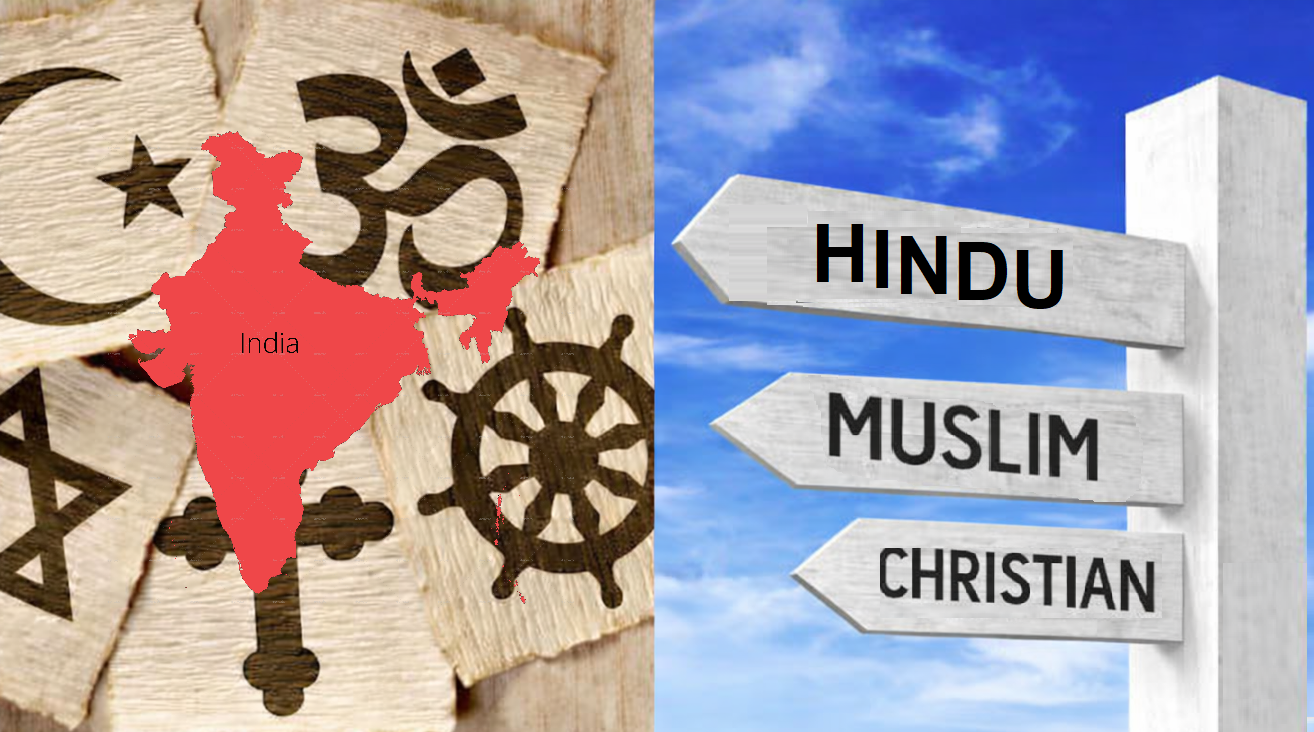
Projected Growth of Hindu Population in Various Countries by 2050 in Comparison to Others and the Indian Context: Based on Pew Research Findings.
~ Upananda Brahmachari
According to projections by the Pew Research Center, the global religious composition is expected to undergo measurable demographic changes by 2050. Hinduism is projected to remain the third-largest religion in the world, growing steadily in absolute numbers while maintaining a largely stable share of the global population.
The global Hindu population is estimated at around 1.2 billion in 2025 and is projected to reach approximately 1.4 billion by 2050, accounting for about 15% of the world’s population. This growth is primarily driven by natural population increase, rather than conversion or geographic expansion.
Earlier, the Pew report highlighted Hindu concerns and described Muslim population growth as outpacing other major religions, reshaping global and Indian demographics. The Census of India 2011 religious data also revealed that the Hindu population declined while the Muslim population increased.
The distribution of Hindus will remain highly concentrated in South Asia. India will continue to have the largest Hindu population, projected to reach nearly 1.3 billion by 2050. Nepal is expected to remain the second-largest centre, followed by Bangladesh, where Hindus will continue to form a significant minority. Pakistan is also projected to witness a gradual increase in its Hindu population in absolute terms.
Outside South Asia, Hindu population growth is expected to be driven mainly by migration. Countries such as the United States, Canada, United Kingdom and Australia are projected to witness steady increases in their Hindu populations due to immigration and higher growth rates among diaspora communities. In the Gulf region, including the United Arab Emirates and Saudi Arabia, Hindu populations are expected to remain sizeable but largely temporary, consisting primarily of expatriate workers.
In Southeast Asia, Indonesia and Malaysia will continue to have established Hindu communities, while countries such as Singapore and Thailand will maintain smaller but stable populations. Additionally, countries like Mauritius, Fiji and Guyana will continue to have Hindu populations that, while smaller in number, remain significant in terms of cultural and social presence.
In comparison with other major religions, Hinduism’s growth rate is moderate. Christianity is projected to remain the largest religion globally, increasing from approximately 2.5 billion in 2025 to about 2.9 billion by 2050, maintaining a relatively stable share of the global population. Islam is expected to be the fastest-growing religion, rising from around 2.0 billion to nearly 2.8 billion over the same period and approaching parity with Christianity by mid-century.
Buddhism is projected to remain largely stable at around 500 million globally, with a slight decline in its share of the world population due to lower fertility rates and ageing populations in key regions. Judaism, the smallest among the major religions, is expected to grow modestly from about 15 million to around 16–17 million, with most of its population concentrated in Israel and the United States.
Overall, these projections indicate that while Hinduism will continue to grow in absolute numbers, its global distribution will remain geographically concentrated, particularly in South Asia. The broader global trend suggests that religious change by 2050 will be driven primarily by demographic factors such as fertility rates, age structures and migration, rather than large-scale religious conversion.
📊 Top 30 Countries by Hindu Population (Descending Order)
(Figures in millions; 2025 vs 2050 projections)
| No. | Country | 2025 | 2050 |
|---|---|---|---|
| 1 | India | 1150 | 1297 |
| 2 | Nepal | 30 | 38 |
| 3 | Bangladesh | 15 | 18 |
| 4 | Pakistan | 4.5 | 5.63 |
| 5 | United States | 2.5 | 4.78 |
| 6 | Indonesia | 4.0 | 4.15 |
| 7 | Sri Lanka | 2.5 | 3.0 |
| 8 | Malaysia | 2.0 | 2.5 |
| 9 | United Arab Emirates | 0.9 | 1.2 |
| 10 | Myanmar | 1.5 | 2.0 |
| 11 | United Kingdom | 1.0 | 1.5 |
| 12 | Canada | 0.9 | 1.5 |
| 13 | South Africa | 1.2 | 1.8 |
| 14 | Australia | 0.7 | 1.2 |
| 15 | Saudi Arabia | 0.5 | 0.8 |
| 16 | Kuwait | 0.4 | 0.6 |
| 17 | Oman | 0.3 | 0.5 |
| 18 | Qatar | 0.3 | 0.4 |
| 19 | Mauritius | 0.6 | 0.8 |
| 20 | Fiji | 0.5 | 0.7 |
| 21 | Trinidad and Tobago | 0.3 | 0.5 |
| 22 | Guyana | 0.25 | 0.3 |
| 23 | Suriname | 0.15 | 0.2 |
| 24 | Singapore | 0.2 | 0.35 |
| 25 | Thailand | 0.1 | 0.2 |
| 26 | Bhutan | 0.6 | 0.7 |
| 27 | Germany | 0.1 | 0.2 |
| 28 | New Zealand | 0.08 | 0.15 |
| 29 | Japan | 0.05 | 0.1 |
| 30 | Russia | 0.05 | 0.1 |
📌 Notes
- Figures are approximate and based on demographic projections and migration trends
- Rankings reflect absolute population size, not percentage share
- South Asia, particularly India, continues to dominate the global Hindu population
📊 The Big Picture: 2025 vs 2050 (Population & Share)
- ✝️ Christianity: ~2.5 billion (31%) → ~2.9 billion (~31%)
- ☪️ Islam: ~2.0 billion (25%) → ~2.8 billion (~30%)
- 🕉️ Hinduism: ~1.2 billion (15%) → ~1.4 billion (~15%)
- ☸️ Buddhism: ~0.5 billion (6–7%) → ~0.5 billion (~5–6%)
- ✡️ Judaism: ~15 million (0.2%) → ~16–17 million (~0.2%)
🧭 Historical Context (1900–1980)
There was a time in the modern era when Hindus outnumbered Muslims
Around 1900–1920, the global Hindu population (~200–230 million) was roughly equal to or slightly higher than the Muslim population (~200 million), largely due to the concentration of Hindus in undivided India.
By the mid-20th century (~1950), Muslims had overtaken Hindus globally. This shift was primarily driven by higher fertility rates and population growth in regions such as Indonesia, Egypt and Turkey, rather than large-scale conversion.
Between 1950 and 1980, Muslim populations grew rapidly, while Hindu populations increased at a steady but comparatively slower rate, resulting in a widening gap.
In contemporary discourse, the demographic shift—where Hindus were once comparable in number to Muslims globally—has drawn attention in countries such as India and parts of Southeast Asia and Africa. Some sections of society attribute this change to factors such as differing fertility patterns, migration trends, and what they describe as socio-cultural dynamics, including ‘targeted religious conversion’ and interfaith relationships through ‘Love Jihad’, specially in India. These concerns are often debated in public and political narratives. However, most demographic research and global studies indicate that variations in population growth are primarily driven by differences in fertility rates, age structures, education levels, and economic conditions, rather than large-scale organised conversion. Additionally, lower fertility rates and smaller family sizes among Hindus are viewed as contributing to slower demographic growth of them.
🧾 Critical Concern
The long-term projections suggest that Hinduism will continue to grow in absolute numbers while maintaining a stable share of the global population. In contrast, Islam is expected to expand more rapidly, narrowing the gap with Christianity. The overall trend underscores the role of demographic dynamics—including population growth, migration, Sharia imposition, and, as debated in public discourse, factors such as religious conversion—as contributors to global religious change.
Post Script:
Hindus Still Ahead in the Global Order? Numbers, Nations, and the Question of Representation.
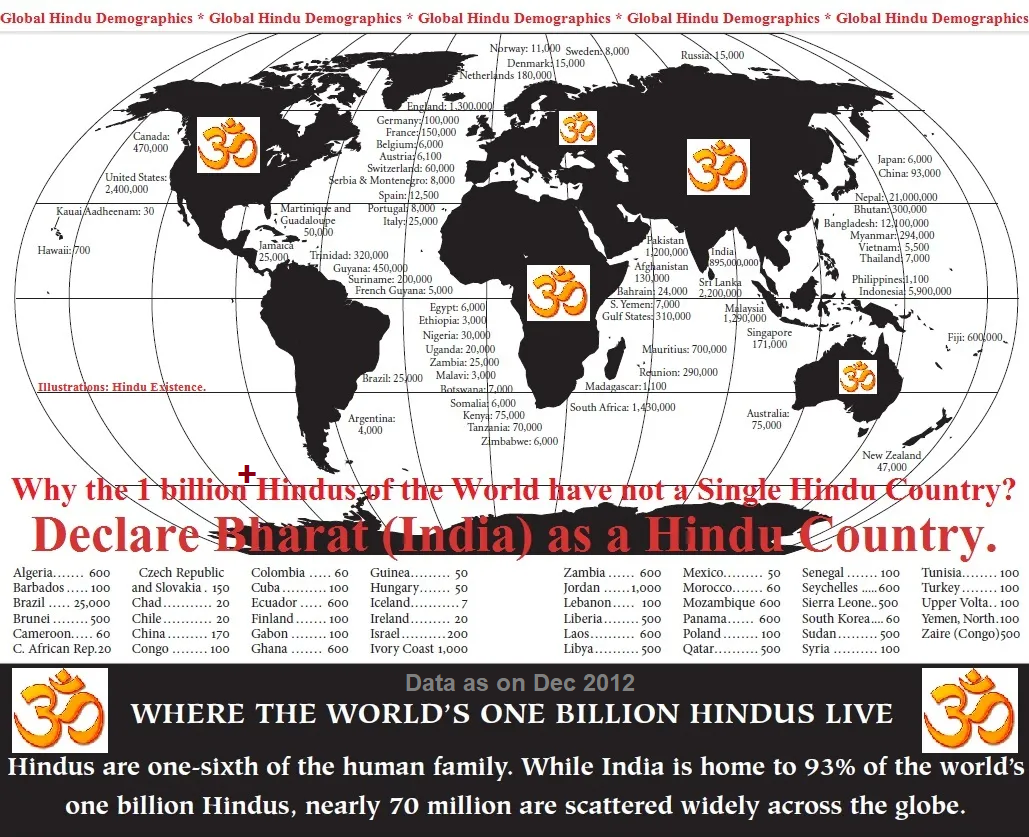
Are Hindus truly in the third position in terms of global population, or do Hindu-rooted traditions collectively occupy a far more prominent place in the world’s religious landscape? This question invites a broader reflection: why do more than one billion Hindus worldwide not have a clearly defined Hindu nation of their own?
If approximately 32% of the global population identifying as Christians are represented across 120 countries with Christian-majority populations, and around 23% Muslims are spread across 57 Muslim-majority countries, while roughly 7% Buddhists are associated with a dozen Buddhist-majority nations, and 0.2% Jews have a clearly defined national homeland in Israel, the contrast in the case of Hindus appears striking.
A further argument is often made that if one considers the broader spectrum of “India-rooted religions”—including Hindus (15%), Buddhists (7%), other Indic traditions such as Sikhs and Jains (around 1%), along with sections of the religiously unaffiliated who are culturally or philosophically connected to these traditions—the combined share may be viewed as significantly larger, potentially exceeding 35% of the global population. From this perspective, such a grouping could be seen as numerically larger than both Christianity and Islam.
Critics also argue that global classifications, including those presented by institutions such as the secretly funded Pew Research Center, tend to present these traditions as separate and fragmented categories. They contend that this framework may understate the broader civilizational continuum of Indian-origin religions under a holistic Hindu umbrella.
Within this line of thought, it is further argued that the historical and cultural identity of Aryavarta—Bharat or Hindusthan—is closely linked to its Hindu majority. Now, majority voices advocate that preserving this identity requires addressing concerns related to demographic change, including debates around conversion and religious balance, and envision the establishment of a state guided by Hindu philosophical principles.
From this perspective, the question is posed: if a substantial proportion of the global population is connected—directly or indirectly—to Hindu or Indic traditions, why does there remain a perceived absence of a formally defined Hindu nation-state? Why does this issue continue to be debated, and what explains the differing viewpoints surrounding it?
The need for a Cultural-Constitutional-&-Sovereign Hindu Rashtra is obviously relevant and justified.
___
Author can be contacted at upananda.br@gmail.com
…


 Struggle for Hindu Existence
[…] [Disclaimer: The content in this RSS feed is automatically fetched from external sources. All trademarks, images, and opinions belong…
Well done but to no effect
I wholeheartedly support the movement of ABVP
This is a common concern in almost all the states in India, as anti-Hindu, anti-Indian terrorist forces are very active…
In Manipur, India, kukis are training child terrotists, taught them to hate and kill the Indigenous people of Manipur.