
Struggle for Hindu Existence
*Hindu Rights to Survive with Dignity & Sovereignty *Join Hindu Freedom Movement to make Bharat Hindu Rashtra within this lifetime *Jai Shri Ram *Jayatu Jayatu Hindu Rashtram *Editor: Upananda Brahmachari.
‘What Are You Doing in a Hindu Area?’: Expulsion of Muslim Vendors Spark Debate in Gujarat.
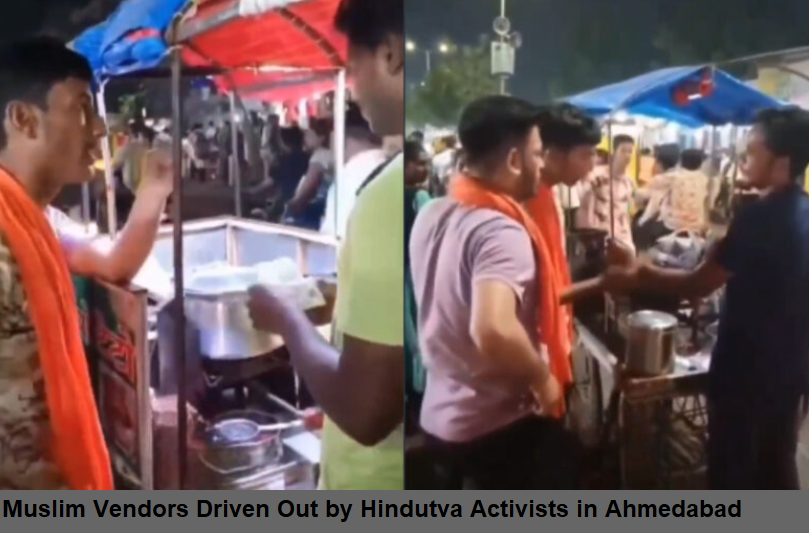
“Only Hindus Can Work Here”: Muslim Vendors Driven Out in Ahmedabad, Video Sparks Debate.
Subham Patel | HENB | Ahmedabad | April 12, 2026:: A video that surfaced on social media on Sunday has brought attention to an incident in Gujarat’s Ahmedabad, where Muslim street vendors were allegedly forced to leave a Hindu-dominated residential colony by individuals said to be associated with the Bajrang Dal.
According to reports, the incident occurred on April 8, but gained wider visibility after the video began circulating online days later.
The surge in anti-Hindu activities is provoking a backlash, with nationwide Hindu repercussions emerging as a consequence, targeting Muslims. Frustrated by alleged Muslim-led activities such as cow slaughter, Love Jihad, Land Jihad, Conversion Jihad, Halal Jihad, Economic Jihad, and Corporate Jihad, Hindu groups like Bajrang Dal, Hindu Jagran Manch, and Hindu Aikya Vedi are pushing back against perceived Islamic aggression. As a result, Hindus are taking measures to protect their communities, securing areas, temples, lands, women, cattle, and businesses, often by limiting interactions with Muslims.
Incident Details
The video shows a group of men, some wearing saffron scarves, approaching a street vendor and asking him to produce identification. Upon examining his Aadhaar card, they questioned him about his presence in the locality.
In the footage, the men can be heard asking in Hindi:
“Kya kar rahe ho bhai aap yahan? Aapka naam kya hai?” (“What are you doing here? What is your name?”)
When the vendor identified himself as Shahjahan, the questioning intensified. The men reportedly asked:
“Toh aap kya kar rahe ho Hindu mohalle mein?” (“So what are you doing in a Hindu area?”)
The vendor was subsequently told to leave the area, with a warning that only Hindus should work in Hindu localities.
The clip further shows similar interactions with other Muslim vendors, who were also reportedly instructed not to operate their stalls in the neighborhood.
Broader Context and Competing Narratives
The incident has sparked wider discussions around community relations, local security perceptions, and rising social tensions in different parts of the country.
Some groups and commentators interpret such actions as part of a broader reactionary trend, arguing that perceived or alleged anti-Hindu activities have contributed to growing mistrust. These narratives often reference issues such as cow slaughter, interfaith relationships, religious conversions, and economic competition, which are described by certain organizations using terms like “Love Jihad,” “Land Jihad,” and others.
Organizations such as the Bajrang Dal, Hindu Jagran Manch, and Hindu Aikya Vedi have, in various contexts, positioned themselves as responding to what they describe as threats to community identity, safety, and economic interests.
However, it is important to note that such claims are contested and debated, and critics argue that they can contribute to profiling, exclusion, and communal polarization, particularly when directed broadly at entire communities rather than specific individuals or verified incidents.
Similar Incidents Reported Elsewhere
The Ahmedabad incident is not isolated. Reports from multiple states indicate instances where street vendors, particularly Muslims, have been asked to disclose their identity or have faced restrictions in certain localities.
- In Ludhiana, Punjab, a Muslim band player was reportedly questioned about his “police verification” before being allowed to operate.
- In Rajasthan, a man named Salim and his associate were allegedly stopped by locals, questioned about their intentions, and temporarily prevented from working. Their keys were reportedly taken, and they were told to obtain verification documents before returning.
In one such exchange, a local resident reportedly said:
“Only if you have an identity card can you work in our village. If you ever get into trouble, how do we identify you? How do we know where you live?”
These incidents reflect a pattern in which informal local enforcement practices are emerging in certain areas, often centered around identity verification and community belonging.
Concerns Over Social Cohesion
Observers note that such developments may contribute to a widening social divide, particularly if communities begin to restrict interaction or economic participation based on religious identity.
Some analysts warn that mutual suspicion and localized exclusion practices could deepen existing fissures, making coexistence more difficult. Others argue that concerns over safety and accountability need to be addressed through formal legal and administrative mechanisms, rather than informal or community-driven enforcement.
The “Resistance” Context
The Ahmedabad incident underscores the complex and sensitive nature of communal relations in India, where local events can quickly gain national attention and feed into broader narratives.
While differing perspectives exist regarding the causes and justifications of such actions, the situation highlights the need for balanced dialogue, lawful processes, and efforts to maintain social harmony in increasingly diverse urban spaces.
In the aftermath of incidents such as the one reported in Ahmedabad, some Hindu organizations and local groups have characterized their actions as a form of “resistance” or “repercussion” to what they perceive as growing insecurity and targeted challenges.
According to these groups, their actions are driven by concerns over:
- Local safety including their women folk, elderly, children and identity preservation
- Allegations of Islamic practices like “Love Jihad,” “Land Jihad,” “Halal Jihad,” “Conversion,” “Cow Slaughter,” and others
- Perceived economic and cultural pressures within mixed localities
Within this narrative, organizations such as the Bajrang Dal, Hindu Jagran Manch, and similar groups present themselves as protective actors, asserting that they are safeguarding neighborhoods, religious spaces, and local economies.
Supporters of this viewpoint argue that:
- These actions represent a grassroots response rather than centrally coordinated campaigns
- Identity checks and restrictions are seen as preventive measures
- There is a perceived lack of adequate institutional response to their concerns
If communal Muslims and radical Islamic organisations fail to grasp the gravity of the situation and continue their anti-Hindu, anti-national activities, it may lead to Hindus distancing themselves from Muslim neighbours, deepening social divisions – an outcome that’s both inevitable and regrettable.
…
_Agency Inputs.


 Struggle for Hindu Existence
[…] Karnataka Police convene meeting of gym owners following protests against Love Jihad […]
[…] False Claim of Waqf Exposed in Pune, Maharashtra; Row Escalates in Karnataka’s Gokak […]
[…] NHRC seeks urgent report from J&K Police on ‘targeted’ Hindu killings. […]
[…] [Disclaimer: The content in this RSS feed is automatically fetched from external sources. All trademarks, images, and opinions belong…
Well done but to no effect