

[…] NHRC seeks urgent report from J&K Police on ‘targeted’ Hindu killings. […]

Struggle for Hindu Existence
*Hindu Rights to Survive with Dignity & Sovereignty *Join Hindu Freedom Movement to make Bharat Hindu Rashtra within this lifetime *Jai Shri Ram *Jayatu Jayatu Hindu Rashtram *Editor: Upananda Brahmachari.
A different Hinduism.
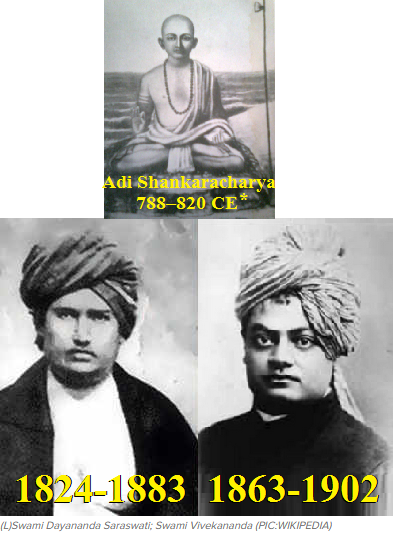
A differential of Hinduism as propounded by Adi Shankaracharya, Swami Dayananda and Swami Vivekananda.
Shaped by the unique historical challenges that marked different eras, its expression changed drastically over time….
By Devdutt Pattanaik.
Hinduism, as expressed by Adi Shankaracharya 1,200 years* ago, was very different from the Hinduism expressed by Swami Vivekananda and Swami Dayananda Saraswati around 150 years ago, because each one faced different challenges, though they did have many things in common
All three chose to live monastic, celibate lives, reflecting upon the nature of life, before communicating it to their followers. Shankaracharya forced his mother to give him permission to become an ascetic. Born Narendranath Datta, in an aristocratic household, Swami Vivekananda chose to be a monk. Dayananda Saraswati was engaged to be married, but he ran away before the nuptials.
Shankaracharya had a guru called Gaudapada, who lived in Central India, a monk strongly influenced by Mahayana Buddhism. Vivekananda’s guru, Ramakrishna Paramahansa, was a priest at a Kali temple, well-versed with Tantrik practices, and was familiar with other religions as well. Dayananda was a disciple of Virajanand Dandeesha, an expert in Sanskrit grammar and and Vedic hymns, who yearned for a return to the original way of the the rishis.
Shankaracharya had to deal with the popularity of Buddhism. Not Theravada Buddhism, the monastic order practised in Sri Lanka, which is popular in Vipassana, but Mahayana, Vajrayana and Tantrik Buddhism, which grant value to the female form. Buddha, in these schools, was visualised in ferocious forms such as Heruka, crushing Hindu deities, and copulating with yoginis and the deity Tara. Vivekananda and Dayananda, by contrast, had to face the hostility of colonial rulers and Christian missionaries, who saw Hinduism as barbaric and pagan.
Shankaracharya challenged the Buddhist way, but his writings showed many similarities between the Buddhist concept of ‘shunya’ and the Vedic concept of ‘Nirguna Brahman’. This led to accusations that he was actually crypto-Buddhist and was appropriating Buddhism within the Hindu fold. In the same way, like other 19th century reformers, Vivekananda and Dayananda were accused of appropriating Christian practices and giving them a Hindu packaging.
Shankaracharya, 1,200 years ago, did not have to deal with Indians emigrating out of the country and foreigners immigrating into the country. He took the caste system for granted. But nobody talked about converting into a particular caste. You didn’t become a member of a caste; you were born into a caste. He would not have understood the idea of conversion, which became prevalent and popular in the 19th century — with Hindus becoming Christians, Caucasians wanting to become Hindus, or Hindus living in America having to explain their faith to others. So, Shankaracharya does not write about purification, or shuddhikaran rituals, that Dayananda establishes to reconvert people back to Hinduism. Vivekananda takes the step of travelling abroad, which was shocking in those times, and introducing Vedanta to the West, reframing Hinduism in a way that wins the validation of colonial gaze. He articulates Hinduism in such a transcendental way, without sociological anchors, that it becomes a doctrine that even non-Hindus and non-Indians can adopt.
Another challenge that Shankaracharya faced (his work in this area is highly underappreciated) was the relationship between the Vedas and the Puranas. The Brahmins were divided internally, between those who practised the old ways of yagna and the new ways based on temple ritual. Shankaracharya is supposed to have done the initial groundwork of connecting the two. He is the one who connected both the formless idea of god (Nirguna Brahman) with the idea of god with form (Saguna Brahman). His appreciation of the Shaivism, Vaishnavism, Smarta and Sauri traditions indicates he was trying to bring them into a common fold. This is why most pilgrim spots in India are associated with Shankaracharya. Similar tensions existed in the 19th century. Dayananda was trying to find the real Hinduism in the Samhitas, i.e. the hymns of the Vedas. He rejected the Puranic and temple-based traditions completely. By contrast, Vivekananda respected temple-based traditions and instituted the worship of Kali as part of the Ramakrishna Mission. His meat-eating habit would have made Dayananda very uncomfortable.
Shankaracharya followed the Vedanta Path (Uttara Mimamsa), based on the Upanishads, and rejected the older method of enquiry based on rituals (Purva Mimamsa). This was much appreciated by Vivekananda. However, Dayananda saw greater value in the Vedic hymns themselves and not in Upanishads per se, and so gave greater importance to the recitation of mantras and the performance of fire rituals.
Shankaracharya worshipped the goddess Sharada, and was taught by the female scholar Ubhaya Bharati. Vivekananda worshipped Kali. From Shankaracharya’s time, education of women started being discouraged, even in elite circles. Its revival took place in schools established by the followers of Vivekananda and Dayananda.
[*Adi Shankaracharya 509–477 BCE as per Dwarika Peetham Rrecord; 44–12 BCE as per Commentary of Anandgiri; 788–820 CE as Accepted by Max Müller, Dr Radhakrishnan etc. ~ Ed. Hinduexistence Website.]
…
This article first published in Mumbai Mirror on January 19, 2020.
(Views expressed by the author may not be identical with the editorial team of Hinduexistence Website).
One comment on “A different Hinduism.”
Leave a comment


[…] [Disclaimer: The content in this RSS feed is automatically fetched from external sources. All trademarks, images, and opinions belong…
Well done but to no effect
I wholeheartedly support the movement of ABVP
This is a common concern in almost all the states in India, as anti-Hindu, anti-Indian terrorist forces are very active…


 Struggle for Hindu Existence
Why you have ignored the Dwaitha phylosophy of Madhvachaarya?
DRVRao
LikeLike