
Struggle for Hindu Existence
*Hindu Rights to Survive with Dignity & Sovereignty *Join Hindu Freedom Movement to make Bharat Hindu Rashtra within this lifetime *Jai Shri Ram *Jayatu Jayatu Hindu Rashtram *Editor: Upananda Brahmachari.
BJP’s Hindutva Gameplan in Tamil Nadu and West Bengal: A Calculated Risk.
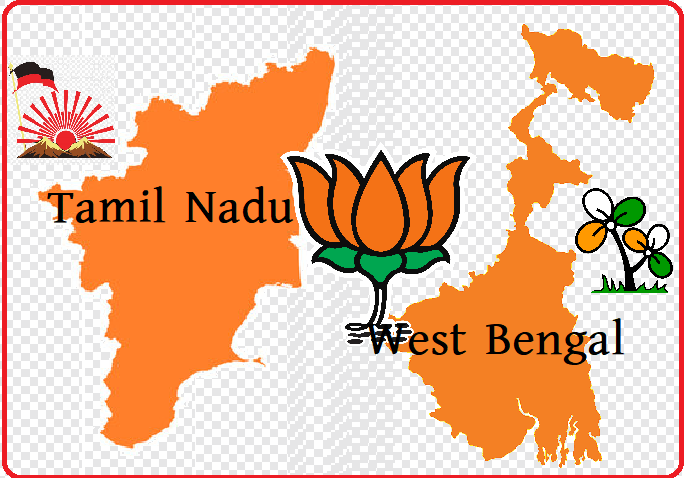
Hindutva Strategy of BJP Faces Conventional Barriers in Tamil Nadu and West Bengal.
By Upananda Brahmachari
Fresh from an emphatic victory in Bihar, the Bharatiya Janata Party (BJP) is entering the 2026 Assembly election cycle with renewed confidence. Yet two forthcoming contests—Tamil Nadu and West Bengal, both voting in April–May 2026—stand apart from the party’s familiar battlegrounds. These are states where regional identity, language, and political memory have historically acted as barriers against national parties, particularly those seeking to impose a uniform ideological framework.
Unlike the Hindi heartland, political power in Tamil Nadu and West Bengal has long been monopolised by entrenched regional forces. The Dravida Munnetra Kazhagam (DMK) and the Trinamool Congress (TMC) have not merely governed these states; they have shaped their political cultures. It is against this backdrop that the BJP is attempting to deploy its most potent electoral instrument—Hindutva.
Congress on the Margins, BJP on the Rise
The Congress, once a dominant national force, has been reduced to a peripheral player in both states. In Tamil Nadu, it has reconciled itself to a subordinate role within the DMK-led alliance. In West Bengal, its political footprint has all but vanished. Electoral disasters in the 2021 Assembly elections and the 2024 Lok Sabha polls, coupled with failed alliances with the Left Front, have left the party without leverage. Even within the Left, constituents such as the All India Forward Bloc and the Revolutionary Socialist Party have expressed resistance to further accommodation with Congress. The TMC, meanwhile, has made it clear that it has no interest in sharing political space.
The BJP, in contrast, has opted for confrontation rather than accommodation. Despite weak grassroots networks in Tamil Nadu and mixed fortunes in West Bengal, it is preparing for an aggressive campaign. In Bengal, the party draws confidence from the 2021 Assembly elections, where it won 77 of 294 seats and secured nearly 38 per cent of the vote share—enough to emerge as the principal Opposition, even though subsequent defections reduced its tally.
Symbolism and Strategy from the Top
Prime Minister Narendra Modi has already begun framing the Bengal contest in symbolic terms. Celebrating the Bihar mandate at the BJP headquarters in Delhi, he invoked the imagery of the Ganga flowing from Bihar to Bengal—suggesting a political momentum that could travel eastward. This was not rhetorical flourish alone. Union Home Minister Amit Shah has since moved to operationalise a Bengal-specific strategy, parts of which are already visible on the ground.
At the heart of this strategy lies Hindutva. Yet its record in both Tamil Nadu and West Bengal remains uneven. Nowhere are its limitations more apparent than in Tamil Nadu—a state where intense personal religiosity coexists with a political tradition shaped by rationalism, social justice movements, and linguistic pride.
Tamil Nadu: Faith, Provocation, and Resistance
The BJP’s renewed push in Tamil Nadu has unfolded amid sharp religious and political provocations. Senior DMK leaders have repeatedly attacked Sanatana Dharma, describing it as a social evil comparable to cancer, AIDS, and malaria. Although the DMK insists these remarks target caste oppression rather than Hindu faith, the language has triggered outrage well beyond the state and handed the BJP a ready-made narrative of cultural insult.
The party has sought to convert this discontent into mobilisation. The flashpoint came at Thiruparankundram Hill in Madurai district, home to the Subramanya Swamy temple—one of the six abodes of Lord Murugan—and located metres away from the Sultan Sikandar Avulia dargah. The controversy centred on the lighting of a ceremonial lamp during the Karthigai Deepam festival at the Deepathoon pillar, barely 15 metres from the dargah.
Though the ritual has historically passed without incident, a petition seeking permission to light the lamp at the pillar reignited tensions. While the Madurai Bench of the Madras High Court allowed the ritual, the district administration imposed prohibitory orders, enforced by the police. The BJP and its allies erupted in protest, portraying the move as state suppression of Hindu religious practice.
RSS chief Mohan Bhagwat entered the debate, remarking that the “awakening of Hindus” was sufficient to achieve the desired outcome—language widely interpreted as a call for sustained mobilisation. The DMK, however, remained unmoved. Congress MP Karti Chidambaram accused the BJP of misunderstanding Tamil Nadu’s cultural fabric, arguing that while the people are deeply religious, faith rarely translates into political mobilisation.
Underlying the DMK’s confidence is the enduring influence of Periyar E.V. Ramasamy and the anti-Hindu stance in the name of Self-Respect Movement. Periyar’s framing of Hinduism as a source of caste oppression—and his portrayal of Muslims as Dalits who converted to escape that hierarchy—continues to find acceptance among large sections of Tamil-speaking voters. This ideological legacy presents a formidable obstacle to Hindutva politics. “But, the Hindutva scenario in Tamil Nadu is rapidly changing.
West Bengal: Discontent, Contradictions, and Communal Signals
In West Bengal, the BJP sees opportunity in growing public dissatisfaction with the TMC after three consecutive terms in power. Allegations of corruption involving Mamata Banerjee’s close associates, everyday encounters with party musclemen, and public anger following the brutal rape and murder of a young doctor in a Kolkata hospital have all eroded the government’s moral authority. For many, the atmosphere recalls the coercive politics of the Left Front era.
Yet the BJP’s campaign in Bengal has been riddled with contradictions. Its aggressive focus on illegal migration has unsettled its own support base, particularly since available data suggests that Hindu migrants outnumber Muslim migrants in the state. The Election Commission’s Special Intensive Revision of electoral rolls added to anxieties, while the Delhi Police’s confusion of Bangla as a “Bangladeshi language” struck at the heart of Bengali cultural pride.
At the same time, the BJP has intensified its attack on what it calls the TMC’s unabated Muslim appeasement. Controversial remarks by TMC leaders likening Muslims to a “doodhel gai” (milch cow) and suggesting that their kicks were “acceptable” have been seized upon by the BJP as evidence of selective governance. The controversy deepened when expelled TMC MLA Humayun Kabir laid the foundation stone for a proposed “Babri Mosque” in Beldanga—a move widely viewed as deliberately provocative. Although the TMC formally distanced itself from Kabir, the episode reinforced the BJP’s polarisation narrative.
Mamata Banerjee has attempted to counter this by projecting herself as culturally inclusive—providing monthly stipends to Hindu priests, institutionalising the Durga Puja carnival, giving fabulous grants-in-aid to Durga Puja Committees, and establishing a magnificent Jagannath Temple in Digha. However, experience elsewhere suggests that symbolic religiosity rarely outmatches the BJP’s ideological messaging.
Recently, Bengal witnessed a huge Gita path programme in Brigade Parade Ground to heighten the BJP’s political Hindutva with a cover of dharmik upheaval.
The Limits of a One-Size-Fits-All Ideology
Tamil Nadu and West Bengal expose the limits of ideological uniformity in Indian politics. In contrast to the Hindi belt, where religious identity often overrides other markers, these states place language, culture, and historical memory at the centre of political belonging. Hindutva, powerful as it is, struggles to subsume these identities without resistance.
The BJP’s bet is clear: that the DMK’s aggressive anti-Sanatana rhetoric in Tamil Nadu and the TMC’s perceived minority appeasement in West Bengal have created a silent churn within Hindu electorates. Whether this discontent can be converted into decisive electoral gains remains uncertain.
The Road Ahead
The BJP’s Hindutva strategy in Tamil Nadu and West Bengal is a calculated risk. It may fracture long-standing political loyalties, but it could just as easily provoke backlash in states fiercely protective of their regional distinctiveness. The DMK and TMC remain dominant forces, yet both face vulnerabilities that did not exist a decade ago.
As the 2026 elections approach, the battle lines are unmistakably ideological. The question is not whether the BJP will make noise in Tamil Nadu and West Bengal—it already has—but whether that noise will translate into power in regions where history has rarely been kind to so-called ‘outsiders’.
Calculating all Hindutva aspects, BJP has the potential to gain in regional politics in both Tamil Nadu and West Bengal in the coming days.
In both cases, the blunt anti-Hindu programming in Tamil Nadu and West Bengal by the ruling parties will give a big push to fruitful Hindutva in favor of the BJP.
_____


 Struggle for Hindu Existence
I wholeheartedly support the movement of ABVP
This is a common concern in almost all the states in India, as anti-Hindu, anti-Indian terrorist forces are very active…
In Manipur, India, kukis are training child terrotists, taught them to hate and kill the Indigenous people of Manipur.
[…] FIR Filed after Hindus Object to Group of Muslims Breaking Ramzan Fast on Disputed Land in Pune […]
reconversion to Hinduism should be the primary goal of Hindu society today. Rest of the goals and actions of society…