

Wishing all success to his journey

Struggle for Hindu Existence
*Hindu Rights to Survive with Dignity & Sovereignty *Join Hindu Freedom Movement to make Bharat Hindu Rashtra within this lifetime *Jai Shri Ram *Jayatu Jayatu Hindu Rashtram *Editor: Upananda Brahmachari.
Exploring Their Continued Influence in Maharashtra Politics, Hindutva Organizations Force Government Rethink on Devasthan Inam Act.
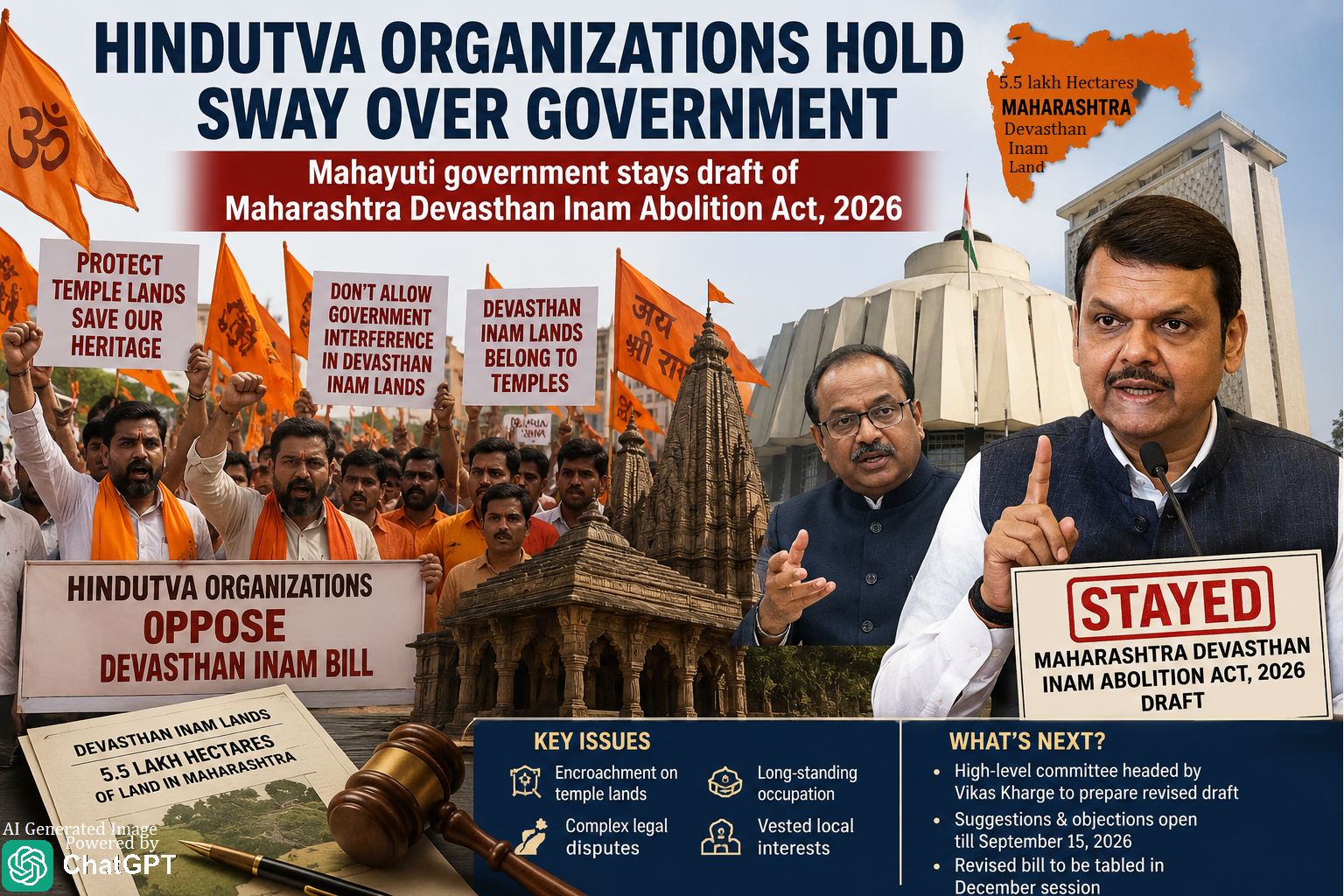
Hindutva Organizations Hold Sway Over Government: The Mahayuti government has stayed the draft of the proposed ‘Maharashtra Devasthan Inam Abolition Act, 2026’.
Upendra Bharti | HENB | Mumbai | June 8, 2026: The Maharashtra government’s decision to stay the draft of the proposed Maharashtra Devasthan Inam Abolition Act, 2026 has reignited debate over the influence wielded by Hindutva organizations in the state’s political and administrative affairs. While the Mahayuti government maintains that the move was prompted by public objections and administrative considerations, critics argue that sustained pressure from influential Hindu organizations played a decisive role in forcing the government to retreat.
The episode has once again highlighted the complex power structure operating within Maharashtra’s ruling alliance. On paper, the Bharatiya Janata Party (BJP), led in the state by Chief Minister Devendra Fadnavis, remains the dominant force in the Mahayuti coalition. Yet political observers often point to the existence of additional, less visible centers of influence, including the BJP’s national leadership in New Delhi and the ideological ecosystem centered around Nagpur, headquarters of the Rashtriya Swayamsevak Sangh (RSS).
The controversy surrounding the Devasthan Inam legislation has provided a fresh example of how these ideological and organizational networks can shape public policy.
Government Retreat After Intensifying Opposition
The draft legislation was intended to address issues relating to Devasthan Inam lands—properties historically granted to temples and religious institutions. However, soon after the proposal was released for public feedback, opposition emerged from several Hindu organizations, including the Vishwa Hindu Parishad (VHP), Hindu Janajagruti Samiti, and Maharashtra Mandir Mahasangha.
Rather than subsiding, resistance intensified over the following weeks. Protest campaigns, public meetings, and coordinated objections transformed the issue into a direct confrontation between the state government and prominent Hindutva groups. As the agitation gained momentum, speculation grew within political circles that influential ideological quarters were closely monitoring developments.
Against this backdrop, Revenue Minister Chandrashekhar Bawankule announced that the government would stay the draft legislation. The decision was widely interpreted as a significant victory for the organizations opposing the bill.
For many observers, the speed with which the government responded stood in sharp contrast to its handling of demands raised by farmers, unemployed youth, government employees, and various social movements. While such groups often wait months—or even years—for meaningful responses, the concerns raised by Hindutva organizations appeared to receive immediate attention.
Minister Denies Political Pressure
Minister Bawankule has rejected suggestions that the government’s decision was politically motivated.
According to him, the draft bill was placed in the public domain between May 6 and June 5, 2026, specifically to invite suggestions and objections. During this period, the government reportedly received a large number of representations from stakeholders. He stated that confusion had arisen among certain sections of society regarding the implications of the proposed law, making it necessary to halt the process temporarily.
The minister insists that the decision was purely administrative and aimed at ensuring broader consultation before any final legislation is introduced.
However, political analysts note that the strongest and most visible opposition came from Hindutva organizations. Their aggressive campaign against the proposal has led many to question whether public consultation alone explains the government’s sudden reversal.
The controversy therefore raises a broader question: Was the stay simply the result of democratic feedback, or did ideological pressure from influential organizations ultimately shape the government’s decision?
High-Level Committee to Prepare Revised Draft
Seeking to defuse the controversy, the government has constituted a high-level committee headed by Vikas Kharge, Additional Chief Secretary of the Revenue Department.
The committee has been tasked with preparing a revised draft of the legislation after examining objections and recommendations submitted by citizens, temple authorities, and other stakeholders. The consultation process will remain open until September 15, 2026.
Government sources indicate that the revised bill is expected to be presented during the winter session of the Maharashtra Legislature in December.
Officials hope that a broader consultative process will reduce tensions and produce a framework acceptable to both temple administrations and affected landholders.
Why Devasthan Inam Lands Matter
At the heart of the dispute lies a vast and historically significant landholding issue.
Maharashtra is estimated to have approximately 5.5 lakh hectares of Devasthan Inam land. These lands were granted to temples and religious institutions over centuries, including during the period associated with Chhatrapati Shivaji Maharaj and subsequent regional rulers.
According to temple representatives and government officials, substantial portions of these lands have gradually come under unauthorized occupation or disputed ownership. Many temple trusts claim they have struggled for decades to regain control over properties that were originally endowed for religious and charitable purposes.
The Revenue Department has argued that stronger legal protections are necessary to safeguard temple assets and prevent further encroachments. Officials have suggested that the objective is to create a framework for temple lands comparable to legal protections available to properties managed by the Waqf Board.
Yet the issue remains politically and legally sensitive. In many cases, families and communities have occupied such lands for generations, creating complex questions regarding tenancy rights, ownership claims, and potential displacement. Local political interests and economic considerations further complicate the matter.
Political Implications Beyond the Bill
Beyond the legal and administrative aspects, the controversy carries significant political implications.
The government’s decision to stay the draft legislation has reinforced perceptions that Hindutva organizations continue to possess considerable influence within Maharashtra’s ruling establishment. While elected ministers formally hold executive authority, the episode suggests that organized ideological groups retain the ability to shape policy outcomes, particularly on issues involving religion, cultural identity, and temple administration.
For supporters of these organizations, the government’s decision demonstrates responsiveness to public concerns and the importance of protecting religious institutions. Critics, however, view the development as evidence that ideological pressure can outweigh broader administrative objectives.
Regardless of interpretation, the Devasthan Inam controversy has sent a clear political message: Hindutva organizations remain a powerful force in Maharashtra’s public life, capable of mobilizing support, influencing political discourse, and compelling the government to reconsider its position when their interests are perceived to be at stake.
As the Kharge Committee begins work on a revised draft, attention will now shift to whether the government can balance competing claims over temple lands while avoiding another confrontation with influential organizations that have once again demonstrated their political weight.
..
_Agency Inputs.
One comment on “Exploring Their Continued Influence in Maharashtra Politics, Hindutva Organizations Force Government Rethink on Devasthan Inam Act.”
Leave a Reply

[…] Hindu Ekta Rath Yatra 3.0 has been announced under Bageshwar Dham’s Dhirendra Shastri as a 500-km mobilisation through five…
[…] On 10 October 2026, West Bengal Chief Minister Suvendu Adhikari gave CPM leader Bikash Bhattacharya …. That establishes the…
[…] concrete case shows why precision matters. On 9 October 2026, Hindu protesters in the Dum Dum area were reported…
[…] Gwalior, Bajrang Dal held a Trishul Diksha ceremony followed by a bike rally, with participating youth pledging to uphold…


Pingback: Maharashtra Halts Devasthan Inam Abolition Draft: Inside Stakeholder Pushback and the Road Ahead – DharmaRenaissance Blog