

[…] 14 October 2026, Anand Dubey resigned from Shiv Sena (UBT), citing ideological differences and sayin… Two facts therefore stand…

Struggle for Hindu Existence
*Hindu Rights to Survive with Dignity & Sovereignty *Join Hindu Freedom Movement to make Bharat Hindu Rashtra within this lifetime *Jai Shri Ram *Jayatu Jayatu Hindu Rashtram *Editor: Upananda Brahmachari.
Demographic Alarm Bells Ring as Natural Growth Turns Negative for Hindus and Christians in Kerala.
Kerala’s Demographic Turning Point: Deaths Now Outnumber Births Among Hindus and Christians.
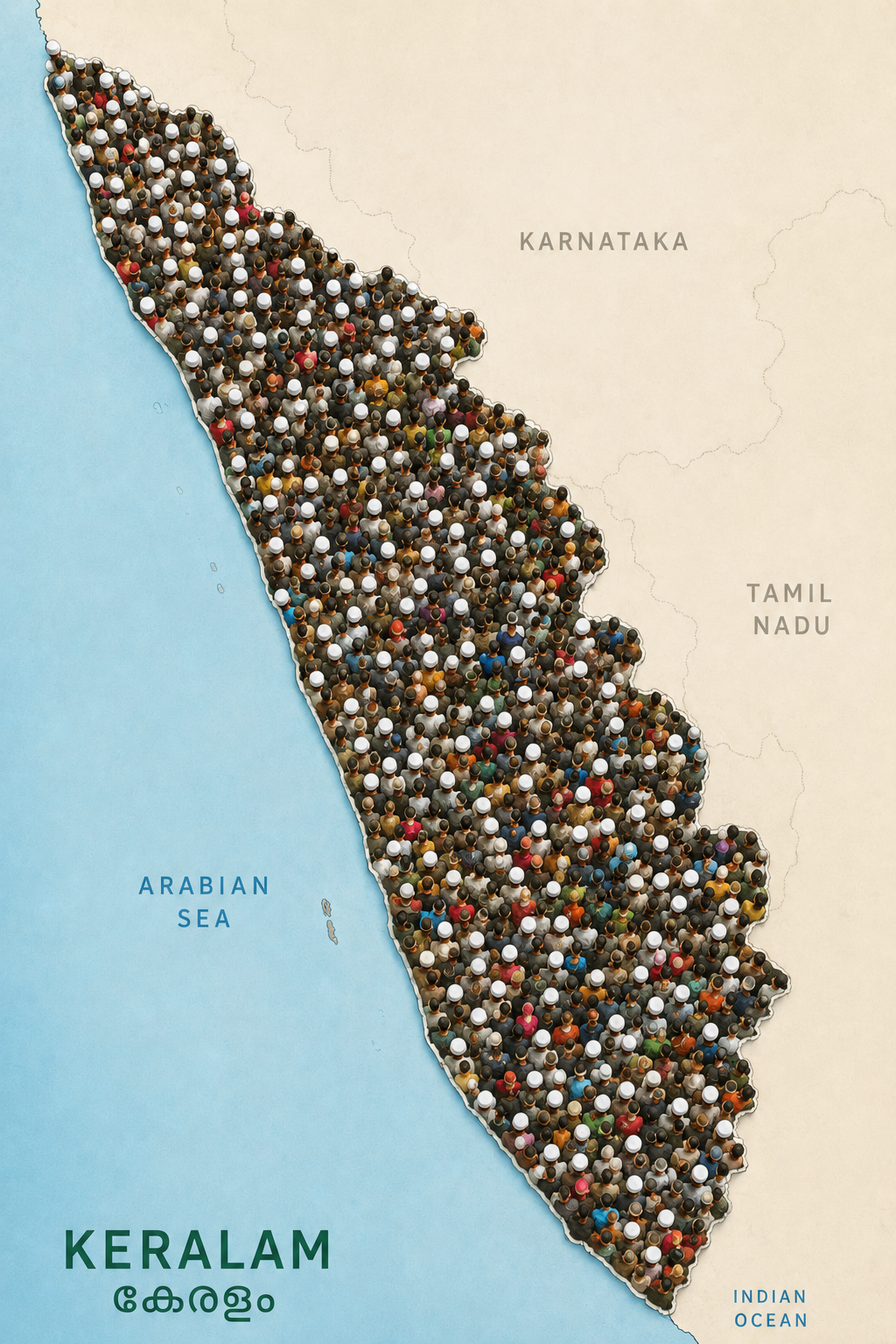 B Upendran | HENB | Thiruvananthapuram | June 12, 2026:: Kerala, long regarded as India’s demographic frontrunner, has entered a new phase of population transition. For the first time in the state’s modern demographic history, two of its largest religious communities—Hindus and Christians—are experiencing sustained negative natural population growth, with deaths exceeding births annually.
A detailed analysis of Kerala’s Vital Statistics Reports between 2014 and 2023 reveals a profound transformation underway. While the state’s total population continues to grow naturally, that growth is increasingly dependent on one community alone: Muslims. Even there, however, demographic experts caution that birth rates are declining steadily and the community is moving along the same trajectory, albeit at a slower pace.
The findings underscore a broader reality confronting Kerala: an ageing society, shrinking family sizes, and a future in which population decline may become the norm rather than the exception.
A Historic Demographic Shift
Natural Growth Rate (NGR)—the difference between births and deaths in a population—has traditionally remained positive across Kerala’s major communities. A positive NGR indicates that births outnumber deaths, allowing a population to replace itself and grow without relying on migration.
That pattern has now changed.
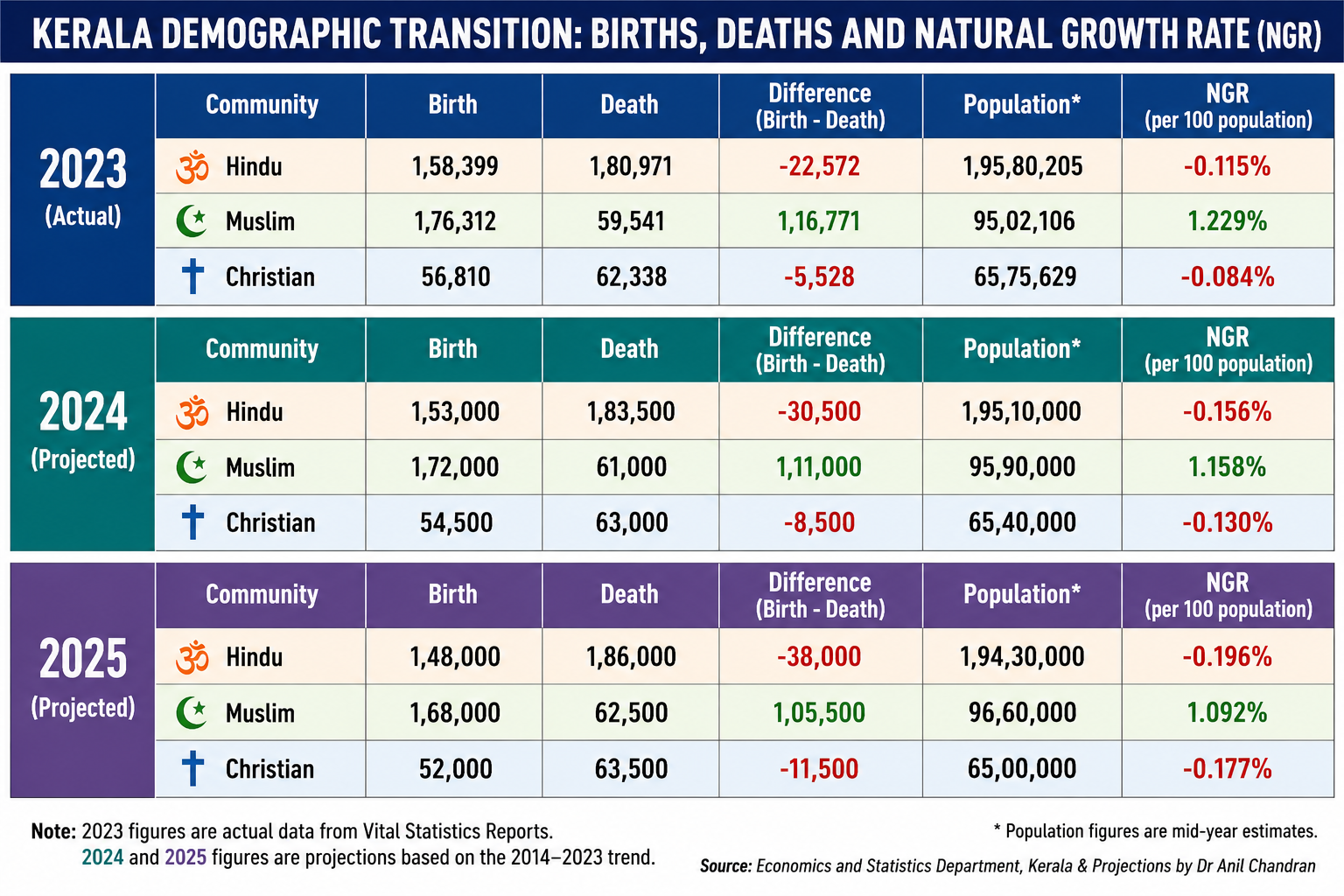
In 2023, Kerala’s overall NGR stood at 0.249 percent, remaining positive only because births among Muslims significantly exceeded deaths. However, both Hindus and Christians recorded negative rates.
For Hindus, the NGR fell to -0.115 percent, marking the second consecutive year of decline after crossing into negative territory for the first time in 2022. Christians recorded an NGR of -0.084 percent, extending a trend that began in 2021.
The figures mean that, within these communities, more people died than were born during the year.
While the percentages may appear small, demographers emphasize that the significance lies not in the size of the numbers but in the direction of the trend. Once a community consistently enters negative natural growth, reversing the process becomes increasingly difficult.
The Numbers Behind the Trend
The decade-long data reveal a dramatic fall in births across all three major communities.
Among Hindus, annual births dropped from 231,031 in 2014 to 158,399 in 2023, representing a decline of nearly one-third. At the same time, deaths increased from 150,159 to 180,971.
The Christian community witnessed a similar pattern. Births declined from 83,616 to 56,810, while deaths rose from 50,095 to 62,338.
Muslims also experienced falling birth rates, though their demographic balance remains positive. Births declined from 218,437 in 2014 to 176,312 in 2023. Deaths rose from 46,468 to 59,541 over the same period.
The result is a narrowing gap between births and deaths across all communities, though the pace varies considerably.
 2024 and 2025: A Warning Sign for the State
While the projected figures for 2024 and 2025 are not official government statistics, they reinforce a clear message emerging from the decade-long data: Kerala’s demographic slowdown is no longer a future concern but a present reality.
If current trends continue, Hindu and Christian communities will see deeper natural population decline over the next two years, while Muslim growth will continue to slow. The state’s overall natural growth rate, although still positive, is expected to narrow further.
Researchers estimate that Kerala’s population growth through natural increase could turn negative around 2041, making it one of the first major Indian states to enter a phase where deaths consistently outnumber births across the entire population.
For policymakers, the challenge is shifting from managing population growth to preparing for population ageing and eventual decline. The demographic story unfolding in Kerala today may offer a preview of what many other Indian states could face in the decades ahead.
Why Is This Happening?
Kerala’s demographic transformation did not emerge suddenly. Experts describe it as the culmination of trends that have been developing for decades.
The state has long been recognized for achieving demographic indicators comparable to many developed countries. High literacy, widespread access to healthcare, greater participation of women in education, and lower infant mortality rates have all contributed to smaller family sizes.
As educational attainment rose and economic aspirations changed, families increasingly chose to have fewer children. Delayed marriages, rising living costs, urbanization, and changing social attitudes toward family planning accelerated the process.
According to demographer Dr. Anil Chandran S. of the University of Kerala, the decline first became visible among socially and economically advanced sections of society before gradually spreading across wider population groups.
The current negative growth among Hindus and Christians is therefore not an isolated phenomenon but the latest stage of a demographic transition that began decades ago.
The Emergence of an Ageing Society
One of the most significant consequences of declining birth rates is population ageing.
As fewer children are born and life expectancy rises, the proportion of elderly people increases. Kerala already has one of the oldest populations in India, and the trend is expected to intensify in the coming decades.
An ageing society faces a unique set of challenges:
- Greater demand for healthcare and geriatric services.
- Increased pension and social welfare burdens.
- Shrinking working-age populations.
- Growing dependency ratios, where fewer workers support more retirees.
- Potential labour shortages in key sectors.
Experts warn that communities experiencing negative growth first are likely to confront these challenges earlier and more intensely.
Muslims Remain Positive—But Not Immune
While public discussions often focus on differences between communities, demographic experts caution against interpreting current figures as evidence of permanently divergent trends.
The Muslim community remains the only major group in Kerala where births substantially exceed deaths. However, its natural growth rate has also declined significantly over the past decade.
Between 2014 and 2023, the Muslim NGR fell by approximately 35 percent, from 1.898 percent to 1.229 percent.
This decline suggests that the same forces shaping fertility behavior among Hindus and Christians—education, urbanization, healthcare access, and economic change—are increasingly influencing Muslim families as well.
Demographers therefore view the current differences as largely a matter of timing rather than direction.
Looking Ahead to 2041
Perhaps the most consequential projection emerging from the analysis concerns Kerala’s future as a whole.
Researchers estimate that the state’s overall natural growth rate could turn negative by around 2041. If that occurs, Kerala would become one of the first large Indian states where deaths consistently exceed births across the entire population.
Such a development would represent a landmark moment in India’s demographic evolution.
Population decline does not necessarily imply economic decline. Several developed societies have experienced low or negative population growth while maintaining high living standards. However, managing such a transition requires significant policy adjustments, including investments in elderly care, workforce productivity, healthcare infrastructure, and migration management.
A Glimpse of India’s Future?
Kerala has often served as a demographic bellwether for the rest of the country. The state was among the first to achieve replacement-level fertility, among the first to experience rapid population ageing, and now among the first to approach negative natural growth.
What is unfolding in Kerala today may offer an early glimpse of demographic patterns that other Indian states could encounter in the decades ahead as fertility rates continue to decline nationwide.
For now, the state’s population remains on the positive side of growth. Yet the latest figures suggest that Kerala has crossed an important threshold. The debate is no longer about how quickly the population is growing, but about how a society prepares for a future in which growth itself may no longer be guaranteed.
…
_Agency Inputs.
One comment on “Demographic Alarm Bells Ring as Natural Growth Turns Negative for Hindus and Christians in Kerala.”
Leave a Reply

[…] 13 October 2026, multiple complaints were reported against CPI(M) leader and advocate Bikash Ranjan Bhattacharya in W…. The complainants…

[…] a reactionary state. This is worrying. Already, Hindu radicals have occupied public discourse and have won favours from some…
no you are a fool
Wishing all success to his journey


Pingback: Kerala’s Demographic Crossroads: Natural Growth Turns Negative for Hindus and Christians – DharmaRenaissance Blog