

[…] The disputed words were reported as the slogan ‘Hindutva Murdabad.’ […]

Struggle for Hindu Existence
*Hindu Rights to Survive with Dignity & Sovereignty *Join Hindu Freedom Movement to make Bharat Hindu Rashtra within this lifetime *Jai Shri Ram *Jayatu Jayatu Hindu Rashtram *Editor: Upananda Brahmachari.
Constitutional Freedom, Legal Accountability, and the Politics of RSS Registration.
The RSS and the Law: Constitutional Freedom, Legal Accountability, and the Politics of Registration.
Upananda Brahmachari
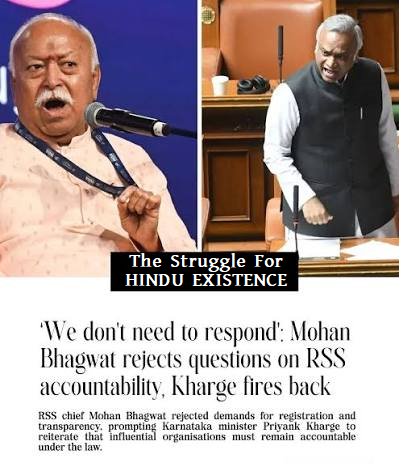
The controversy surrounding Karnataka Home Minister Priyank Kharge’s letter to Rashtriya Swayamsevak Sangh (RSS) chief Mohan Bhagwat has reignited a long-standing debate over the legal status of one of India’s oldest and most influential socio-cultural organisations. More than a political exchange, the episode raises important constitutional and legal questions about the nature of voluntary associations, the limits of State authority, and the balance between freedom of association and public accountability.
At the same time, the controversy has evolved into a larger ideological contest between the Congress and the Sangh Parivar, reflecting the continuing clash between constitutional politics, cultural nationalism, and electoral strategy.
The Background
On June 13, 2026, Karnataka Home Minister Priyank Kharge addressed a detailed letter to RSS chief Mohan Bhagwat seeking clarification on the organisation’s legal status. The letter requested the RSS to disclose:
- Its legal status and constitutional basis for functioning.
- Details of its office-bearers.
- Financial statements and sources of funding.
- Information regarding movable and immovable assets.
- Income-tax compliance.
- Permissions obtained for public meetings, route marches and other activities.
- The legal grounds on which an organisation of such magnitude continues to function without formal registration.
The letter further urged the RSS to register itself under an appropriate legal framework and to depute authorised representatives to explain its organisational structure.
Although drafted in the language of a legal notice, the communication was simultaneously released on social media, making it both a legal inquiry and a political statement.
The Central Legal Question
The primary legal issue is straightforward:
Can the RSS be compelled under existing Indian law to register itself or respond to such a letter?
The answer, under the present legal framework, appears to be No.
India presently has no general law requiring every voluntary association to obtain registration merely because people have chosen to organise themselves around a common objective.
The Karnataka Societies Registration Act, 1960, like similar legislation across India, is an enabling statute rather than a compulsory one. Registration provides an association with legal personality and various procedural advantages, but non-registration does not automatically render an organisation illegal.
Moreover, Priyank Kharge’s letter itself carries no statutory force. It cites no legal provision requiring compliance, identifies no investigating authority, and alleges no specific violation of law. Consequently, the RSS is legally entitled to decline registration and is equally entitled not to respond to the letter.
Constitutional Protection Under Article 19(1)(c)
The strongest legal foundation supporting the RSS’s position lies in Article 19(1)(c) of the Constitution of India, which guarantees every citizen the fundamental right to form associations and unions.
This constitutional guarantee recognises that citizens may organise themselves voluntarily without requiring prior approval or registration by the State.
The Constitution protects the freedom to associate—not merely the freedom to create formally incorporated entities.
Therefore, the mere absence of registration cannot be equated with illegality.
Freedom Does Not Mean Immunity
However, constitutional freedom does not place any organisation beyond the reach of law.
Article 19(1)(c) protects the right to associate but does not create a legally immune enclave.
Every association—registered or otherwise—remains subject to laws enacted within the legislative competence of Parliament or State Legislatures. These include laws relating to:
- Income tax.
- Labour welfare.
- Property ownership.
- Public order.
- Criminal liability.
- Information disclosure where legally authorised.
- Foreign funding.
- Regulatory compliance.
Consequently, the RSS cannot claim exemption from taxation, financial scrutiny, criminal investigation, or regulatory oversight merely because its apex body remains unregistered.
Legal Status of an Unregistered Association
RSS chief Mohan Bhagwat has dismissed demands for the Rashtriya Swayamsevak Sangh (RSS) to formally register, calling the calls political gimmicks. He stated the organization functions openly, is officially recognized as a body of individuals, and does not require registration unless seeking government funds.
Legally speaking, an unregistered association is simply a body of individuals united by a common purpose.
Such an association ordinarily lacks an independent legal personality.
As a consequence:
- It cannot own property in its own name.
- It cannot enter contracts as a separate legal entity.
- It cannot ordinarily sue or be sued in its own name.
Instead, its affairs are managed through trustees, registered societies, trusts, or representative office-bearers.
According to senior RSS leader Ram Madhav, this is precisely how the Sangh operates. While the central organisation remains an informal voluntary association, its schools, educational institutions, service organisations, charitable activities and properties are administered through legally registered trusts and societies.
Nothing in Indian law prohibits such an arrangement.
Income Tax Obligations
Remaining unregistered does not exempt any organisation from taxation.
The Income Tax Act expressly defines a “person” to include:
“an association of persons or body of individuals, whether incorporated or not.”
Thus, liability depends upon the nature of income and statutory exemptions—not upon registration.
If taxable income exists, tax liability follows irrespective of registration.
Foreign Contributions
The position is considerably stricter regarding foreign funding.
Under the Foreign Contribution (Regulation) Act, 2010 (FCRA), registration or prior governmental permission is mandatory before receiving foreign contributions.
Therefore, an unincorporated apex organisation cannot lawfully receive foreign funds in its own name.
Any foreign-funded activities must necessarily be conducted through legally registered entities possessing valid FCRA approval.
Public Processions and Law and Order
The State unquestionably possesses authority to regulate public order.
Route marches, rallies and public gatherings organised by the RSS are governed by provisions of the Karnataka Police Act and related public-order legislation.
Authorities may regulate:
- Routes.
- Timing.
- Crowd management.
- Security arrangements.
- Temporary restrictions where public safety so requires.
However, permission cannot lawfully be denied solely because the parent organisation remains unregistered.
Restrictions must be based upon objective considerations concerning public peace and safety rather than organisational status.
Why the “Hinduism Is Not Registered” Analogy Fails
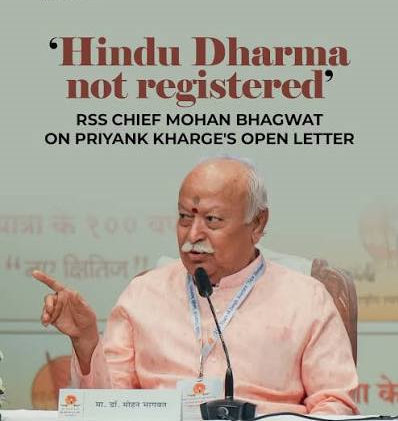 Some RSS supporters have argued that asking the RSS to register is akin to asking Hinduism itself to register.
Legally, this comparison is unsustainable.
Hinduism is a religion—a body of beliefs, practices and traditions—not an organisation possessing office-bearers, constitutions, financial accounts or administrative headquarters.
Institutions managing religious affairs—temples, trusts, mutts and charitable bodies—are, however, routinely registered and regulated under various laws.
The RSS itself describes its organisational framework through a written constitution, office-bearers, defined administrative structures and nationwide coordination.
Therefore, unlike a religion, it is capable in principle of being regulated as an association.
Moreover, the RSS does not regard Hindu as an “ism” or merely a ‘practice of Dharma’. Rather, it describes Hindu as a way of life. Therefore, comparing Hindu Dharma with the RSS on the issue of registration is nothing but a double standard.
Can Karnataka Make Registration Mandatory?
Yes.
The Karnataka Legislature possesses legislative competence under Entry 32 of the State List to regulate societies and unincorporated associations.
Accordingly, the State may enact a law requiring specified categories of organisations to:
- Register.
- File annual disclosures.
- Maintain financial transparency.
- Report office-bearers.
- Submit compliance reports.
However, such legislation must satisfy constitutional requirements under Articles 14 and 19.
A law directed exclusively against the RSS would almost certainly fail constitutional scrutiny.
A neutral law applicable to all similarly situated organisations, irrespective of ideology or religion, would stand on considerably stronger constitutional footing.
Beyond Law: The Political Contest
While the legal questions are relatively clear, the political implications are considerably more complex.
Priyank Kharge’s letter appears to be part of a broader ideological strategy pursued by sections of the Congress Party to challenge the RSS through constitutional discourse rather than merely through electoral rhetoric.
By invoking constitutional morality, transparency and legal accountability, the Congress seeks to distinguish itself from the ideological framework of Hindutva.
Yet this strategy also carries risks.
If the courts ultimately affirm that the RSS is legally entitled to remain unregistered under existing law, the political campaign could lose much of its legal force.
Moreover, the Congress has yet to articulate an equally compelling cultural narrative capable of challenging the civilisational appeal that the BJP-RSS ecosystem has cultivated over several decades.
The BJP-RSS Relationship
Another assumption underlying the controversy is that weakening the RSS necessarily weakens the BJP.
History suggests the relationship is considerably more nuanced.
Former Prime Ministers Atal Bihari Vajpayee and Narendra Modi have both demonstrated significant political autonomy despite their ideological roots in the RSS.
Statements made over the years by senior BJP leaders, including J.P. Nadda and Amit Shah, have repeatedly emphasised the organisational independence of the BJP.
Similarly, historical debates within the Jana Sangh also reflected disagreements regarding the extent of RSS influence over political decision-making.
Thus, any attempt to equate criticism of the RSS with political damage to the BJP oversimplifies a relationship that has evolved over decades.
Questions of Political Consistency
Critics of the Congress argue that its demand for transparency appears selective.
Several Christian, Muslim and other socio-religious organisations functioning across India have similarly escaped comparable political scrutiny regarding registration, governance or institutional transparency.
If transparency is indeed the objective, many observers contend that identical legal standards should apply uniformly to every organisation irrespective of religion, ideology or political affiliation.
Selective constitutionalism risks weakening the moral authority of any campaign for legal reform.
The Way Forward
The present controversy ultimately exposes a gap in Indian regulatory law rather than proving wrongdoing by either side.
Under existing law:
- The RSS is legally entitled to remain unregistered.
- It remains fully subject to taxation, criminal law, public-order regulation and financial scrutiny.
- It cannot claim immunity merely because it lacks formal registration.
- Equally, governments cannot compel registration without statutory authority.
If Parliament or State Legislatures believe that large voluntary organisations exercising significant public influence should maintain greater transparency, the appropriate constitutional course is not selective correspondence but comprehensive legislation applicable equally to all organisations.
Conclusion
The debate over the RSS is not merely about registration; it concerns the relationship between constitutional liberty and institutional accountability.
Priyank Kharge’s letter has undoubtedly succeeded in provoking a national discussion. Legally, however, its demand for compulsory registration rests on uncertain foundations under the existing statutory framework.
At the same time, the RSS would also benefit from recognising that legal permissibility and public confidence are not always identical. Voluntary disclosure of organisational structure, financial governance and institutional accountability could strengthen public trust without compromising constitutional freedoms.
Ultimately, transparency should not become a weapon against one organisation alone, nor should constitutional freedoms become a shield against legitimate public accountability. A uniform legal framework applicable to every voluntary association—irrespective of religion, ideology or political affiliation—would best uphold both the spirit of the Constitution and the principle of equality before the law.
The controversy should therefore serve not as an occasion for partisan confrontation, but as an opportunity for institutional introspection. The RSS leadership may consider addressing the concerns raised by clarifying its organisational and legal framework voluntarily, thereby dispelling public doubts and reinforcing confidence in its functioning. Equally, governments must ensure that any future regulatory framework is even-handed, constitutionally sound, and free from ideological selectivity. Only then can transparency, accountability and constitutional liberty coexist in a manner consistent with India’s democratic values.
The patriotism and service to the motherland demonstrated by the RSS since its inception in 1925 are unquestionable. Undoubtedly, it is the world’s largest cadre-based volunteer organisation. Therefore, the question of registering the RSS should not become a political slugfest or a bone of contention like many other issues confronting the nation.
..
The author can be reached at upananda.br@gmail.com
3 comments on “Constitutional Freedom, Legal Accountability, and the Politics of RSS Registration.”
Leave a Reply

[…] 14 October 2026, Anand Dubey resigned from Shiv Sena (UBT), citing ideological differences and sayin… Two facts therefore stand…
[…] 13 October 2026, multiple complaints were reported against CPI(M) leader and advocate Bikash Ranjan Bhattacharya in W…. The complainants…

[…] a reactionary state. This is worrying. Already, Hindu radicals have occupied public discourse and have won favours from some…
no you are a fool


Pingback: RSS Registration Debate: A Powerful Test of Freedom, Transparency, and the Rule of Law – DharmaRenaissance Blog
Very elaborately discussed the details
LikeLike
Pingback: RSS Registration and the Constitutional Limits of Regulation – DharmaRenaissance Blog