

[…] clearest lesson from the Madras High Court is narrow but important: a return to Hinduism must be established through…

Struggle for Hindu Existence
*Hindu Rights to Survive with Dignity & Sovereignty *Join Hindu Freedom Movement to make Bharat Hindu Rashtra within this lifetime *Jai Shri Ram *Jayatu Jayatu Hindu Rashtram *Editor: Upananda Brahmachari.
No Relief for 11 Activists in ‘Hindu Is an Abuse’ Remarks Case, Must face Trial: Chhattisgarh HC.
Chhattisgarh High Court Refuses to Quash Case Against 11 Activists Over ‘Hindu Is an Abuse’ Remarks; Says Free Speech Defence Must Be Tested at Trial.
Sulochna Pandit | HENB | Raipur | July 11, 2026:: The Chhattisgarh High Court has refused to quash criminal proceedings against 11 social activists accused of making controversial remarks about the Hindu religion during a public meeting in Jashpur district in February 2024, holding that their defence of freedom of speech cannot be adjudicated at the preliminary stage and must instead be examined during a full-fledged trial.
In a significant ruling dealing with the intersection of free speech, hate speech, and religious harmony, a Division Bench comprising Chief Justice Ramesh Sinha and Justice Ravindra Kumar Agrawal dismissed a petition seeking the quashing of the First Information Report (FIR), chargesheet, and all consequential criminal proceedings.
The petition had been filed by Sunil Kumar Xalxo, Sanjay Saxena, Remish Terkey, Shyam Sundar Maravi, Arvind Kachhap, Paulus Kujur, Harsh Kujur, Dharmu Ekka, Dinesh Bhagat, Meera Tirkry, and Blaciyus Tigga. Although 12 individuals were originally named in the FIR, one accused, Roopnarayan Ekka, did not join the petition before the High Court.
Background of the Case
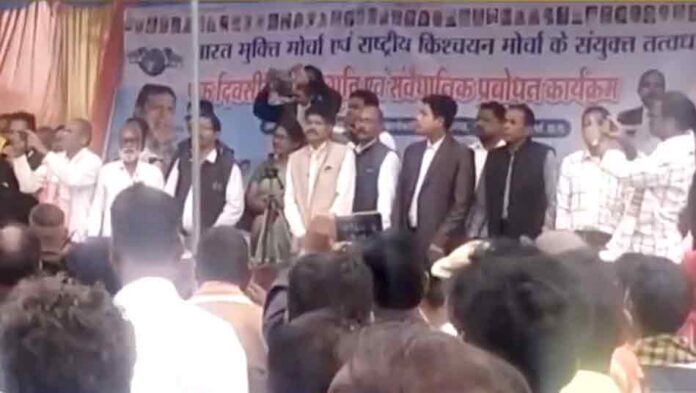
The controversy stems from a public gathering held on 27 February 2024 at Saliyatoli Mini Stadium in Kunkuri, Jashpur district, reportedly organized by the Bharat Mukti Morcha and the Rashtriya Christian Morcha.
According to the prosecution, several speakers at the event allegedly made statements describing the term “Hindu” as meaning “thief, dacoit, robber and slave,” and further asserted that “Hindu is not a religion but an abuse.” The prosecution also alleged that speeches at the event contained remarks targeting religious preacher Dhirendra Shastri, criticism of the Chhattisgarh Chief Minister, and calls urging people to break Electronic Voting Machines (EVMs) and oppose elections conducted through them.
The speeches were recorded and later became the basis of a criminal complaint.
Complaint Filed by VHP Leader
On 28 February 2024, Karnail Singh, District President of the Vishva Hindu Parishad (VHP), Jashpur, lodged a complaint at Kunkuri Police Station.
The complaint alleged that the speakers had insulted Hindu deities, hurt the sentiments of the Hindu and Brahmin communities, and delivered speeches capable of promoting communal hostility and disturbing public order.
Police subsequently registered a criminal case on 4 March 2024 against 12 persons and, after investigation, filed a chargesheet.
Charges Framed
Following the investigation, the trial court framed charges under several provisions of the Indian Penal Code (IPC), including:
- Section 153A – Promoting enmity between different religious groups.
- Section 153B – Making imputations prejudicial to national integration.
- Section 295A – Deliberate and malicious acts intended to outrage religious feelings.
- Section 505(2) – Statements promoting enmity, hatred, or ill will between classes.
- Section 294 – Obscene acts and utterances.
- Section 34 – Acts committed in furtherance of common intention.
The order framing charges was later upheld by the First Additional Sessions Judge, Kunkuri, prompting the accused to approach the High Court under Section 528 of the Bharatiya Nagarik Suraksha Sanhita (BNSS), the provision corresponding to the erstwhile Section 482 of the Code of Criminal Procedure (CrPC), seeking exercise of the High Court’s inherent powers to quash criminal proceedings.
Activists Invoke Constitutional Protection
Before the High Court, the petitioners argued that they were social activists working among socially and economically marginalized communities and that the speeches formed part of discussions on social reform, religion, caste, and politics.
They contended that their remarks were protected by Article 19(1)(a) of the Constitution, which guarantees freedom of speech and expression, and were also consistent with the constitutional duty under Article 51A(h) to promote scientific temper, humanism, and the spirit of inquiry and reform.
The petitioners further submitted that there was no deliberate or malicious intention to insult Hindu beliefs, incite communal hatred, or disturb public order.
Prosecution Opposes Quashing
The State opposed the plea, arguing that the speeches could not be viewed in isolation but had to be examined in the context of the audience before whom they were delivered and their potential impact on communal harmony.
The prosecution maintained that the investigation had yielded substantial material supporting the allegations, including witness statements, pamphlets distributed at the event, videographic evidence, and electronic records accompanied by a Section 65-B certificate under the Indian Evidence Act.
According to the prosecution, the evidence warranted a full trial rather than termination of proceedings at the threshold.
High Court: Issues Require Evidence at Trial
Rejecting the petition, the High Court observed that the material collected during investigation disclosed a prima facie case and that disputed questions concerning the nature, context, and legal consequences of the speeches could only be determined after evidence is recorded during trial.
The Bench observed that the investigation prima facie indicated that, during a public gathering attended by members of different communities, statements concerning the Hindu religion, religious personalities, and the electoral process had allegedly been made.
The Court emphasized that determining whether those statements constituted legitimate criticism protected by the Constitution or crossed the legal threshold into criminal conduct punishable under the penal provisions invoked by the prosecution was a matter requiring detailed examination of evidence and could not appropriately be decided in proceedings seeking quashing of the FIR.
Free Speech Defence Not Enough at Preliminary Stage
The Bench also rejected the argument that the petitioners’ status as social activists or rationalists, or their stated objective of promoting scientific temper and social reform, by itself justified quashing the criminal proceedings.
The Court held that such claims constitute matters of defence that must be established during trial rather than being accepted at the preliminary stage.
Importantly, the High Court clarified that the absence of actual communal violence or public disorder following the speeches does not automatically negate the alleged offences, observing that criminal liability under the relevant provisions may arise even where violence has not actually occurred, provided the statutory ingredients are otherwise made out.
Court Finds Material Supporting Investigation
The judgment noted that the prosecution’s case was not founded on mere allegations or conjecture.
Instead, investigators had collected documentary and electronic evidence, including witness testimonies, pamphlets circulated during the programme, videographic recordings of the event, and certification under Section 65-B of the Evidence Act supporting the admissibility of electronic evidence.
Given the existence of such material, the Court concluded that the proceedings should continue before the trial court.
Petition Dismissed
Consequently, the High Court held that no grounds existed to quash:
- the FIR,
- the chargesheet,
- the order dated 19 September 2025 by the Judicial Magistrate First Class, Kunkuri, framing charges,
- the revisional order dated 24 January 2026 passed by the First Additional Sessions Judge, Kunkuri, and
- the consequential criminal proceedings.
The Bench dismissed the petition as being devoid of merit.
Observations Limited to Quashing Stage
The High Court also clarified that its observations were confined solely to deciding whether the criminal proceedings should be terminated at the threshold and should not be construed as findings on the guilt or innocence of the accused.
The Court directed that the trial court proceed independently, evaluate the evidence presented by both sides, and decide the case strictly in accordance with law.
Legal Significance
The ruling underscores the judiciary’s consistent approach that the inherent power to quash criminal proceedings is an exceptional jurisdiction to be exercised sparingly. Where the investigation discloses prima facie evidence and the allegations require factual determination, courts ordinarily refrain from short-circuiting the criminal process.
The judgment also highlights the delicate constitutional balance between the right to free expression under Article 19(1)(a) and the statutory restrictions intended to preserve religious harmony and public order. While criticism of religion and advocacy of social reform remain protected forms of expression, the Court indicated that whether specific statements amount to protected speech or constitute offences under criminal law depends on their content, context, intent, and effect—questions that must be resolved through a full trial rather than at the preliminary stage.
Post Script: Arya Samaj also says the same thing. But, who will file a case against them?
…
_Agency Inputs.
2 comments on “No Relief for 11 Activists in ‘Hindu Is an Abuse’ Remarks Case, Must face Trial: Chhattisgarh HC.”
Leave a comment


Pingback: Inside Chhattisgarh HC’s Crucial Order: 11 Activists Face Trial Over ‘Hindu’ Remarks – DharmaRenaissance Blog
Pingback: Hindu Rights, Religious Speech and the Discipline of Law – DharmaRenaissance Blog