
Struggle for Hindu Existence
*Hindu Rights to Survive with Dignity & Sovereignty *Join Hindu Freedom Movement to make Bharat Hindu Rashtra within this lifetime *Jai Shri Ram *Jayatu Jayatu Hindu Rashtram *Editor: Upananda Brahmachari.
West Bengal: Left Bookstalls Targeted During Durga Puja, Hindutva Battle Escalates.
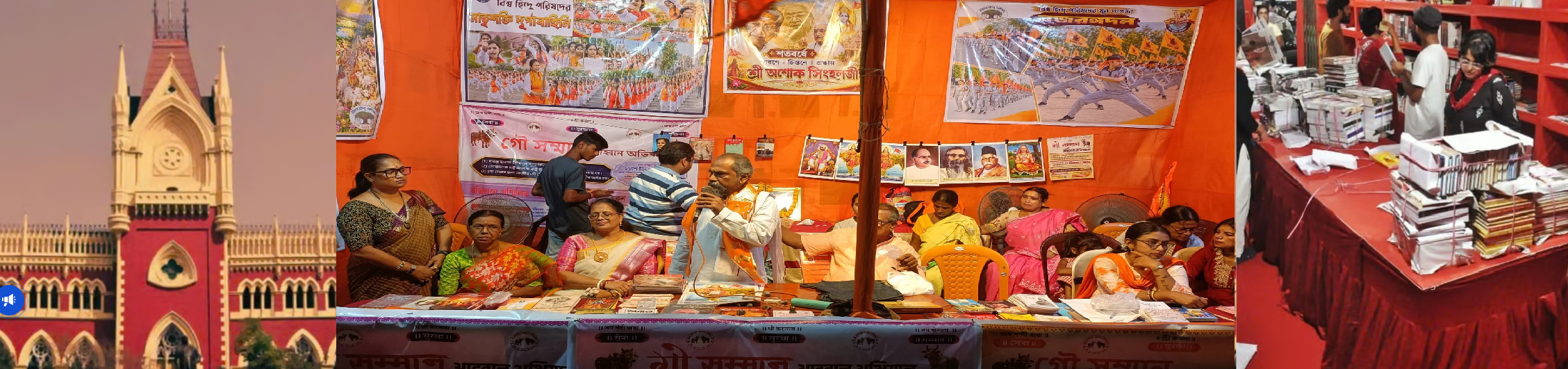
West Bengal: Left Bookstalls Targeted by Hinduta Organisations During Durga Puja; Political and Legal Battle Intensifies.
Left parties allege vandalism and obstruction across the state; BJP leaders deny involvement in the attacks, while the Calcutta High Court stresses equal treatment under the law.
Sankirtan Das | Kolkata | HENB | October 21, 2026:: A fresh political controversy has erupted in West Bengal over the setting up of Left-wing bookstalls during Durga Puja, with the CPI(M), CPI(ML) Liberation, the Socialist Unity Centre of India (Communist), and other Left groups alleging vandalism, threats and obstruction at several locations across the state.
The reported incidents, including those in Bijpur in North 24 Parganas, Dhakuria in Kolkata, Diamond Harbour in South 24 Parganas and other parts of Bengal, have brought the competing political and cultural narratives surrounding the state’s biggest Hindu festival into sharp focus. The controversy has also triggered legal proceedings in the Calcutta High Court, where disputes over permission, police protection and the removal of temporary stalls have produced different orders in individual cases.
The Left parties have accused supporters of Hindutva organisations of targeting their stalls. The BJP, however, has denied responsibility for the attacks, and the allegations against individual perpetrators require investigation.
Vandalism allegations from multiple locations
Reports of attacks on Left bookstalls have emerged from several districts and neighbourhoods during this year’s Durga Puja festivities. CPI(M) leaders have described the incidents as an attempt to prevent them from distributing literature and expressing their political views during the festival.
In Bijpur, North 24 Parganas, a CPI(M) bookstall was reportedly vandalised and set on fire, according to media reports. Other complaints have concerned alleged obstruction of stalls in Kolkata and elsewhere in the state. Left leaders have maintained that their longstanding practice of operating temporary bookstalls during Durga Puja has come under unprecedented pressure.
The dispute has also involved allegations that activists were threatened or assaulted while preparing stalls. The precise circumstances and responsibility for each incident remain matters for police investigation.
The controversy is no longer confined to differences over the contents of books or the location of temporary structures. It has become a broader dispute over whether political organisations should be able to use the public spaces around Durga Puja celebrations to disseminate their ideological literature.
An ideological contest over Durga Puja’s public space
For decades, Left organisations in West Bengal have used the Durga Puja season to operate bookstalls offering Marxist literature, political publications, progressive writing and other books. These stalls have served as a means of political outreach during a period when large numbers of people visit neighbourhood pandals.
Their presence has also attracted criticism from sections of the Hindu and Hindutva-oriented public, who question the participation of organisations they regard as dismissive of Hindu religious traditions and sentiments.
Critics have argued that some Left intellectuals and political activists challenge the religious vocabulary, symbols and customs associated with Sanatan Dharma while using Durga Puja gatherings to promote their own political interpretations. The use of terms such as Sharodotsav rather than Durga Puja has become one point of contention in the current debate.
Left parties, for their part, maintain that selling books during the festival is a longstanding cultural and political activity, and that their publications are not grounds for denying them access to public spaces.
The resulting confrontation reflects a wider ideological struggle over the relationship between religious festivals, political expression and cultural identity in Bengal.
From past political dominance to a new contest
The controversy has acquired additional significance following the change in West Bengal’s political leadership. With the BJP now in power, Left organisations and Hindu-oriented groups are contesting access to spaces around Durga Puja venues, where political literature can reach large audiences.
The current dispute has revived questions about the treatment of rival ideological groups during earlier periods of Left rule. Critics of the former CPI(M)-led establishment have long alleged that political opponents faced intimidation and restrictions on their activities. Such historical allegations form part of the political context, although they do not establish the circumstances of the present incidents.
Hindutva organisations have increasingly sought to challenge Left-wing narratives through their own publications and public outreach. The result is a direct contest between competing interpretations of Hindu culture, secularism, Marxism and nationalism.
However, political rivalry cannot by itself justify vandalism, threats or physical intimidation. Any allegation that an organisation’s supporters were involved in the attacks must be established through evidence rather than assumed from ideological differences.
Suvendu Adhikari’s remarks add to the controversy
The issue has also been sharpened by Chief Minister Suvendu Adhikari’s public criticism of Left bookstalls at Durga Puja venues.
During a September 10 address in the West Bengal Assembly, Adhikari reportedly urged Durga Puja committees not to permit CPI(M) bookstalls that used the term Sharodotsav rather than Durga Puja. He argued that the former expression diminished the explicitly religious character of the celebration.
On October 20, Adhikari reiterated that Left parties could sell books from their own offices rather than setting up stalls near Puja pandals. He questioned the appropriateness of using the festival for political outreach while opposing particular Hindu customs and symbols.
These remarks have become part of the larger dispute over the conditions under which political groups may operate bookstalls during religious festivals. They also raise a distinction between the freedom of a Puja committee to manage its premises and the obligation of public authorities to apply applicable rules fairly.
The BJP’s state president, Samik Bhattacharya, has denied that the party was responsible for the reported vandalism and condemned attacks on bookstalls. Other public figures have also called for the freedom to sell books and express political views to be respected.
Calcutta High Court proceedings: A changing legal position
The dispute has reached the Calcutta High Court through several separate petitions. The court’s orders must be understood individually rather than treated as a single blanket ruling on all Left bookstalls at Durga Puja venues.
On October 14, the High Court questioned the alleged obstruction of a CPI(M) bookstall near the party’s office on Jessore Road in Bongaon. Justice Saugata Bhattacharyya emphasised the importance of allowing differing political ideologies to be expressed in a democracy and directed the authorities to inquire into the complaint.
On October 15, the single-judge bench allowed the CPI(M) to set up its stall at the Bongaon location and directed the police to maintain order. The observations underscored the importance of political pluralism and equal treatment.
However, on October 16, a division bench led by Chief Justice Ravindra Vithalrao Ghuge stayed the single judge’s order following an appeal by the state government. The division bench also directed that stalls erected without the requisite permission, including those associated with Hindu Jagran Manch if they lacked permission, should be removed. The principle of equality before the law was central to the proceedings.
In a separate case concerning a CPI(M) stall near Jadavpur Coffee House, the High Court rejected the party’s plea against removal on October 20, with the court emphasising that an application and payment of a fee did not, by themselves, establish that the necessary permission had been granted.
These developments do not amount to a judicial finding that Left literature is prohibited at Durga Puja venues or that the stalls were restricted because they hurt Hindu sentiments. Rather, the cases have addressed questions of political expression, permission, administrative consistency and the legal authority to erect temporary structures.
The proceedings illustrate that the right to express a political viewpoint and compliance with lawful requirements for public or temporary installations are separate issues.
Freedom of expression versus religious sensitivities
At the heart of the controversy lies a difficult question: how should public authorities balance the religious character of Durga Puja with the freedom of political organisations to disseminate their views?
For Hindu-oriented groups, the festival is fundamentally a religious celebration dedicated to Maa Durga, and they argue that its cultural and spiritual significance should not be disregarded. For Left organisations, the annual bookstalls represent a longstanding opportunity to reach readers and participate in Bengal’s public cultural life.
Neither argument resolves the question of whether a particular stall has obtained the necessary permission or whether an alleged act of vandalism took place. Those questions require evidence and application of the relevant law.
The same standards should apply to all organisations, whether Left-wing, Hindu nationalist or otherwise. If a stall has been erected without permission, the authorities may act in accordance with the law. If a stall is vandalised or its organisers are threatened, the police should investigate and take appropriate action against those responsible.
A wider political and cultural confrontation
The bookstall controversy has exposed the depth of ideological divisions surrounding Durga Puja in West Bengal. What began as a dispute over temporary stalls and political publications has developed into a wider confrontation involving the BJP government, Left parties, Hindu-oriented organisations, Puja committees and the courts.
For the Left, the issue concerns the ability to distribute literature and articulate political positions. For critics among Hindu-oriented groups, it concerns the representation of Hindu religious traditions and the use of a major religious festival as a platform for ideological campaigning.
The immediate questions are whether the reported attacks will be investigated, whether the authorities will apply permission requirements consistently and whether competing organisations can coexist without intimidation.
The broader challenge is to ensure that Durga Puja remains a major religious and cultural celebration without allowing political disagreements to spill over into violence or selective restrictions on lawful expression.
..
_Inputs from Social Media.


[…] distinction matters because the dispute now includes a VHP demand that Muslims not attend Garba and Dandiya, alongside reported…
[…] The narrow factual frame available on 19 October 2026 is this: a Muslim student died after a violent clash…
[…] 18 October 2026, Goa Police were reported to have registered an FIR against 300 unidentified people after “Murd…. Those…
[…] the Varanasi observance, Uttar Pradesh Chief Minister Yogi Adityanath honoured Yugacharya Swami Pranavananda Ji Maharaj and highlighted Bharat Sevashram…
[…] The disputed words were reported as the slogan ‘Hindutva Murdabad.’ […]