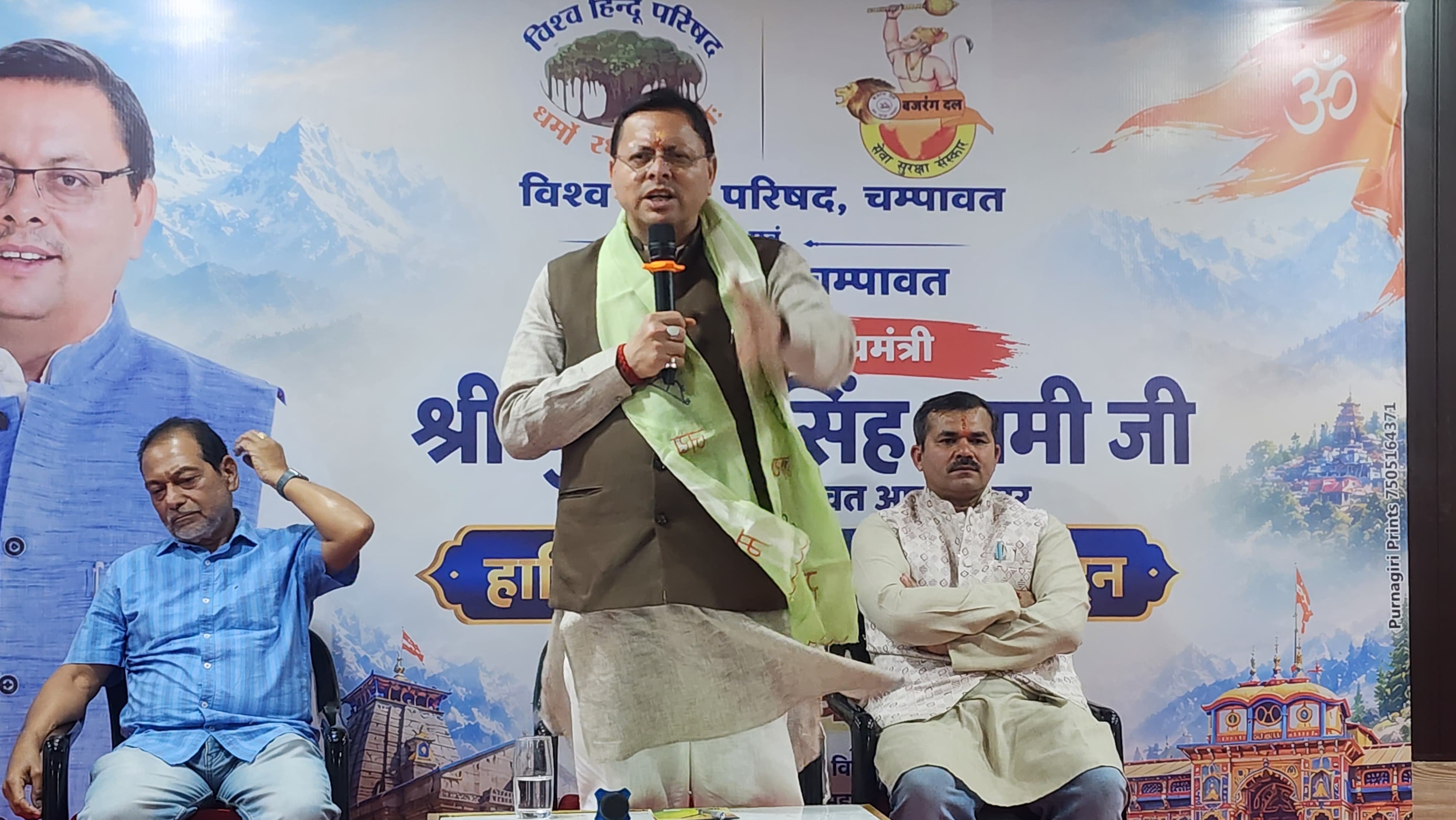


[…] from a government that speaks in its name. In fact, the dignity of the Kumbh requires both. The Dhami…

Struggle for Hindu Existence
*Hindu Rights to Survive with Dignity & Sovereignty *Join Hindu Freedom Movement to make Bharat Hindu Rashtra within this lifetime *Jai Shri Ram *Jayatu Jayatu Hindu Rashtram *Editor: Upananda Brahmachari.
2027 Kumbh: Dhami’s Hindutva Push Puts Sanatan Dharma at Centre Stage.
Dhami Government’s Hindutva Agenda Gains Momentum Ahead of 2027 Haridwar Kumbh and Assembly Elections.
Upananda Brahmachari | HENB | Haridwar | Oct 22, 2026:: As the Shankhnaad (the ceremonial blowing of conch shells) heralds the approach of the Kumbh in Haridwar, waves of Sanatani faith rising from the banks of the Ganga are set to resonate beyond the spiritual realm and reach the corridors of power in a confluence of Hindutva. With the 2027 Kumbh Mela preceding the Uttarakhand Assembly elections, the BJP is preparing to use the mega religious gathering as a major platform to highlight its Hindutva agenda, showcase the achievements of the Pushkar Singh Dhami government, and reaffirm Uttarakhand’s identity as Devbhoomi (the Land of the Gods).
Over the past five years, Chief Minister Pushkar Singh Dhami has sought to give fresh momentum to Hindutva-oriented governance through a series of policy initiatives, including the implementation of the Uniform Civil Code (UCC), stricter enforcement of anti-conversion laws, and measures aimed at protecting the religious and cultural identity of Devbhoomi. The government is now looking to bring the Sanatan Dharma tradition, the spiritual leadership of the Sant Samaj (community of saints), and religious tourism to the forefront of its political messaging.
The upcoming Kumbh is expected to provide a significant opportunity to connect these initiatives with the BJP’s broader ideological vision, presenting the preservation of Sanatani traditions, cultural continuity, and development as interconnected priorities.
Uniform Civil Code: A Landmark in Hindutva-Oriented Governance
The Dhami government has placed Hindutva-inspired governance at the centre of its political identity, with initiatives spanning legislation, administration, and cultural preservation. The implementation of the Uniform Civil Code stands out as one of its most prominent achievements.
Uttarakhand became the first state in independent India to implement a Uniform Civil Code, marking a significant milestone in the BJP’s long-standing advocacy of a common civil framework. The party has presented the move as a step towards legal uniformity, gender justice, and equality, while underscoring its commitment to fulfilling a key ideological promise.
The government has also emphasised the enforcement of anti-conversion legislation and action against unauthorised encroachments in the vicinity of religious sites. It has framed these measures as efforts to uphold the rule of law, protect vulnerable communities from coercion, and safeguard the distinctive religious and cultural character of Devbhoomi.
Together, these decisions have enabled the BJP to project its ideological commitments as an integral part of governance rather than merely as electoral rhetoric. For the party, Uttarakhand’s cultural heritage and Sanatani identity remain central to its vision of the state’s future.
Religious Tourism and Pilgrimage Infrastructure: Faith Meets Development
The expansion of religious tourism and the development of pilgrimage infrastructure have emerged as important components of the government’s strategy. Improvements associated with the Char Dham Yatra, enhanced access to temples, and infrastructure development around prominent religious destinations have helped the government promote a vision in which spiritual heritage and economic development reinforce each other.
The BJP intends to showcase these initiatives as evidence of its commitment to preserving Sanatan traditions while improving facilities for pilgrims and supporting tourism-related livelihoods. The underlying political message is that Uttarakhand’s sacred geography, temples, pilgrimage routes, and centuries-old traditions constitute an enduring civilisational heritage worthy of protection and promotion.
The party is expected to place these achievements prominently before voters as the 2027 Assembly elections approach, portraying the development of pilgrimage destinations as both a governance priority and a means of strengthening the state’s religious and cultural identity.
Scope of Tourism Promotion During the 2027 Haridwar Kumbh Mela
The 2027 Haridwar Kumbh Mela offers Uttarakhand a significant opportunity to emerge as a premier destination for religious and spiritual tourism. The massive influx of pilgrims, saints, and Sanatan Dharma devotees from across India and abroad could boost the state’s hospitality sector, transport services, local businesses, handicrafts, and traditional markets. The Dhami government can leverage the occasion to promote Haridwar’s sacred ghats, ancient temples, ashrams, yoga and meditation centres, and other pilgrimage destinations across Devbhoomi. Better connectivity, improved accommodation, organised pilgrimage circuits, digital information services, and efficient crowd management could encourage visitors to extend their stays and explore destinations beyond Haridwar, including Rishikesh, the Char Dham shrines, and other spiritually significant locations. By integrating religious tourism with cultural experiences and sustainable development, the government can strengthen Uttarakhand’s Sanatani identity while generating employment, supporting local livelihoods, and establishing the Kumbh as a lasting catalyst for the state’s tourism economy.
2027 Kumbh: A Confluence of Sanatan Faith and Political Messaging
The 2027 Kumbh Mela in Haridwar is expected to occupy a central place in this broader narrative. As one of Hinduism’s most significant religious gatherings, the Kumbh draws saints, seers, ascetics, and devotees from across India, transforming Haridwar into a major centre of Sanatani spiritual life.
For the BJP, the gathering offers an opportunity to highlight Uttarakhand’s standing as Devbhoomi and communicate the significance of Sanatan Dharma to millions of pilgrims. The party is likely to emphasise the role of the Sant Samaj, the preservation of sacred traditions, improved pilgrimage facilities, and the government’s initiatives concerning religious and cultural heritage.
The Kumbh, however, is not merely a religious spectacle. Its scale, national reach, and civilisational significance also make it an important arena for public messaging. The BJP’s challenge will be to translate the government’s stated commitment to Sanatan traditions into visible arrangements for pilgrims, effective civic management, and the protection of the sanctity of the sacred gathering.
As Uttarakhand moves towards the next Assembly elections, the convergence of the Kumbh, the Dhami government’s policy agenda, and the BJP’s Hindutva-oriented politics is likely to shape the state’s political discourse. The party’s strategy is to present its record on the UCC, religious-site protection, pilgrimage infrastructure, and cultural identity as evidence of a consistent commitment to its ideological principles.
Ultimately, the 2027 Kumbh is poised to become a defining moment for the BJP’s political messaging in Uttarakhand—a confluence of Sanatan faith, cultural identity, governance, and electoral mobilisation. Whether this narrative translates into electoral gains will depend not only on ideological appeal but also on public perceptions of the government’s performance, the arrangements made for the Kumbh, and its ability to meet the expectations of devotees and ordinary citizens alike.
__
_Agency Inputs.
One comment on “2027 Kumbh: Dhami’s Hindutva Push Puts Sanatan Dharma at Centre Stage.”
Leave a Reply


Pingback: Haridwar Kumbh 2027: Uttarakhand’s Hindutva Test – DharmaRenaissance Blog