
Struggle for Hindu Existence
*Hindu Rights to Survive with Dignity & Sovereignty *Join Hindu Freedom Movement to make Bharat Hindu Rashtra within this lifetime *Jai Shri Ram *Jayatu Jayatu Hindu Rashtram *Editor: Upananda Brahmachari.
Corporate Jihad in TCS Nashik Hits SC: Plea Flags ‘Organised’ Conversions, Seeks ‘Terrorist Act’ Tag, NSA–UAPA Action.
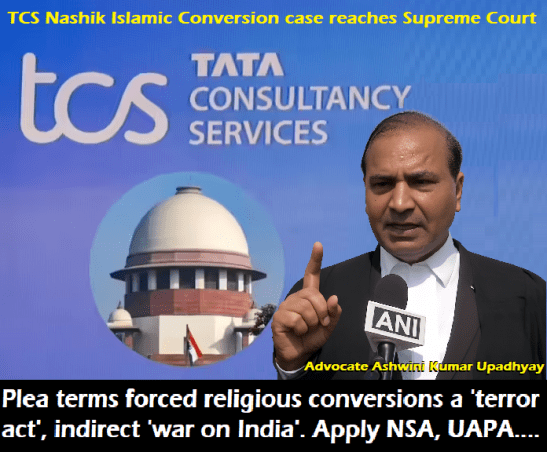
TCS Nashik Case Reaches Supreme Court; Plea Seeks Classification of Forced Conversions as a ‘Terrorist Act’; Calls for Action under NSA and UAPA Provisions.
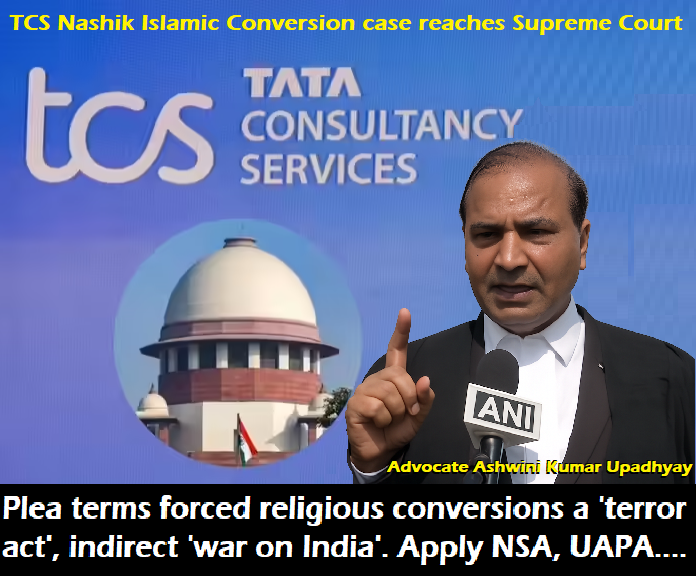
Upananda Brahmachari | HENB | New Delhi | April 17, 2026:: The alleged religious coercion and sexual harassment case linked to a Tata Consultancy Services (TCS) unit in Nashik, Maharashtra, which is now commonly described as ‘Corporate Jihad‘ has reached the Supreme Court, expanding from a workplace dispute into a matter framed as one of national legal and security concern. A petition filed before the apex court urges that forced or deceitful religious conversions be treated as a “terrorist act” under existing criminal law, and calls for the application of stringent provisions under the National Security Act (NSA) and the Unlawful Activities (Prevention) Act (UAPA). The plea argues that the ‘organised conversion’ is not only a ‘terrorist act’ but also an act of ‘waging war against India’.
The plea, submitted by advocate Ashwini Upadhyay, positions the Nashik case as part of a broader pattern of organised and coercive religious conversions. It argues that such acts, when carried out systematically through deception, inducement, or pressure, extend beyond individual criminal misconduct and pose a threat to India’s constitutional values and social fabric.
Workplace Allegations Trigger Wider Legal Debate
At the centre of the case are complaints from multiple women employees at a TCS office in Nashik. The complainants have alleged that certain staff members engaged in religious coercion alongside acts of sexual harassment and workplace exploitation. Authorities have registered several First Information Reports (FIRs), and multiple individuals—including team leaders and a senior human resources official—have been arrested as part of the ongoing investigation.
According to investigators, the case came to light following a tip-off, which led to an undercover police operation. Women police personnel reportedly joined the workplace in disguise to observe interactions and gather evidence before formal action was initiated. The complaints, dating from late March to early April, indicate a pattern in which vulnerable employees—particularly those facing financial or personal challenges—were allegedly identified and targeted during training or workplace interactions.
Petition Frames Conversions as National Security Threat
The petition before the Supreme Court contends that organised religious conversions carried out through coercion or deception should be treated as acts of terrorism under Section 113 of the Bharatiya Nyaya Sanhita, 2023. It argues that such acts fulfill the criteria of intent, method, and impact required under the provision, particularly if they are aimed at instilling fear within specific communities or altering social dynamics.
The plea by Adv. Upadhyay further claims that these activities may be supported by coordinated networks, potentially involving foreign funding, and therefore warrant classification as threats to national security rather than isolated criminal offences. It calls on the court to direct both the Centre and state governments to adopt stricter measures to curb such practices, including the establishment of special courts for expedited trials and the imposition of consecutive sentences in relevant cases.
Supreme Court Petition Seeks Broad Directions
Among its key demands, the petition seeks judicial declarations that deceitful religious conversion constitutes a serious threat to sovereignty, secularism, democracy, and national integration. It also urges the court to mandate stricter enforcement mechanisms and legal frameworks to address what it describes as an organised form of crime with wider societal implications.
NCW Intervention and Expanding
 The gravity of the allegations has prompted a multi-agency investigation involving both state and central authorities. The National Commission for Women (NCW) has taken suo motu cognisance of the matter and constituted a fact-finding committee to examine the allegations of sexual harassment and coercion at the TCS facility.
The committee—comprising retired Bombay High Court Justice Sadhna Jadhav, former Haryana Director General of Police B. K. Sinha, Supreme Court advocate Monika Arora, and NCW Senior Coordinator Lilabati—is tasked with conducting an on-site inquiry, interacting with stakeholders, and identifying any institutional lapses. It has been directed to submit its findings within ten working days.
TCS, for its part, has initiated an internal investigation, suspended the accused employees, and temporarily shifted staff at the Nashik office to remote work as a precautionary measure.
Allegations of Systemic Failures
Scrutiny has also turned to the company’s internal grievance redressal mechanisms, including compliance with the Prevention of Sexual Harassment (POSH) framework. Authorities are examining whether complaints were addressed adequately and in a timely manner. The involvement of a senior HR official among the accused has intensified concerns regarding institutional accountability.
Developments in Bail Proceedings
In a related development, one of the accused, Nida Khan, is expected to file an anticipatory bail application before a Nashik court, citing her pregnancy as a ground for relief. Her legal counsel advocate Baba Sayyed has indicated that the bail plea will be submitted imminently.
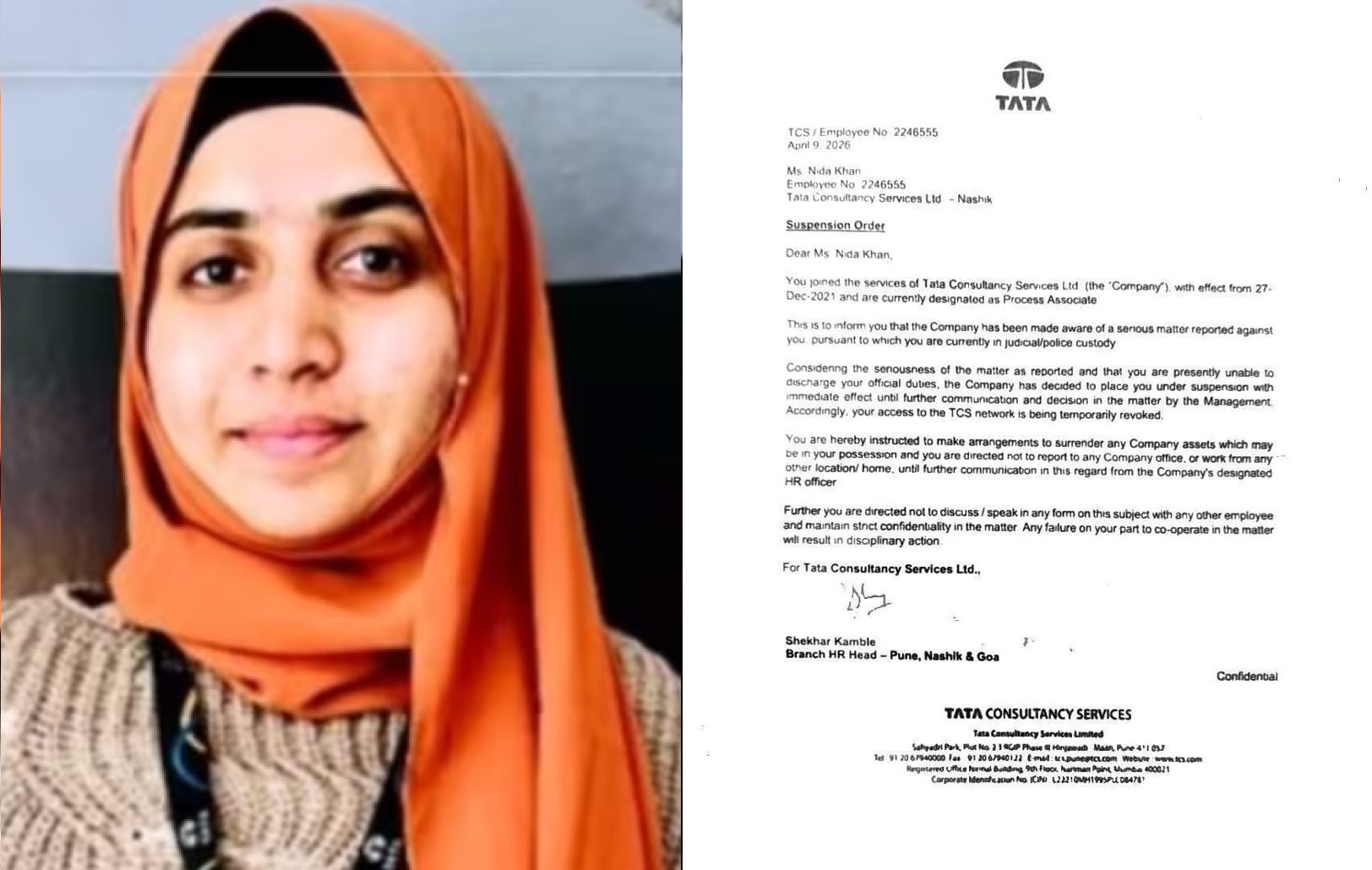
Accused Nida Khan, who was initially described as an HR head and later as a teleseller at the TCS Nashik BPO unit, has been suspended by the company forthwith.
Broader Implications
The case has evolved beyond a workplace investigation into a contentious legal and political issue, raising questions about the boundaries between criminal law, religious freedom, and national security. While the allegations remain under investigation and subject to judicial scrutiny, the Supreme Court’s response to the petition could have significant implications for how coercive religious conversions are interpreted and prosecuted under Indian law.
As inquiries continue, the case is likely to remain at the intersection of legal reform, corporate accountability, and constitutional debate.
…
_Agency Inputs.


 Struggle for Hindu Existence
[…] by this post on Struggle for Hindu […]
why HINDUS in TmailNadu elected a MAGA ASSLICKER EVENGALIST AS CM. Has the people of TAMIL NADU secretly converted to…
[…] by this post on Struggle for Hindu […]
[…] by this post on Struggle for Hindu […]
[…] by this post on Struggle for Hindu […]