
Struggle for Hindu Existence
*Hindu Rights to Survive with Dignity & Sovereignty *Join Hindu Freedom Movement to make Bharat Hindu Rashtra within this lifetime *Jai Shri Ram *Jayatu Jayatu Hindu Rashtram *Editor: Upananda Brahmachari.
Over 100 Muslim Communities Dropped as Bengal BJP Govt Reinstates Old OBC List, Bringing Relief to Hindu OBCs.
End of Long-Standing Deprivation of Hindu OBCs.
Bengal OBC Quota Reset: Suvendu Adhikari Government Scraps Mamata-Era List, Over 100 Muslim Communities Excluded, Cuts Reservation to 7%.
Sankirtan Das | HENB | Kolkata | May 21, 2026:: In a major overhaul of West Bengal’s reservation framework, the BJP government led by Suvendu Adhikari has rolled back the Mamata Banerjee-era Other Backward Classes (OBC) regime, restoring the state’s pre-2010 reservation structure and reducing the total OBC quota from 17% to 7%.
The decision effectively removes more than 100 Muslim communities that had been included in the OBC list during the tenure of the Trinamool Congress (TMC) government headed by Mamata Banerjee. The BJP has described the earlier expansion as an exercise in “minority appeasement”, alleging that Hindu OBC communities were deprived of educational, employment, and welfare opportunities under the revised system introduced after 2010.
Return to Pre-2010 OBC Structure
The new state government has notified 66 caste groups that existed in West Bengal’s OBC list prior to 2010, while abolishing the Category A and Category B sub-classifications introduced by the TMC government.
Under the earlier TMC-era system, 17% reservation had been allocated to OBCs:
- 10% for “More Backward Classes” under Category A
- 7% for “Backward Classes” under Category B
The Suvendu Adhikari government has now replaced that structure with a flat 7% reservation applicable only to the restored 66 OBC groups.
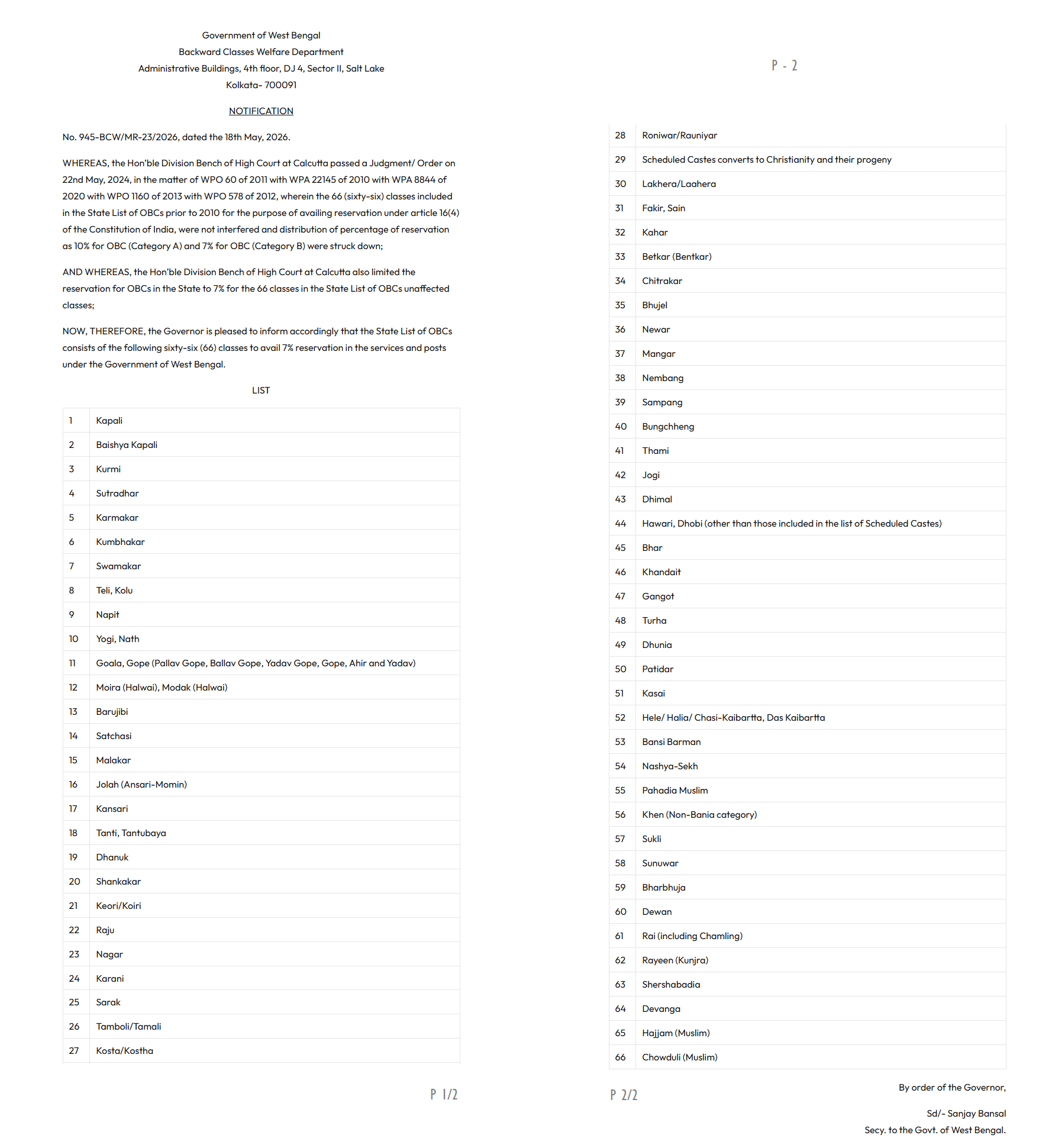
The move marks a complete reversal of the reservation architecture introduced after the TMC came to power in 2011.
Mamata Government’s OBC Expansion
The controversy dates back to a series of executive orders issued between March 2010 and May 2012, through which 77 communities — most of them Muslim groups — were added to the OBC list in West Bengal.
After coming to power, the Mamata Banerjee government institutionalised the arrangement through the West Bengal Backward Classes (Other than Scheduled Castes and Scheduled Tribes) (Reservation of Vacancies in Services and Posts) Act, 2012.
Subsequently, between 2012 and July 2022, more than 30 additional Muslim communities were reportedly included in the OBC list.
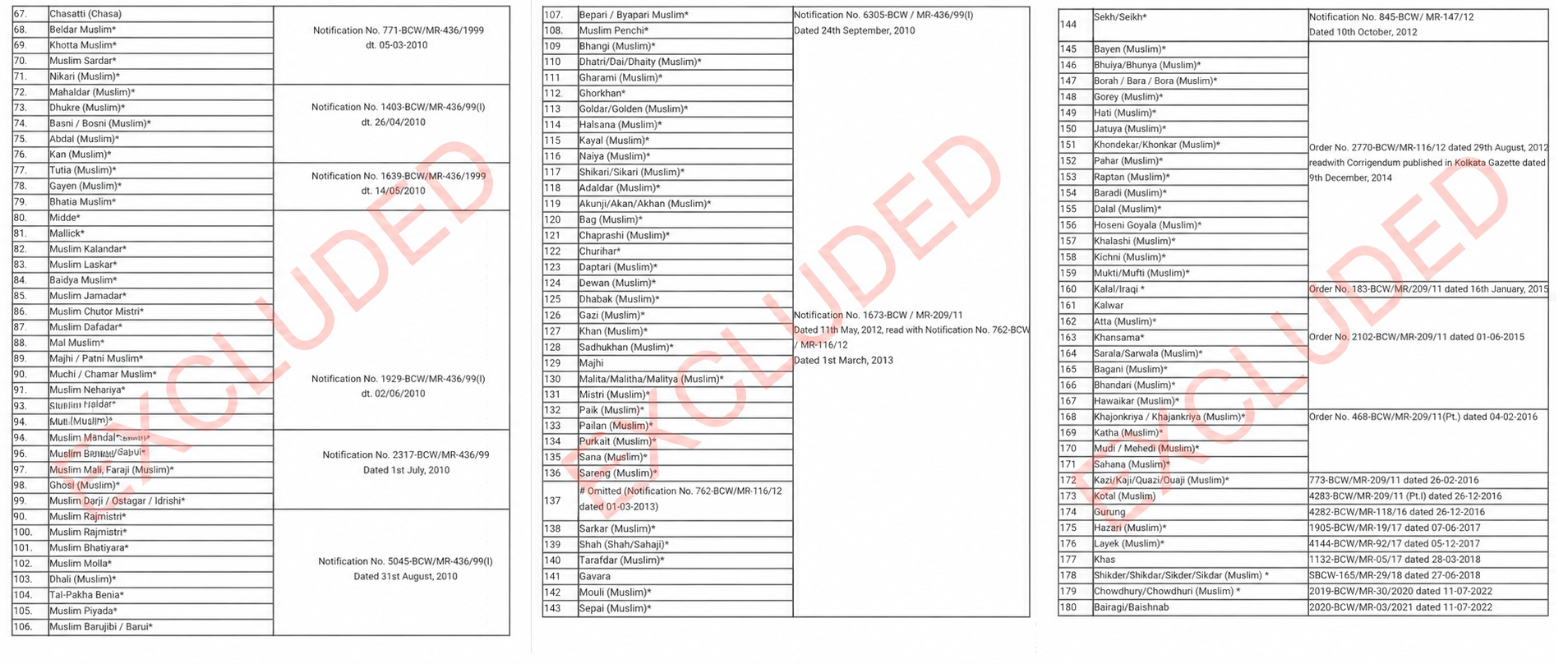
The BJP repeatedly accused the TMC government of restructuring the reservation system to consolidate its Muslim vote base. BJP leaders alleged that traditional Hindu OBC communities were sidelined while reservation benefits were increasingly directed toward Muslim groups.
Now, the BJP government in West Bengal, led by Suvendu Adhikari, has excluded all these 100-plus Muslim communities from the current list, reducing the OBC reservation from 17% to 7%, which was earlier allocated to the OBC A and B categories.
Calcutta High Court Verdict
The matter reached a turning point in May 2024, when the Calcutta High Court struck down multiple state government notifications issued between 2010 and 2012.
A Division Bench comprising Justices Tapabrata Chakraborty and Rajasekhar Mantha held that religion had been the “sole criterion” in identifying several groups for OBC reservation, which violated constitutional principles and existing judicial precedents.
The court cancelled all OBC certificates issued after 2010 under the disputed framework, although individuals already employed using those certificates were allowed to retain their jobs.
The judgment became a politically explosive issue during the 2024 Lok Sabha election campaign, with the BJP accusing opposition parties of diverting reservation benefits from Hindu communities to Muslims.
Reservation Politics Intensifies
Reservation politics continued to dominate Bengal’s political discourse through 2025.
On June 11, 2025, then Leader of Opposition Suvendu Adhikari sharply criticised the TMC government’s revised OBC notification, describing it as a “One-Sided Beneficiary Classes” quota system.
According to Adhikari, while the state had only 11 Muslim groups among 66 OBC castes before 2010, the Mamata government’s revised list included:
- 46 Muslim groups among 51 communities in Category A
- 21 Muslim groups among 25 communities in Category B
He claimed that Muslims constituted nearly 90% of Category A beneficiaries and 84% of Category B beneficiaries.
“If this reservation list is not prepared with the intention of providing one-sided benefits exclusively to Muslims by deliberately depriving Hindus and other communities, then the sun rises in the west,” Adhikari had remarked during his campaign against the TMC government’s quota policy.
Supreme Court and NCBC Intervention
The reservation dispute also drew the attention of the Supreme Court of India and the National Commission for Backward Classes (NCBC).
During hearings in December 2024, the Supreme Court reportedly observed that reservation could not be granted solely on the basis of religion.
The NCBC, under then chairman Hansraj Ahir, repeatedly questioned the methodology used by the Bengal government in expanding the OBC list.
In June 2025, the NCBC issued a notice to then Bengal Chief Secretary Manoj Pant seeking detailed data regarding surveys conducted for newly added OBC communities. The commission noted that despite repeated communications, the state government had failed to provide complete information regarding the inclusion process.
Later, in July 2025, the Supreme Court stayed a Calcutta High Court order that had frozen the revised OBC list prepared by the state government. Hearing the matter, then Chief Justice of India B R Gavai observed that reservation policy largely fell within the executive domain, while also reiterating that constitutional safeguards must be maintained.
Political Reactions and Future Debate
The Suvendu Adhikari government’s latest move is expected to trigger a fresh political confrontation in West Bengal.
While BJP supporters have projected the rollback as a corrective measure against alleged religion-based reservation and “minority appeasement,” opposition parties are likely to attack the government for reducing the total OBC quota from 17% to 7%.
The development has once again brought the debate over caste-based reservation, minority inclusion, and constitutional safeguards to the forefront of Bengal politics, with both the BJP and the Opposition expected to use the issue aggressively in future electoral campaigns.
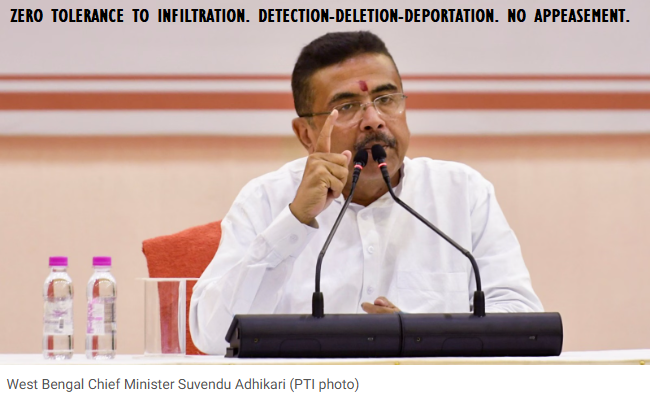
Zero Tolerance to Infiltration: Detection-Deletion-Deportation, No Appeasement
The Suvendu Adhikari-led government has reiterated its policy of “Zero Tolerance to Infiltration,” emphasizing a strict approach based on “Detection, Deletion, Deportation.” The administration has asserted that illegal infiltration poses serious demographic, economic, and security challenges to West Bengal, particularly in border districts. According to the government, individuals identified as illegal infiltrators will face removal from voter lists, cancellation of unlawful documents, and deportation in accordance with constitutional and legal procedures. At the same time, the government has stated that non-Muslim migrants from neighbouring countries who are residing in India without formal citizenship but are seeking protection under the Citizenship Amendment Act (CAA) will not face harassment or coercive police action while their cases are being processed under the legal framework. The BJP leadership has also declared that there will be “No Appeasement” in matters concerning national security and citizenship, stating that state policies will be guided by constitutional principles rather than vote-bank considerations.
..
_Agency Inputs.


 Struggle for Hindu Existence
[…] are grave but limited. A Hindu temple in Pakistan, reported to be a century old, was demolished. India condemned…
[…] promise behind the current emphasis. At a VHP meeting in Bhopal on 1 September 2026, leaders placed satsang, seva,…
[…] August 31, 2026, members of some Hindutva groups alleged religious conversion pressure at an ONQ corporate firm in Hyderabad.…
[…] reported New York formulation – “If Hindus think Muslims have no place, they cease to be Hindu” – carries…
I do not concur with the views of Mohan Bhagawat Ji