

[…] concrete case shows why precision matters. On 9 October 2026, Hindu protesters in the Dum Dum area were reported…

Struggle for Hindu Existence
*Hindu Rights to Survive with Dignity & Sovereignty *Join Hindu Freedom Movement to make Bharat Hindu Rashtra within this lifetime *Jai Shri Ram *Jayatu Jayatu Hindu Rashtram *Editor: Upananda Brahmachari.
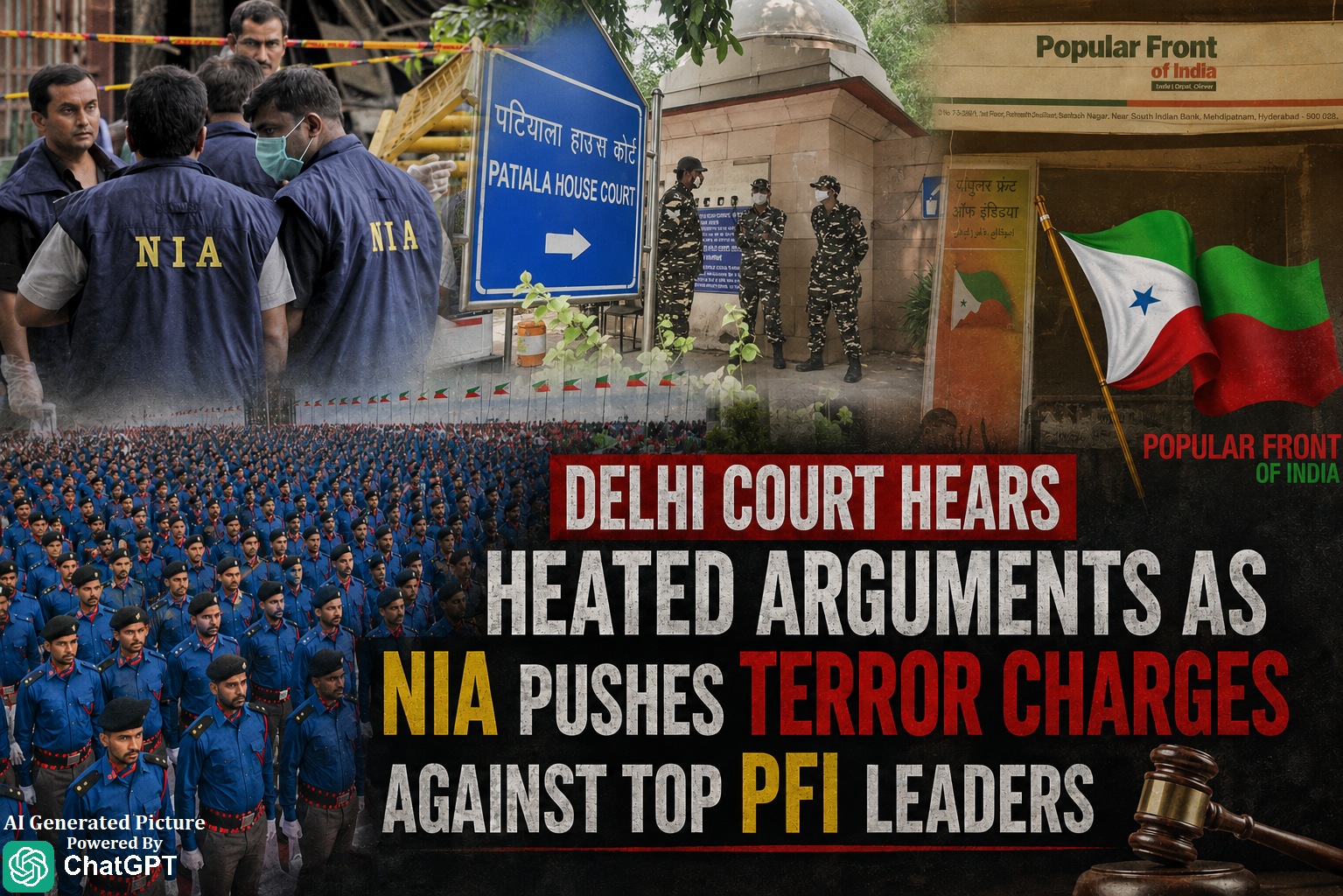
Delhi Court Hears Heated Arguments as NIA Pushes Terror Charges Against Top PFI Leaders.
 If RSS can call for a ‘Hindu Rashtra’ in Bharat, PFI can aspire to an ‘Islamic State’ in India: Heated arguments before Delhi court. Court orders framing of charges in terror case against top PFI leaders.
Upananda Brahmachari | HENB | New Delhi | June 6, 2026:: A Delhi court hearing the National Investigation Agency’s (NIA) case against the banned Popular Front of India (PFI) witnessed sharp exchanges between the prosecution and defence this week, as both sides concluded arguments on the framing of charges in a high-profile terror conspiracy case involving the organisation and its senior leadership.
After nearly three months of extensive hearings, Special Judge Prashant Sharma of the Patiala House Court reserved his order on whether charges should be formally framed against the accused. The case involves the PFI as an organisation along with 20 individuals alleged to have been part of a larger conspiracy to radicalise Muslim youth, promote communal hatred, and undermine national security.
Heated Debate Over Ideology and Nationalism
One of the most contentious moments during the proceedings came when defence counsel drew a comparison between the PFI’s alleged ideological objectives and the Rashtriya Swayamsevak Sangh’s (RSS) vision of a “Hindu Rashtra.”
Arguing on behalf of the accused, the defence contended that if the RSS could openly advocate the concept of a Hindu nation (Hindu Rashtra in Bharat), the PFI could not be faulted merely for aspiring to an Islamic nation (Islamic State in India). “If the RSS is right, how can they be wrong?” the defence reportedly argued before the court.
The NIA’s Special Public Prosecutor (SPP), Rahul Tyagi, strongly rejected the comparison. He maintained that the distinction lay in both intent and methods. According to Tyagi, the RSS is a nationalist organisation that neither seeks India’s destruction nor employs unlawful means to pursue its objectives. He further argued that “Hindutva is a way of life” and cannot be equated with the alleged activities attributed to the PFI.
NIA Calls PFI ‘Most Sinister Organisation’
During his final submissions, Tyagi described the PFI as “the most sinister organisation,” claiming that its activities, if left unchecked, could have pushed the country toward civil conflict.
The prosecution alleged that behind a public image centred on welfare, social upliftment, and socio-economic activities, the organisation was secretly pursuing a long-term strategy aimed at creating an Islamic state in India.
According to the NIA, PFI leaders systematically recruited young Muslim men and subjected them to ideological indoctrination. The agency alleged that these recruits were encouraged to develop hostility toward Hindus and were gradually prepared for what prosecutors described as a campaign of jihad intended to establish an Islamic order.
The agency further claimed that the organisation had devised a long-term plan to build a trained and organised force capable of advancing its objectives through violent means.
Alleged Links to Islamic State and Militant Networks
Among the most serious allegations presented before the court were claims that PFI cadres were encouraged to establish links with the terrorist organisation Islamic State (IS).
The NIA alleged that members were directed to travel to Syria to study the operational methods of IS and then replicate similar strategies within India. Prosecutors argued that such actions demonstrated the organisation’s intention to move beyond ideological mobilisation toward organised extremist activity.
Investigators also claimed that the PFI maintained lists of political and religious figures who had been identified as potential targets. According to the prosecution, certain internal units of the organisation allegedly prepared “hit lists” that included leaders associated with the Bharatiya Janata Party (BJP) and the Vishva Hindu Parishad (VHP).
The agency further alleged that PFI operatives sought assistance from surrendered militants to procure firearms and provide military-style training to cadres. Such activities, prosecutors argued, were part of preparations to wage war against the Indian state.
Broader Investigation and Ban
The case forms part of a wider investigation into the activities of the PFI, an organisation that was banned by the Union government in September 2022 under the Unlawful Activities (Prevention) Act (UAPA).
At the time of the ban, the Ministry of Home Affairs (MHA) cited alleged links between the organisation and extremist activities, as well as threats to national security. The government stated that law enforcement agencies across the country had registered more than 1,300 criminal cases involving PFI members.
These cases reportedly relate to allegations ranging from the murder of individuals associated with Hindu organisations to suspected terror training camps, radicalisation activities, and links with foreign terrorist organisations, including the Islamic State.
The MHA also referred to recoveries allegedly made from PFI members over the years. According to official claims, investigators seized documents relating to the manufacture of improvised explosive devices (IEDs), material advocating the transformation of India into an Islamic state, ammunition, weapons, marine communication equipment, and digital storage devices containing pro-IS content.
Defence Challenges Prosecution Narrative
Throughout the hearings, defence lawyers challenged the NIA’s allegations and questioned the interpretation of the organisation’s ideological objectives. They argued that political and ideological aspirations, in themselves, should not automatically be criminalised.
The defence has consistently maintained that the prosecution’s case relies heavily on interpretation rather than proof of actionable criminal conduct, while disputing claims that the organisation functioned as a terrorist network.
What Happens Next?
With arguments now concluded, the court will decide whether sufficient material exists to formally frame charges against the accused. If charges are framed, the matter will move into the trial stage, where evidence, witness testimony, and cross-examination will determine the validity of the allegations.
The outcome of the case is likely to have significant legal and political implications, not only for the individuals accused but also for broader debates surrounding national security, religious radicalisation, freedom of association, and the limits of ideological expression in India.
For now, the court’s forthcoming order will mark the next major step in one of the country’s most closely watched terrorism-related prosecutions.
…
_Agency Inputs.
2 comments on “Delhi Court Hears Heated Arguments as NIA Pushes Terror Charges Against Top PFI Leaders.”
Leave a Reply

[…] Gwalior, Bajrang Dal held a Trishul Diksha ceremony followed by a bike rally, with participating youth pledging to uphold…
Ok. Thank You brother for sharing this inmpoirtant information. Upananda Brahmachari, Editor in Chief, Struggle For Hindu Existence Website.
Great reporting! Just wanted to add a bit more context here. The Sarvjan Sanatan Party isn't actually a brand-new outfit—it…
[…] CBI director M. Nageswara Rao took charge as the party’s national president in Varanasi on 8 October 2026 while…


Pingback: Delhi PFI Terror Case Erupts: NIA Charges, and the ‘Hindu Rashtra’ vs ‘Islamic State’ Clash – DharmaRenaissance Blog
Pingback: PFI Prosecution: Why Rival State Ideologies Are Not the Test – DharmaRenaissance Blog