

Government Of India should stop the grants immediately. Let them get finance from elsewhere. Sincerely, Rajalakshmi Paramasivam

Struggle for Hindu Existence
*Hindu Rights to Survive with Dignity & Sovereignty *Join Hindu Freedom Movement to make Bharat Hindu Rashtra within this lifetime *Jai Shri Ram *Jayatu Jayatu Hindu Rashtram *Editor: Upananda Brahmachari.
Hindu Groups Storm Prayer Meet in WB’s Raniganj, Clash Erupts Over Christian Conversion Row.
Agitated Hindutva Mob Attacks Christian Prayer Gathering in Eastern India Amid Conversion Allegations.
Arnab Das Adhikari | HENB | Raniganj, West Bengal | June 24, 2026:: A Christian prayer gathering in eastern India was disrupted on Sunday after members of Hindu nationalist organizations allegedly stormed the meeting, accusing participants of carrying out religious conversions among local Hindu women. The incident has reignited debate over religious freedom, conversion laws, and communal tensions in West Bengal.
According to reports, the confrontation took place during a prayer service in Raniganj, located in West Bengal’s Purba Bardhaman district. Individuals identified by participants as members of the Vishva Hindu Parishad (VHP) and its youth wing, Bajrang Dal, and members of Bhairav Sena entered the gathering and challenged those present over allegations that Christian groups were attempting to convert Hindu women to Christianity. Such conversion ploys conducted by Christian missionaries have also been challenged in different parts of West Burdwan, according to local sources.
Videos circulating on social media appear to show a tense scene in which religious books were seized, worshippers were confronted, and Hindu religious slogans were shouted. Footage also reportedly shows participants being physically manhandled during the disruption.
One individual seen in the videos can allegedly be heard claiming that Christian groups were using the Bible to influence Hindu women to change their faith. The speaker further warned that the VHP and Bajrang Dal would oppose and prevent any such activities in the area.
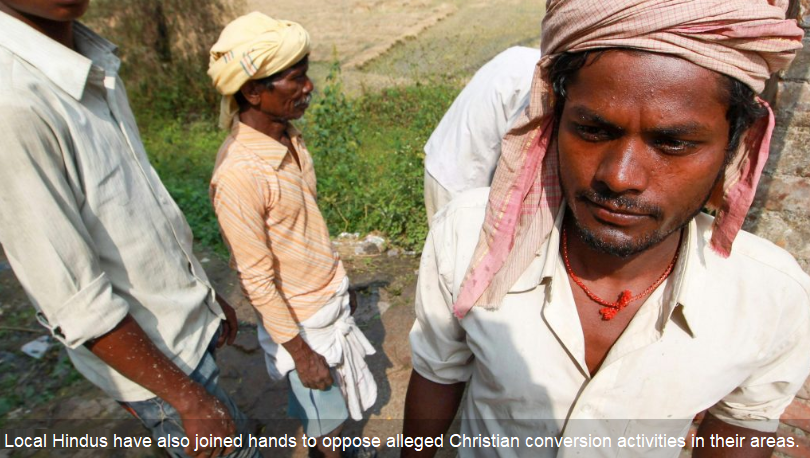
Christian women attending the gathering reportedly denied the allegations of coercion. According to participants, several women informed both the mob and police officials that they had adopted Christianity voluntarily and had not been subjected to force, threats, or financial inducements. Despite these statements, attendees said they continued to face intimidation during the confrontation. Local Hindus have also finally joined hands to oppose alleged Christian conversion activities in their localities.
Local sources indicated that approximately 25 people involved in the disturbance were later handed over to the police. However, authorities had not issued a detailed public statement regarding the incident at the time of reporting, and no official findings concerning the conversion allegations had been released.
The episode comes amid a politically significant period in West Bengal. The incident occurred only weeks after the Bharatiya Janata Party (BJP), India’s Hindu nationalist party, reportedly came to power in the state for the first time, ending 15 years of rule by the Trinamool Congress. Observers note that debates over religious conversion and minority rights have become increasingly prominent in several parts of India in recent years.
Unlike a number of BJP-governed states, West Bengal currently does not have a specific anti-conversion law. Such legislation, commonly referred to as “freedom of religion” laws by supporters, has been enacted in several Indian states to regulate religious conversions and penalize conversions carried out through force, fraud, or inducement.
Organizations advocating stronger anti-conversion measures argue that such laws are necessary to prevent unlawful religious influence and to maintain social harmony, particularly in sensitive border regions and areas experiencing demographic changes. Supporters contend that legal safeguards are needed to address concerns about religious proselytization and to preserve communal balance.
On the other hand, Christian groups, civil rights organizations, and religious freedom advocates have repeatedly expressed concern that allegations of forced conversion are often made without sufficient evidence and can be used to justify harassment, intimidation, or attacks on minority communities. These groups argue that individuals have a constitutional right to choose and practice their religion freely, provided no coercion or illegal inducement is involved.
The Raniganj incident highlights the growing tensions surrounding religious conversion debates in India, where competing concerns over religious freedom, community identity, and public order continue to fuel political and social controversy. As investigations proceed, attention is likely to remain focused on whether authorities can establish the facts surrounding the allegations while ensuring the protection of both religious liberty and law and order.
Broader Debate Over Conversion and Regulation
The incident has also revived wider discussions surrounding religious conversion patterns and the need for legal safeguards in West Bengal.
Supporters of stricter anti-conversion measures argue that allegations of organized conversion activities are reported predominantly in Hindu-majority localities, while similar claims are rarely raised in Muslim-majority areas. Some proponents contend that Muslim communities generally discourage or restrict missionary activities within their localities, resulting in Christian evangelical groups focusing their outreach efforts in nearby Hindu-populated regions.
The controversy has further intensified calls from Hindu organizations and sections of civil society for the introduction of an anti-conversion law in West Bengal. Advocates maintain that, given the state’s sensitive border location and recurring communal tensions, a legal framework regulating religious conversions is necessary to preserve law and order, prevent coercive or fraudulent conversions, and curb what they describe as religious expansionism or hegemony. They argue that such legislation would bring West Bengal in line with several other Indian states that have enacted laws governing religious conversions.
Opponents of such legislation, including Christian groups, civil liberties advocates, and religious freedom organizations, counter that existing laws are sufficient to address cases involving fraud, coercion, or inducement. They warn that anti-conversion laws can be misused to target minority communities and may undermine the constitutional right of individuals to freely choose and practice their religion. Critics, however, dispute such characterizations and argue that broad generalizations about religious communities require substantial evidence.
As debates over religious freedom, conversion, and social harmony continue, the Raniganj incident is likely to remain a focal point in the broader political and legal discussion surrounding faith-based outreach activities and communal relations in West Bengal.
…
_Agency Inputs.
2 comments on “Hindu Groups Storm Prayer Meet in WB’s Raniganj, Clash Erupts Over Christian Conversion Row.”
Leave a Reply

[…] immediate dispute is framed as a demand to shut Jamia Millia Islamia if alleged anti-Hindu and anti-national activity persists.…
[…] Akhil Bharatiya Sant Samiti, Ganga Mahasabha and Akhada Parishad plan to frame a Hindu Code of Condu…. This establishes…
[…] from a government that speaks in its name. In fact, the dignity of the Kumbh requires both. The Dhami…
[…] discipline matters because Left parties allege obstruction and vandalism of their bookstalls during Durga Puja events across We…. Allegation,…


Wholeheartedly support the activities of Hindu organizations protesting conversion into christianity
LikeLike
Pingback: Raniganj Prayer Meet Clash: Crucial Lessons on Conversion, Rights, and Social Trust – DharmaRenaissance Blog