


[…] present contest is often framed as Marxist history giving way to Hindutva history. More concretely, NCERT textbooks produced during…

Struggle for Hindu Existence
*Hindu Rights to Survive with Dignity & Sovereignty *Join Hindu Freedom Movement to make Bharat Hindu Rashtra within this lifetime *Jai Shri Ram *Jayatu Jayatu Hindu Rashtram *Editor: Upananda Brahmachari.
Amid Rising Attacks on Christian Conversion Rackets, Maharashtra Orders Statewide Audit of Church, Missionary Lands.
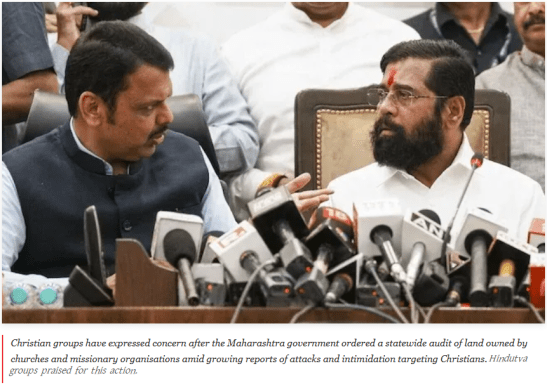
Maharashtra Govt. Launches Statewide Review of Church, Missionary Land Holdings Amid Rising Concerns Over Christian Conversion and their Safety.
 Upendra Bharti | HENB | Mumbai | July 8, 2026:: The Maharashtra government has initiated a statewide examination of land owned by churches, Christian missionary organisations and affiliated institutions, directing revenue authorities to complete a comprehensive audit within three months. The decision, announced during the Monsoon Session of the state legislature, comes at a time when Christian groups have been voicing increasing concern over harassment, disruption of religious gatherings and the broader climate surrounding religious minorities in the state.
Revenue Minister Chandrashekhar Bawankule said the exercise is intended to verify the legal status of land held by churches and missionary bodies, including properties originating from the colonial period as well as those acquired after Independence. According to the government, the review seeks to identify disputed ownership, unlawful transfers, encroachments and any violations of existing land regulations and growing hostality against Christians linked to rising Christian Conversion row.
Government Frames Exercise as Administrative Review
Addressing the Assembly, Bawankule maintained that the audit is part of the state’s ongoing efforts to modernise land administration and strengthen transparency in property records. He emphasised that institutions possessing valid ownership documents should not view the exercise as a cause for concern.
Officials said that where evidence of forged documents, illegal transfers or unauthorised occupation is found, the state will pursue legal measures to recover the land. The government has also indicated that each case will be examined individually before any action is taken.
The audit will be supervised by a committee headed by the respective Divisional Commissioner, with senior representatives from the Settlement Commissioner’s office, the Inspector General of Registration, the Revenue Department and the police participating in the review. In cases where disputed land has already been developed or is being used for public purposes, the committee will seek legal guidance before arriving at a final recommendation.
The announcement followed discussions in the Assembly over alleged irregularities involving the ownership and transfer of certain missionary properties, including disputes reported from Nashik and other parts of Maharashtra.
Tighter Rules for Agricultural Land Transactions
Alongside the land audit, the government unveiled new measures regulating the purchase of agricultural land across Maharashtra.
Under the revised framework, only individuals officially recognised as agriculturists will be eligible to buy agricultural land. Buyers must establish their status through revenue records, including the 7/12 extract, an official document containing details relating to land ownership, cultivation patterns, crop information and financial liabilities.
The government said the policy forms part of a wider initiative to improve digital land records, strengthen land mapping and prevent unauthorised transactions involving agricultural property.
Christian Organisations Voice Anxiety Over Timing
While the government has described the audit as a routine administrative exercise, its timing has drawn attention from Christian organisations that say the community is already facing growing hostility in several parts of Maharashtra.
Only days before the announcement, representatives from more than 25 Christian and civil society organisations, operating under the banner Mumbai for Peace, met the Mumbai Police Commissioner to express concern over repeated disruptions of prayer meetings by Hindu right-wing groups.
Members of the delegation alleged that activists had entered churches and prayer halls during worship services, accused Christians of engaging in unlawful religious conversions and circulated misinformation targeting the community. They appealed for stronger police protection and preventive action against those responsible for disrupting peaceful religious gatherings.
Religious Freedom Debate Extends Beyond Maharashtra
The developments also coincide with renewed international attention on India’s record regarding religious freedom.
Earlier this year, the U.S. Commission on International Religious Freedom (USCIRF) recommended that the United States designate India as a Country of Particular Concern (CPC), citing what it described as continuing violence, discrimination and intimidation directed at religious minorities. The commission also urged greater accountability for attacks allegedly linked to Hindu nationalist organisations.
New Delhi has repeatedly rejected USCIRF’s assessments, maintaining that the commission’s reports are selective, lack objectivity and fail to reflect India’s constitutional guarantees protecting freedom of religion.
Anti-Conversion Legislation Remains Contentious
The latest announcement follows Maharashtra’s approval earlier this year of the Freedom of Religion Act, legislation intended by the government to prevent religious conversions achieved through force, fraud or inducement.
Christian organisations and several civil rights groups had opposed the Bill, arguing that similar laws in other Indian states have frequently resulted in police action against pastors, prayer meetings and religious workers despite insufficient evidence of forced conversions. The state government, however, has maintained that the legislation is necessary to prevent coercive conversion practices while safeguarding genuine religious freedom.
Audit Likely to Face Close Public Scrutiny
Although the Maharashtra government insists the land audit is aimed solely at ensuring legal compliance and protecting public property, the decision has become part of a wider conversation about the treatment of religious minorities in the state.
Supporters argue that reviewing land records is a legitimate administrative responsibility that should apply equally to all institutions. Critics, however, contend that conducting such an exercise amid reports of increasing hostility towards Christians risks deepening apprehension within an already vulnerable community.
As authorities begin examining thousands of land records over the coming months, the transparency of the process, adherence to legal safeguards and handling of disputed properties are expected to remain under close observation from religious institutions, legal experts and civil society organisations alike.
…
_Agency Inputs.
One comment on “Amid Rising Attacks on Christian Conversion Rackets, Maharashtra Orders Statewide Audit of Church, Missionary Lands.”
Leave a comment


Pingback: Maharashtra’s Church Land Audit: Powerful Lessons in Law, Faith, and Trust – DharmaRenaissance Blog