

[…] The disputed words were reported as the slogan ‘Hindutva Murdabad.’ […]

Struggle for Hindu Existence
*Hindu Rights to Survive with Dignity & Sovereignty *Join Hindu Freedom Movement to make Bharat Hindu Rashtra within this lifetime *Jai Shri Ram *Jayatu Jayatu Hindu Rashtram *Editor: Upananda Brahmachari.
Criticizing RSS-BJP Narratives: Alternative Hindutva Portals & Channels Come Under Scanner.
Delhi Police Action Against Pro-Hindutva X Handles Sparks Debate Over Free Speech and the Future of Alternative Hindutva Media.
FIR, takedown notices, and a widening political controversy raise questions over online expression, selective enforcement, and ideological contestation. Among the names frequently mentioned in these discussions are Sandip Deo’s India Speaks Daily and the YouTube channels of Ajeet Bharti and Vishal Singh.
Upendra Bharti | HENB | New Delhi | July 30, 2026:: A recent action by Delhi Police against several prominent X (formerly Twitter) handles associated with the pro-Hindutva ecosystem has triggered a fresh political debate over free speech, online regulation, and the relationship between the ruling establishment and independent voices within the broader Hindutva movement.
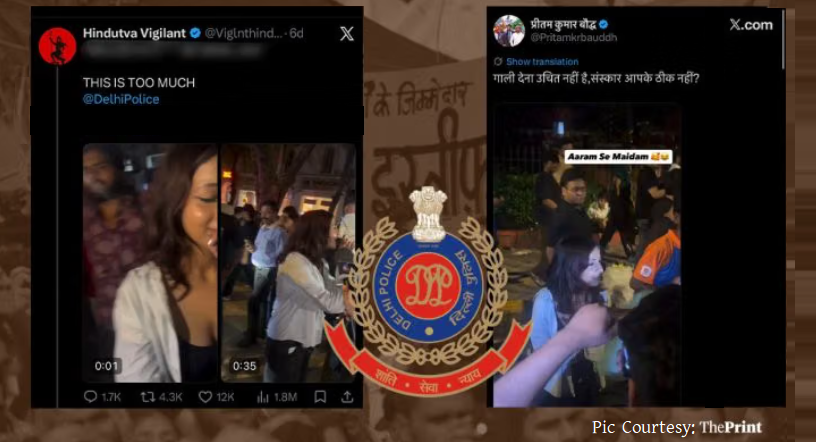
The Intelligence Fusion and Strategic Operations (IFSO) unit of the Delhi Police Special Cell has registered an FIR and issued notices to multiple X handles, including Jaipur Dialogues, Ratan Ranjan, Vigilant Hindutva, Saffron Chargers, Alpkanya, Deepika Bhardwaj, Besura Taansane, Pritamkrbauddh, and Practical Spy. The action follows allegations that the accounts circulated “derogatory, malicious and defamatory content targeting constitutional authorities.”
According to ThePrint, the police also served notices on X directing the platform to remove or disable access to identified posts within three hours while preserving subscriber information, electronic records, login details, and other digital evidence for investigation.
The FIR reportedly invokes Sections 351(3), 353(2), and 356(2) of the Bharatiya Nyaya Sanhita (BNS), relating to criminal intimidation, dissemination of false information, and criminal defamation.
Posts Linked to the ‘Sansad Chalo’ Protest
Police sources told ThePrint that the investigation stems from complaints alleging that objectionable social media content was circulated during and after the 20 July “Sansad Chalo” protest organised by the Cockroach Janta Party (CJP).
According to the complaint, some of the posts contained abusive remarks directed at Prime Minister Narendra Modi, Delhi Police, and personnel of the Central Armed Police Forces (CAPF).
One notice issued to X stated that the identified URLs were allegedly being used to disseminate “false, defamatory, manipulated and objectionable content” intended to tarnish the reputation of public personalities. The notice further argued that the continued availability of such content could adversely affect public order, fuel political controversy, and erode public confidence.
The police consequently directed X to remove or disable access to the identified content while preserving all associated digital records for evidentiary purposes.
Content Creators Question the Action
Among those receiving notices was content creator Ratan Ranjan, who questioned the basis of the police action.
Speaking to ThePrint, Ranjan said he had not posted anything abusive during the CJP protest and expressed surprise at receiving another police notice. He remarked that he could not understand why he continued to receive notices from jurisdictions governed by the Bharatiya Janata Party (BJP).
Similarly, activist Deepika Narayan Bhardwaj maintained that she had merely shared a screenshot from a video showing a protester carrying what she described as an “extremely derogatory” placard against Prime Minister Modi. According to Bhardwaj, her intention was to condemn the protester’s conduct rather than endorse it.
She further stated that after explaining the context of her post to the investigating officer, she voluntarily removed the content from X.
Beyond Law Enforcement: A Political Debate Emerges
While the police action has been presented as an exercise to curb defamatory and objectionable online content, it has also generated political debate extending well beyond the immediate investigation.
Supporters of the affected accounts argue that many of them have consistently backed the broader Hindutva movement and the BJP on numerous national issues. Consequently, they contend that the present action has surprised sections of the ideological support base.
Critics of the police action argue that the notices risk creating a chilling effect on political commentary by independent digital creators. They maintain that even content shared for criticism, documentation, or public discussion could potentially attract legal scrutiny if interpreted differently by investigating agencies.
Others, however, argue that online platforms cannot become spaces for abusive or defamatory content directed at constitutional authorities. They contend that law enforcement agencies are obligated to intervene whenever speech allegedly crosses legal boundaries established under criminal law.
Allegations of Pressure on Alternative Hindutva Voices
The controversy has also revived a larger debate within sections of the Hindutva ecosystem regarding the relationship between the Sangh Parivar and independent ideological influencers.
Some commentators and social media users have alleged that organisations affiliated with the Sangh Parivar—including the Rashtriya Swayamsevak Sangh (RSS) and the BJP—have adopted a more assertive approach toward independent voices that criticise or diverge from the official political narrative.
These allegations remain unverified and have not been publicly acknowledged by either the RSS or the BJP.
Nevertheless, the claims have gained traction on social media, where some users argue that independent Hindutva commentators increasingly face legal, administrative, or platform-related scrutiny whenever their views differ from those of the political establishment.
Among the names frequently mentioned in these discussions are Sandip Deo’s India Speaks Daily and the YouTube channels of Ajeet Bharti and Vishal Singh. At the time of writing, there has been no official confirmation from law enforcement agencies that these individuals or platforms are subjects of any formal investigation.
A Broader Question for India’s Digital Public Sphere
The episode highlights a broader challenge confronting India’s rapidly evolving digital information ecosystem: balancing the constitutional guarantee of free expression with the responsibility to prevent unlawful online abuse, misinformation, and defamation.
As social media increasingly shapes political discourse, law enforcement agencies face growing pressure to regulate allegedly unlawful content, while journalists, activists, and digital creators continue to raise concerns about transparency, consistency, and the potential impact of such actions on legitimate political expression.
Whether the present case ultimately proves to be a routine exercise in cyber law enforcement or becomes a defining moment in the debate over digital free speech and ideological pluralism within India’s political landscape will likely depend on the outcome of the ongoing investigation and any subsequent judicial scrutiny.
For now, the controversy has added another dimension to the national conversation on the limits of online speech, the role of the State in regulating digital platforms, and the evolving relationship between political power and independent voices in the age of social media.
Read also: Delhi Police Identify 2,873 Protesters With Criminal Records From Cockroach Protest CCTV Footage (via The Commune).
…
Inputs from ThePrint and others.
One comment on “Criticizing RSS-BJP Narratives: Alternative Hindutva Portals & Channels Come Under Scanner.”
Leave a Reply

[…] 14 October 2026, Anand Dubey resigned from Shiv Sena (UBT), citing ideological differences and sayin… Two facts therefore stand…
[…] 13 October 2026, multiple complaints were reported against CPI(M) leader and advocate Bikash Ranjan Bhattacharya in W…. The complainants…

[…] a reactionary state. This is worrying. Already, Hindu radicals have occupied public discourse and have won favours from some…
no you are a fool


Pingback: Police Scrutiny and the Future of Alternative Hindutva Media – DharmaRenaissance Blog