

[…] The disputed words were reported as the slogan ‘Hindutva Murdabad.’ […]

Struggle for Hindu Existence
*Hindu Rights to Survive with Dignity & Sovereignty *Join Hindu Freedom Movement to make Bharat Hindu Rashtra within this lifetime *Jai Shri Ram *Jayatu Jayatu Hindu Rashtram *Editor: Upananda Brahmachari.
Hindutva Retaliation Fuels Nepal’s Expanding Communal Violence including Mosque Attacks in Several Districts.
Nepal’s Communal Violence Spreads Beyond Sunsari: Mosques, Homes, and Businesses Attacked Amid Growing Religious Tensions nd Hindutva Retaliation.
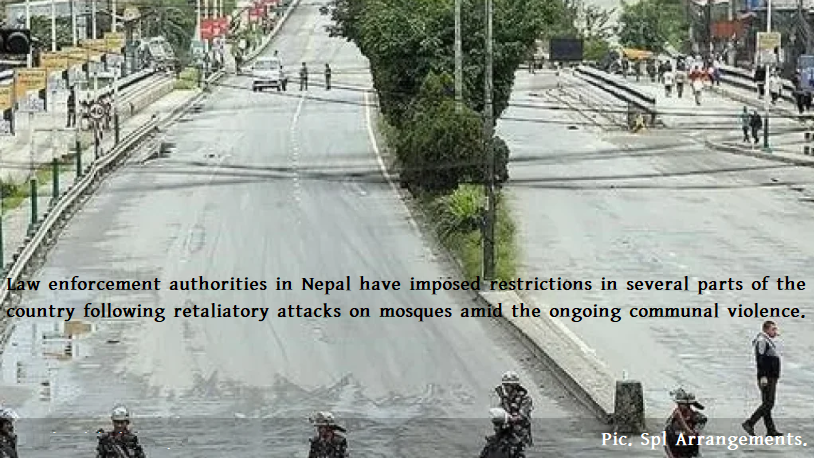
Upananda Brahmachari | HENB | Nrw Delhi | Aug 2, 2026:: Communal violence in Nepal has spread across multiple districts following clashes that first erupted in Sunsari in late July, leaving at least three people dead, dozens injured, and prompting authorities to impose curfews and deploy large numbers of security personnel. The unrest has been accompanied by attacks on mosques, Muslim-owned homes and businesses, and allegations of retaliatory violence by Hindu nationalist groups, while competing narratives over the causes of the conflict continue to fuel public debate.
The violence has raised concerns over Nepal’s fragile communal harmony and highlighted the growing influence of religious polarization in a country that, despite becoming a secular republic in 2008, remains overwhelmingly Hindu.
Violence Escalates Across Southern Nepal
According to reports and videos circulating on social media, communal violence that began in Sunsari District spread into neighboring Siraha, Dhanusha, and parts of Madhesh Province.
Multiple videos appear to show mobs setting fire to shops, damaging religious sites, and looting Muslim-owned businesses. Other footage shows individuals identified as Muslims being assaulted before police officers intervened.
Several videos also capture crowds chanting “Jai Shri Ram,” a Hindu devotional slogan that has increasingly featured during Hindu nationalist mobilizations across South Asia. The authenticity and complete context of every video could not be independently verified.
Shops, Mosques, and Homes Targeted
Among the incidents documented through eyewitness accounts and videos:
- A Muslim-owned vehicle repair workshop in Sunsari was reportedly set ablaze while crowds chanted religious slogans.
- At Phool Chowk in Bhokraha Narsingh Rural Municipality, the shop of Siraj Ansari allegedly suffered extensive damage, with local residents claiming that cash and merchandise worth hundreds of thousands of Nepali rupees were looted.
- A historic mosque in Koshi Rural Municipality was reportedly vandalized. Allegations include the burning of copies of the Quran and the assault of elderly worshippers. These allegations have circulated widely but remain subject to official investigation.
- In Golbazar of Siraha District, another mosque was reportedly attacked during a Hindu nationalist demonstration.
- The residence of Shoaib Anwar, the elected Ward 12 chair of Golbazar Municipality, was also reportedly set on fire.
- Separate videos show Muslim civilians allegedly being assaulted in Kaptanganj and Kasaha before police intervened.
Authorities have not yet released a comprehensive assessment of the total damage.
From Local Dispute to Province-Wide Unrest
Officials say the unrest originated on July 26 following a dispute involving loud music and religious flags during a Hindu procession in Sunsari. The disagreement escalated into stone-pelting, clashes with police, and eventually gunfire.
As violence spread, at least three people lost their lives and more than two dozen others were injured. Curfews were imposed across several districts while hundreds of police officers and security personnel, supported by the Nepal Army, were deployed to restore order. Schools remained closed in affected areas, markets shut down, and residents were advised to stay indoors.
Government Response Under Scrutiny
Prime Minister Balendra Shah addressed the nation several days after the violence began, promising an impartial investigation and legal action against those responsible.
However, opposition voices and civil society groups questioned whether the government’s response came too late, arguing that attacks had already spread across multiple districts before stronger intervention was announced.
Investigators are expected to examine the sequence of events, the role of local authorities, and whether sufficient preventive measures were taken as tensions escalated.
Competing Narratives Behind the Violence
The violence has generated sharply different interpretations among political observers, religious organizations, and commentators.
One narrative attributes the unrest primarily to rising Hindu nationalist mobilization, pointing to attacks on Muslim places of worship and businesses and the religious slogans heard during the incidents.
Another perspective, advanced by some Hindu organizations and commentators, argues that growing concerns over religious conversions, demographic change, and the increasing construction of mosques and churches have contributed to heightened tensions among sections of Nepal’s Hindu population. These groups allege that foreign-funded Islamic and Christian missionary activities have accelerated religious change in parts of the country.
These claims remain politically contested and require careful examination. No publicly available official investigation has established that such factors directly caused the current violence.
Historical Context
Although Nepal is often viewed as comparatively peaceful in terms of communal relations, religious tensions are not unprecedented.
One of the country’s most significant attacks on the Muslim community occurred in March 2008, when a bomb exploded inside a mosque in Biratnagar during evening prayers. Two people were killed and two others were injured.
At the time, police reported that two explosive devices had been thrown toward the mosque, one of which detonated. The Nepal Defence Army, an armed Hindu extremist group advocating the restoration of Nepal as a Hindu kingdom, claimed responsibility for the attack.
The incident underscored the presence of extremist elements capable of exploiting religious divisions.
The Broader Challenge
Nepal’s transition from the world’s only officially Hindu kingdom to a secular republic transformed the country’s constitutional identity but did not eliminate debates surrounding religion, national identity, and conversion laws.
Questions relating to religious freedom, conversion, demographic change, and cultural identity continue to generate political and social debate. At the same time, communal violence poses significant risks to public safety regardless of the underlying grievances.
The latest unrest illustrates how localized disputes can rapidly escalate into wider communal confrontations in an era of instant social media dissemination, making timely law enforcement intervention and credible public communication increasingly important.
With investigations underway, authorities face the challenge of establishing accountability for the attacks while preventing further retaliatory violence. The findings are expected to play an important role in shaping both public confidence and Nepal’s broader efforts to preserve communal peace in an increasingly polarized environment.
Earlier, Hindus in Nepal vehemently opposed the public slaughter of cows by Muslims in broad daylight.
Media Narratives and the Al Jazeera Coverage
The violence has also triggered debate over international media coverage of the unrest. Some Hindu organizations and commentators have criticized the reporting of the Qatar-based news network Al Jazeera, alleging that its coverage focused predominantly on attacks against Muslims and portrayed the violence chiefly through the lens of Hindu nationalism. They argue that the reporting did not sufficiently examine the broader political and religious context, including concerns raised by some Hindu groups regarding religious conversion, demographic change, and the expansion of Islamic and Christian institutions in Nepal. Al Jazeera, however, has reported extensively on the attacks against Muslim communities and the humanitarian consequences of the violence. These competing assessments underscore the broader debate over how international media frame complex communal conflicts and the importance of examining multiple sources before drawing conclusions.
…
_Agency Inputs.
One comment on “Hindutva Retaliation Fuels Nepal’s Expanding Communal Violence including Mosque Attacks in Several Districts.”
Leave a Reply

[…] 14 October 2026, Anand Dubey resigned from Shiv Sena (UBT), citing ideological differences and sayin… Two facts therefore stand…
[…] 13 October 2026, multiple complaints were reported against CPI(M) leader and advocate Bikash Ranjan Bhattacharya in W…. The complainants…

[…] a reactionary state. This is worrying. Already, Hindu radicals have occupied public discourse and have won favours from some…
no you are a fool


Pingback: Communal Violence in Nepal: Dharma Beyond Retaliation – DharmaRenaissance Blog