
Struggle for Hindu Existence
*Hindu Rights to Survive with Dignity & Sovereignty *Join Hindu Freedom Movement to make Bharat Hindu Rashtra within this lifetime *Jai Shri Ram *Jayatu Jayatu Hindu Rashtram *Editor: Upananda Brahmachari.
Hindus Under Persecution in Pakistan: UK Raises Its Voice, India Remains Silent!?
Pakistan’s Hindu Population Plunges from 14.6% to 1.7%: UK MPs to Raise Persecution with Government; Where Is India’s Response?
INSIGHT UK report documents decades of alleged persecution, dispossession and forced conversions; British Hindu parliamentarians seek diplomatic intervention as questions mount over India’s response to minority persecution in Pakistan and Bangladesh.
Upanada Brahmachari | HENB | New Delhi | Oct 29, 2026:: A new report on the historical and ongoing persecution of Hindus in Pakistan has brought the plight of the country’s religious minorities into the British parliamentary arena, prompting discussions about diplomatic intervention, possible restrictions on British aid and stronger protection for victims of religious persecution.
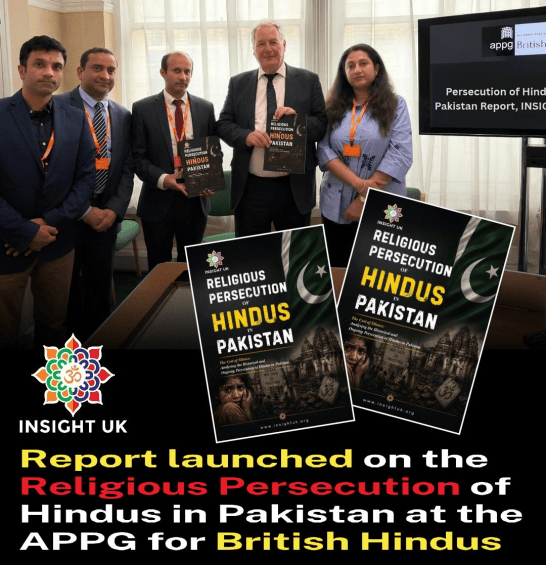
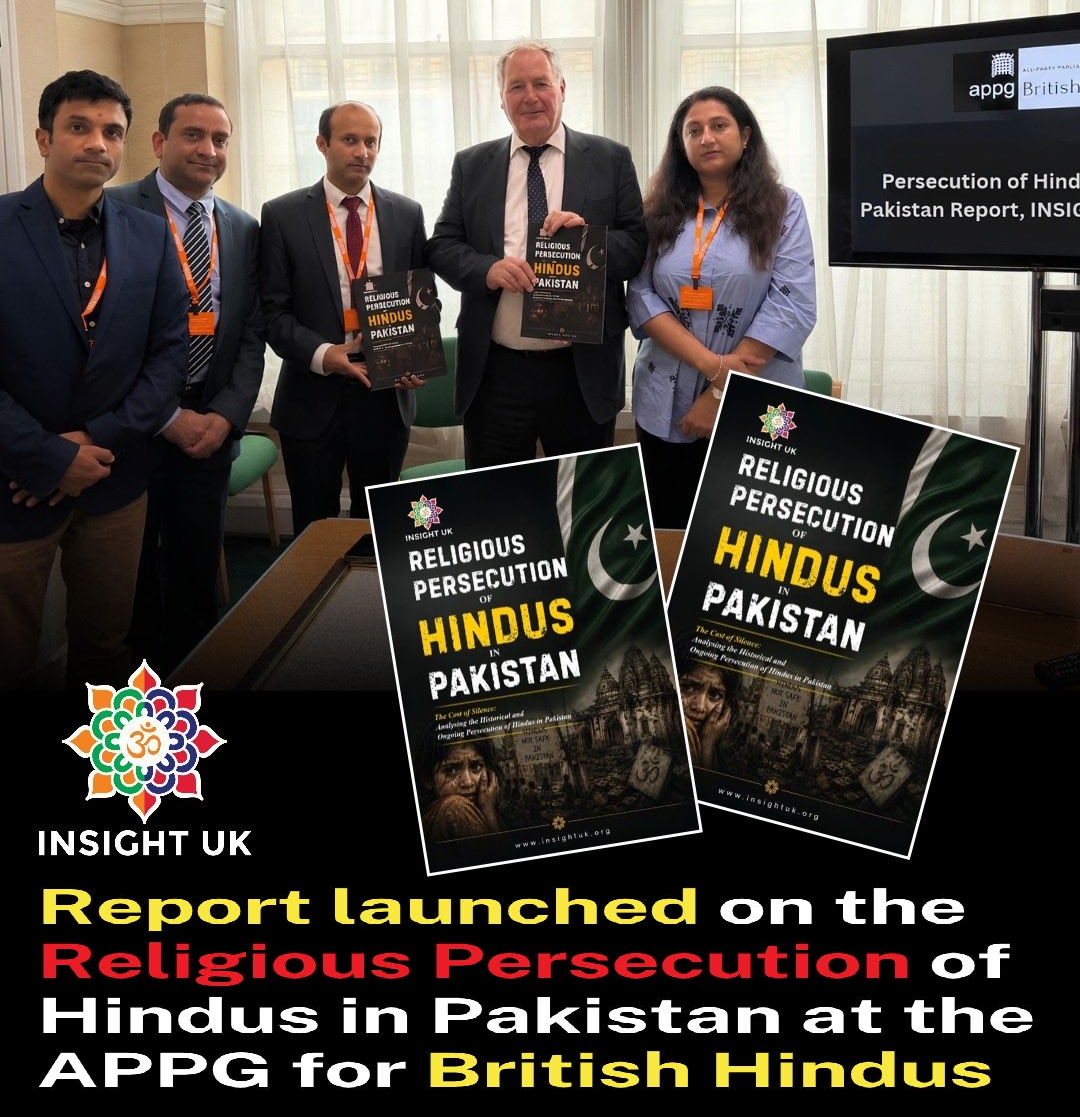
The report, titled The Religious Persecution of Hindus in Pakistan, was presented by British Hindu advocacy organisation INSIGHT UK before the All-Party Parliamentary Group (APPG) for British Hindus. Drawing on historical records and contemporary accounts, it documents allegations of religious discrimination, violence, dispossession, attacks on Hindu temples and the abduction, forced conversion and forced marriage of Hindu and Christian women and girls.
The initiative has also raised a pointed question for India’s political leadership: while Hindu representatives in Britain are pressing their government to address the persecution of Hindus in a neighbouring country, what concrete steps is India taking to protect Hindu minorities facing insecurity in Pakistan and Bangladesh?
From 14.6% to less than 2%: A demographic decline that demands scrutiny
One of the report’s most striking findings concerns the changing demographic position of Hindus in the territory that became Pakistan.
According to the 1941 Census of India, Hindus constituted approximately 14.6% of the population in the region that later became West Pakistan. INSIGHT UK’s report places their present share of Pakistan’s population at approximately 1.7%.
The figures highlight a dramatic change in the religious composition of the population over the decades since Partition in 1947. However, the historical and contemporary figures must be understood in their respective demographic contexts, including Partition-related migration, displacement, changes in territorial boundaries and subsequent population growth.
The report argues that the decline, alongside evidence of violence and discrimination, raises serious questions about the protection afforded to Hindu communities in Pakistan. It challenges Islamabad’s claims of safeguarding religious minorities and calls for greater international scrutiny of their circumstances.
The demographic transformation cannot, by itself, establish the causes of population change. Nevertheless, the report argues that its scale, when considered alongside documented cases of persecution and displacement, warrants sustained investigation and a stronger human-rights response.
Partition, displacement and the loss of ancestral property
The report traces the vulnerability of Pakistan’s Hindu community to the violence and upheaval surrounding Partition, when millions of people crossed the newly established borders amid widespread communal violence and displacement.
It documents allegations that Hindu families who fled Pakistan or were displaced during subsequent periods lost ancestral homes, agricultural land and other property under enemy property legislation. Such dispossession, the report argues, deprived families of their traditional livelihoods and contributed to prolonged economic hardship.
It also highlights the experiences of Hindus who left Pakistan during the 1965 India-Pakistan war and subsequently faced the loss of property and agricultural livelihoods.
For many affected families, the consequences extended beyond the immediate loss of land. The destruction of established economic foundations could leave successive generations struggling with poverty, insecurity and diminished opportunities.
The report presents these experiences as part of a broader pattern in which religious minorities have faced not only physical insecurity but also economic and institutional disadvantages.
Constitutional restrictions and religious freedom
A major concern raised by INSIGHT UK is the constitutional position of non-Muslims in Pakistan.
Articles 41 and 91 of Pakistan’s Constitution require the President and Prime Minister, respectively, to be Muslims. These provisions prevent Hindus, Christians and members of other non-Muslim communities from holding the country’s two highest executive offices.
The report argues that such constitutional restrictions institutionalise unequal access to the highest levels of political leadership, regardless of an individual’s qualifications or commitment to public service.
It also raises concerns about the practical exercise of religious freedom, including access to places of worship and protection against attacks on religious sites.
Islamabad’s long-running Hindu temple controversy is cited as an example. Plans for the construction of a Hindu temple in the Pakistani capital encountered opposition and protests in 2020, halting the project despite earlier official approval. The issue became a focal point in the wider debate over the rights of religious minorities to establish and maintain places of worship.
The report contends that constitutional guarantees and official assurances must translate into effective protection on the ground, including security for temples, freedom of worship and equal access to justice.
Forced conversions and marriages: The plight of Hindu and Christian girls
The report’s most disturbing allegations concern Hindu and Christian women and girls who are reportedly abducted, pressured or compelled to convert to Islam and subsequently married to their abductors.
INSIGHT UK cites estimates that more than 1,000 women and girls from these minority communities may experience abduction, forced conversion and forced marriage in Pakistan each year. Similar concerns have been raised in human-rights reporting, although precise annual totals remain difficult to establish.
According to the report, many victims come from economically disadvantaged families and are minors. Their families may face serious obstacles in pursuing legal remedies, particularly where questions of age, consent, religious conversion and the validity of marriages are disputed.
The alleged abuses have consequences extending far beyond individual cases. They raise questions about child protection, the independence of law enforcement, access to legal representation and the ability of minority families to obtain impartial investigations.
The report calls for stronger safeguards, prompt investigations, accountability for perpetrators and effective support for survivors. It also urges international partners to ensure that religious freedom and the protection of vulnerable women and children remain central to their engagement with Pakistan.
UK parliamentary group considers diplomatic intervention
The presentation of the report has prompted discussions within the APPG for British Hindus about raising the issue directly with the British Government.
According to a spokesperson for the APPG secretariat, one proposal was to write to the Foreign Office seeking a meeting to highlight alleged atrocities against religious minorities and encourage the department to raise these concerns with the Pakistani authorities.
The spokesperson also said that the possibility of requesting a reduction in British aid to Pakistan had been discussed.
These are proposals under consideration, rather than evidence that the UK Government has already adopted new aid restrictions or announced a specific diplomatic measure.
The initiative is significant because it seeks to move the issue beyond advocacy statements and into formal parliamentary and diplomatic channels. A letter to the Foreign Office could provide a mechanism for raising specific cases, seeking explanations from Pakistani officials and requesting measurable commitments to protect minority communities.
The APPG’s deliberations also underline the role that diaspora organisations and parliamentary groups can play in bringing human-rights concerns to the attention of policymakers.
Five demands placed before the British Government
INSIGHT UK’s report sets out five principal recommendations intended to strengthen the protection of Hindus and other religious minorities in Pakistan.
First, make minority protection a non-negotiable diplomatic priority. The report calls for the British Government to raise the protection of religious minorities in every relevant UK-Pakistan dialogue, with time-bound commitments on temple security, investigations and speedy trials.
Second, link British aid to measurable human-rights progress. It recommends making assistance conditional on demonstrable improvements in minority protection and ring-fencing funding for organisations working to defend the rights of vulnerable communities in Pakistan.
Third, strengthen independent monitoring. The report proposes reserving two positions at the British High Commission in Islamabad for members of minority communities, with the objective of improving the reporting of abuses and ensuring that minority concerns reach British officials directly.
Fourth, publish an official assessment every six months. It calls on the UK Government to commission and publish a biannual report examining the socio-economic circumstances of Hindus, Christians, Sikhs and other religious minorities in Pakistan.
Fifth, establish safe asylum pathways. The report urges the creation of accessible routes to protection for people who have suffered religious persecution, forced conversion or related abuses and who cannot safely remain in Pakistan.
It also urges the Foreign Secretary, the Prime Minister’s Special Envoy for Freedom of Religion or Belief, and the Indo-Pacific Minister to take up the issue.
The underlying argument is that religious freedom cannot be secured through declarations alone. It requires effective enforcement, transparent monitoring, access to justice and consequences for those responsible for abuses.
The question for India: Where is the comparable diplomatic pressure?
The British initiative raises a difficult question for India, which shares a border, a history of Partition and longstanding political and social ties with the region.
Why should British Hindu representatives have to press the UK Government to take up the persecution of Hindus in Pakistan, while India’s own Parliament and political leadership face continuing demands to demonstrate what they are doing to address similar concerns?
The question is particularly relevant to the Bharatiya Janata Party (BJP), which identifies itself with Hindutva and has repeatedly emphasised Hindu cultural identity and civilisational concerns in its political discourse.
The BJP holds a substantial presence in both Houses of Parliament. Official parliamentary listings show 240 BJP members in the Lok Sabha and 116 in the Rajya Sabha in the current figures displayed by the respective parliamentary websites.
That representation gives the party a significant platform for parliamentary questions, debates, resolutions and scrutiny of government policy. It does not, by itself, establish whether the party has adequately addressed the persecution of Hindus abroad.
The so-called Hindutva party, the Bharatiya Janata Party (BJP), holds 239 seats in the Lok Sabha (Lower House) and 113 seats in the Rajya Sabha (Upper House) of the Indian Parliament as of 2026. However, the party appears less concerned about the persecution of Hindus in neighbouring Bangladesh and Pakistan, including the huge decline in their share of the population in these countries.
The relevant question is what the party and the Indian Government have actually done: whether they have raised specific cases through diplomatic channels, sought accountability from the Pakistani authorities, pressed for protection of Hindu religious sites, assisted vulnerable families and maintained consistent engagement on the rights of minorities.
India has its own diplomatic and security considerations in dealing with Pakistan. Nevertheless, those considerations do not remove the need for transparency about the measures taken to protect vulnerable communities or to raise documented human-rights concerns.
A meaningful assessment would require a clear record of official statements, parliamentary interventions, diplomatic representations and humanitarian initiatives, rather than relying solely on political rhetoric.
Bangladesh: A related concern that requires separate scrutiny
The debate also extends to Bangladesh, where Hindu minorities have faced recurring concerns over communal violence, attacks on homes and businesses, vandalism of temples and threats to personal security.
These concerns have repeatedly prompted appeals from Hindu organisations and human-rights advocates for effective investigations, protection of religious sites and accountability for those responsible for attacks.
However, the demographic history of Hindus in Bangladesh is distinct from that of Pakistan and cannot be reduced to a single comparison. Partition, the 1971 Bangladesh Liberation War, migration, property disputes, population growth and changes in census methodology all form part of the historical context.
Any assessment of the decline in the Hindu share of Bangladesh’s population must therefore be based on comparable census data and a careful examination of the factors responsible for demographic change.
That qualification does not diminish the importance of investigating attacks on minorities. Rather, it strengthens the case for a systematic approach that combines reliable demographic analysis with documentation of individual incidents, institutional discrimination and failures of law enforcement.
India, as Bangladesh’s neighbour, has diplomatic channels through which it can raise minority-protection concerns. The extent and effectiveness of those efforts should be assessed through verifiable official records and outcomes.
From political rhetoric to measurable action
The INSIGHT UK report presents a challenge to Pakistan’s claims that it adequately protects religious minorities. Its allegations concerning forced conversions, the loss of ancestral property, constitutional restrictions and attacks on religious freedom call for transparent investigation and effective remedies.
The proposed British response also raises a wider policy question: how can governments use diplomatic engagement, development assistance and humanitarian protection to encourage better treatment of vulnerable communities?
For the UK, the next steps will determine whether the APPG’s discussions lead to formal representations, a parliamentary debate or policy recommendations. For Pakistan, the central test is whether it can provide effective protection, impartial justice and equal religious freedom to its Hindu and other minority citizens.
For India, the question is whether its political leadership can demonstrate a sustained, evidence-based response to the plight of Hindus in neighbouring countries, beyond expressions of concern.
The contrast highlighted by the British initiative is therefore not simply between two parliaments. It is between advocacy and implementation, between declarations of concern and verifiable action.
If the safety, dignity and religious freedom of minorities are universal human rights, their protection should not depend on the country in which they live or the political calculations surrounding them. The task before governments is to turn that principle into measurable protection, accountability and justice.
..
_Agency Inputs.


[…] distinction became concrete in a temple-entry dispute in which the Madras High Court said Tamil Nadu Chief Minister Vijay…
[…] distinction matters in Jaunsar-Bawar, where eight Muslim Van Gujjar families were reportedly evicted by Hindutva organisations amid allegations described…
Bhagyalakshmi Temple at Charminar holds deep religious and cultural significance for many devotees in Hyderabad. It is meaningful to learn…
Update:Jamia University orders student union polls within 15 days of constitution approval; two students continue hunger strike.See link: https://www.thehindu.com/news/cities/Delhi/jamia-university-orders-student-union-polls-within-15-days-of-constitution-approval-two-students-continue-hunger-strike/article71625645.ece .
Government Of India should stop the grants immediately. Let them get finance from elsewhere. Sincerely, Rajalakshmi Paramasivam