

[…] present contest is often framed as Marxist history giving way to Hindutva history. More concretely, NCERT textbooks produced during…

Struggle for Hindu Existence
*Hindu Rights to Survive with Dignity & Sovereignty *Join Hindu Freedom Movement to make Bharat Hindu Rashtra within this lifetime *Jai Shri Ram *Jayatu Jayatu Hindu Rashtram *Editor: Upananda Brahmachari.
Bengal’s Silent Conversion Conspiracy Sparks Hindu Backlash.
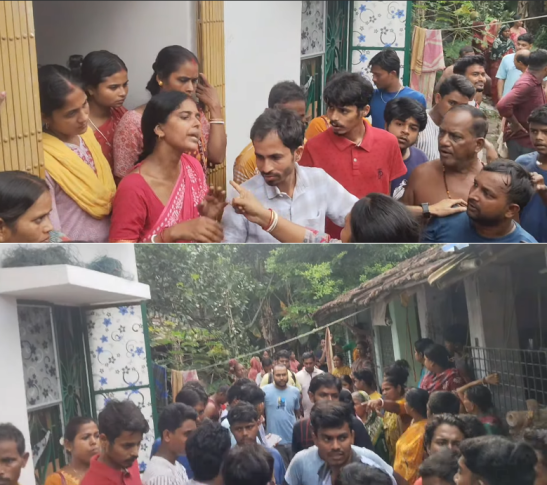
Christian Groups in Bengal Face Hindutva Outfits’ Hard Resistance Amid Conversion Allegations
Prayer services disrupted, churches vandalised and worshippers allegedly assaulted as disputes over proselytisation intensify across several districts…
Sankirtan Das | HENB | Kolkata | Sept 29, 2026:: In the hinterlands of West Bengal, largely beyond the sustained attention of the mainstream media, small Christian communities have increasingly found themselves at the centre of confrontations with Hindutva organisations amid allegations of religious conversion and proselytisation.
Since the Bharatiya Janata Party (BJP) came to power in West Bengal earlier this year, Christian groups have alleged a rise in hostility against their communities. A recent report by independent fact-checking website Alt News documented a series of incidents in which Hindutva organisations and other groups allegedly disrupted Christian prayer services, confronted worshippers, vandalised churches and, in some cases, physically assaulted members of the community. The groups involved have frequently cited allegations of forced conversion or proselytisation to justify their actions. Alt News said it had documented around 35 such incidents between July 1 and September 20.
At the same time, organisations associated with the Hindu side have alleged that some Christian groups are entering predominantly Hindu areas and attempting to attract economically and socially vulnerable people—including members of Scheduled Caste, Scheduled Tribe and Other Backward Class communities—towards Christianity through prayer meetings, claims of miraculous healing and other forms of religious outreach. Such allegations, however, are disputed by Christian representatives, who deny coercive conversion and say that the Christian Church does not support conversion through force, fear or unlawful inducement. Interestingly, such Christian operations are seen only in Hindu areas and not found in any single Muslim area.
Christian body alleges repeated attacks
The Bangiya Christiya Pariseba (BCP), a Christian organisation, has alleged that the incidents have increased across several districts in recent months.
BCP founder Herod Mullick told Alt News that police have registered FIRs in several cases but alleged that effective action against the perpetrators has been lacking. He further alleged that, instead of the attackers being held accountable, victims were sometimes taken to police stations.
“Over the past two-and-a-half to three months, such incidents have increased across districts, following a similar pattern. We have repeatedly sought a meeting with the Chief Minister, demanding an impartial investigation. But the government is not paying heed. So many people are being beaten, crosses are being broken, and someone or the other is being subjected to harassment every other day. The chief minister has not said a single word. We are all frightened and anxious,” Mullick told Alt News.
Responding to allegations of forced conversion, Mullick said that Christianity did not endorse conversion through coercion or fear.
“Conversion does not happen by simply gathering people and sprinkling water on them. False narratives are being deliberately created. The Christian Church is totally opposed to converting people forcefully or through fear. If any group is engaging in anything unlawful, we dissociate ourselves from it,” he said.
Mullick also distinguished between established churches and house churches. According to him, an established church is a long-standing congregation with its own church building, whereas a free or house church generally consists of smaller congregations, often made up of first-generation Christians, that are not affiliated with an established church. He said that most of the reported confrontations had involved such house churches.
Khejuri church confrontation
One of the most recent incidents occurred on September 20 at Dekhali Jalpai village in Khejuri Block II of East Midnapore.
According to Alt News, a group of around 50 people affiliated with the Vishva Hindu Parishad (VHP) and Bajrang Dal entered a church during a Sunday prayer service and demanded that it be shut down. A video from the incident reportedly shows one participant saying that “Christianity is not an Indian culture” and arguing that the Bible was neither written in India nor in an Indian language. The confrontation subsequently escalated, with worshippers allegedly being assaulted, heckled and manhandled.
Lucky Jana, who led the prayer, gave a somewhat higher estimate of the number of people who entered the premises.
“Around 12 noon, around 70-80 unknown men entered the church chanting ‘Jai Sri Ram’. They told us to stop the proceedings and warned us to close the church,” Jana told Alt News.
There were around 20 worshippers at the prayer service, he said. According to Jana, attempts to reason with the group failed and the confrontation turned violent.
“They physically heckled us. They pulled my collar and intimidated me. Multiple attendees got hurt. They even hit a juvenile—the grandson of the pastor,” he alleged.
Jana said the church had existed for approximately 28 to 30 years and that this was the first major incident of such intimidation, apart from isolated incidents during Christmas.
The church had anticipated a possible disruption and had sought police protection for its Sunday service. Two civic police personnel were reportedly present during the altercation. An FIR was also said to have been filed at Khejuri police station. According to the account cited by Alt News, the attackers subsequently locked the church and wrote “Ram” on its walls and doors.
The Times of India separately reported that the BCP alleged a mob of more than 50 people surrounded the Dekhali church during the prayer service. Police reportedly intervened and brought the situation under control, although the police had not confirmed whether an FIR had been formally registered in that particular case at the time of the report.
Amta family alleges pressure to renounce Christianity
Four days earlier, on September 16, Putul Manna and her husband, Kanchan Manna, residents of Ghoraberia Dakshin Bhatora village in Amta, Howrah, alleged that a group of men entered their home while they were conducting a prayer meeting.
According to the couple, the group threatened them with eviction and demanded that they renounce Christianity and embrace Hinduism. The Times of India reported the couple’s allegations and said Putul later lodged a police complaint.
“When we said we can’t renounce our faith, we were told we had to leave that night itself,” Kanchan was quoted as saying.
Other reports subsequently said the family alleged repeated intimidation over three days, including a second confrontation around their home. These allegations were contained in a complaint filed by the couple and should therefore be distinguished from independently established findings.
Prayer meeting disrupted in West Midnapore
On September 13, a group of saffron-clad men allegedly disrupted a Sunday prayer service at a house church in Sirni village in Talda, Dantan, West Midnapore. The group reportedly raised “Jai Sri Ram” slogans.
A video uploaded by one of the alleged disruptors, Indrajit Das, appears to show men confronting people attending the prayer service. One participant is heard saying that Christianity was not an Indian religion and making claims about the Indian government and Christian observances.
The confrontation reportedly developed into a heated altercation. The worshippers alleged that they were threatened with being tied to tree trunks if they did not comply with the demands of the group.
Ashalata Murmu, who was leading the service, later recounted the incident to The Times of India. According to her account, one of the men claimed that the government had ordered churches and mosques to remain closed and that such activities could no longer take place. When the worshippers disputed the claim, one of them was allegedly assaulted.
Bankura woman accused of conversion
A day earlier, a group of more than 20 men identifying themselves as members of Hindutva organisations, including the Hindu Jagran Manch and Bajrang Dal, allegedly confronted a woman, Tulsi Das, at her home in Shalpudanga village in the Joypur area of Bankura.
The men allegedly accused Das of forcibly converting Hindus to Christianity.
Das rejected the allegation. She said she was herself a Hindu but chose to pray to Jesus and maintained that doing so was not illegal. Three or four other women present at the house also denied that Das had offered or solicited money in return for religious conversion. They said she had told them that prayer could help with healing.
According to the account, the Hindutva activists allegedly threatened that Das would be suspended from the school where she taught and socially boycotted unless she wrote a letter admitting to the alleged “crime” of converting Hindus.
Video evidence cited in Kulpi incident
Alt News also cited a Facebook video uploaded by Raja Pramanik, who identifies himself as the head of the Bajrang Dal Kulpi unit.
The video reportedly shows members of the Bajrang Dal and VHP in Patkelberia village of Ishwarpur, Kulpi, confronting people whom they described as “Christian Jihadis”. According to the report, the group claimed that it had prevented Hindus from being converted to Christianity.
The video allegedly shows the group confronting elderly worshippers, shouting at them and tearing a Bible carried by an elderly woman. The worshippers were reportedly warned against continuing to pray to Jesus. Same situations were reported in Uluberia of Howrah District.
https://www.facebook.com/share/v/1D2R6e4PtG/
During the confrontation, one woman was allegedly threatened with the words, “Jib tene chirey debo (jodi ar ekta kotha Hindu dhrama bishwaser biruddhe balo)” (“I’ll tear your tongue out- if you say further anything agaist Hindu faith”).
The women at the house repeatedly maintained that they had neither forced anyone to visit them nor pressured anyone to embrace Christianity and that they were praying to Jesus by their own choice.
Dispute over conversion and cultural identity
According to Alt News, several recurring themes appeared across the incidents it documented. These included the raising of “Jai Sri Ram” slogans; claims that a “new Bengal” under BJP rule would not tolerate Christianity; assertions that Christianity was incompatible with Indian culture; and allegations that small private churches were engaged in forced conversion.
Some confrontations also centred on cultural practices. According to the report, participants in some of the disputes questioned why Christian women wore traditional Hindu-Bengali markers such as bangles and vermillion while following Christianity. In other cases, attackers reportedly pointed to statements by worshippers that they had begun praying to Jesus or embraced Christianity after experiencing relief from health problems.
These disputes have consequently extended beyond the question of religious conversion to broader arguments over cultural identity, religious practice and the place of Christianity within Bengali society.
Faith healing becomes another point of contention
The question of faith healing has emerged as another major point of dispute.
When Alt News asked pastors, evangelists and BCP founder Herod Mullick about claims of miraculous healing, they attributed such experiences to faith, collective prayer and an individual’s belief in recovery.
“We, on behalf of the Church,” Mullick said, “believe in a healing ministry. But it is not that a person is healed simply because of prayer. The person who comes to us develops a sense of faith.”
At the same time, Mullick said the Church did not support inviting people to practices such as jolpora or telpora, traditional water- and oil-based remedies or ritual treatments associated with folk healing practices in Bengal.
“If I invite people solely by promising healing, that too becomes a form of inducement, and we condemn it,” he said. “It is acceptable to say, ‘Come and pray to the Lord, have faith and you may get better.’ But saying, ‘Come to me and I will cure you’ is not right.”
Sindoor, bangles and Bengali Christian identity
Cultural practices have also become part of the controversy.
Evangelist Geeta Haldar said Christianity did not prevent believers from expressing themselves through local cultural traditions.
“Christianity does not restrict a person from expressing themselves or practising cultural traditions. A Christian couple may choose to apply sindoor during their wedding,” she said.
Mullick attributed some misconceptions about Christianity to its portrayal in popular films and other fictional representations.
“What we see in movies and similar fictional representations is a Westernised idea of Christianity. We are Bengalis, and because of our culture and traditions, Bengali Christians wear bangles (sakha-pawla) and apply sindoor. It is quite common,” he said.
He added that while some Christian denominations might not permit such practices, he did not believe they represented Christianity as a whole.
A widening confrontation
The incidents documented over the past several months point to a widening confrontation between Christian prayer groups and Hindu organisations in parts of rural Bengal. Christian representatives describe the incidents as intimidation and attacks on religious freedom, while Hindu organisations involved in the confrontations have generally framed their actions around allegations of religious conversion and proselytisation.
The central dispute therefore extends beyond individual prayer meetings. It involves competing claims over religious freedom, the legality and manner of proselytisation, faith-healing practices, cultural identity and the operation of house churches outside established church structures.
https://www.facebook.com/reel/1453361033282497
The allegations made by either side require case-by-case examination, including scrutiny of police complaints, FIRs, videos, witness accounts and any subsequent investigation. The reported incidents also underline the responsibility of law-enforcement authorities to prevent violence and intimidation while dealing impartially with allegations of unlawful conversion or coercive religious activity.
For the Christian community, BCP leaders have called for protection and impartial investigations. For Hindu organisations raising conversion concerns, the issue is whether religious outreach in predominantly Hindu localities is being conducted within the law and without coercion or inducement.
Hindu Organisations Raise Demographic Concerns
Hindu organisations involved in opposing Christian outreach have also raised a broader concern over what they describe as the possibility of demographic change in Bengal. According to these organisations, sustained religious outreach and alleged conversion activities in economically vulnerable Hindu-majority areas could, over time, affect the religious composition of certain localities, particularly where Scheduled Caste, Scheduled Tribe and Other Backward Class communities are concentrated. They argue that the issue should therefore not be viewed merely as a dispute over individual prayer meetings, but also in the context of Bengal’s changing demographic and religious landscape. Christian representatives, however, reject the allegation of an organised conversion drive and maintain that their religious activities are voluntary and that the Church does not support conversion through force, fear or unlawful inducement. The competing claims have added a demographic dimension to an already contentious debate over religious freedom, proselytisation and cultural identity in Bengal.
HENB Findings Point to a “Silent Conversion Conspiracy”
According to HENB’s own source authentication and ground-level inputs, the controversy is not confined to isolated prayer meetings or individual disputes. HENB has received information pointing to what its sources describe as a “silent conversion conspiracy” operating through organised Christian conversion rackets in parts of rural Bengal. The inputs indicate that paid young women and male youths are allegedly being engaged in organised religious outreach, particularly in economically vulnerable Hindu localities. HENB sources further claim that these Christian preachers and evangelists deliberately avoid Muslim localities and concentrate their outreach in Hindu-dominated areas, approaching Hindu men and women with messages promoting the “Love of Jesus” through various forms of inducement and faith-healing claims. According to the authenticated inputs, such outreach reportedly portrays human beings as sinners and presents faith in Jesus Christ as a means of redemption from sin, suffering and even ailments. HENB sources maintain that claims of miraculous healing and relief from diseases are used as an important component of this outreach. When local Hindu organisations question such activities or challenge claims made during prayer meetings, confrontations frequently follow, creating tension between the Christian groups and Hindu residents. Hindu organisations view these developments with particular concern because they fear that sustained conversion activity among vulnerable Hindu communities, especially SC, ST and OBC populations, could contribute to a gradual demographic and religious transformation of parts of Bengal. Christian representatives, however, deny any organised coercive conversion campaign and maintain that their religious activities are voluntary and that the Church does not support conversion through force, fear or unlawful inducement.
Unless these competing allegations are addressed through transparent investigations rather than street confrontations, the possibility of further tension between Christian groups and Hindu organisations remains a significant concern in several parts of Bengal.
…
_With Agency Inputs.
One comment on “Bengal’s Silent Conversion Conspiracy Sparks Hindu Backlash.”
Leave a comment


Pingback: Religious Conversion Conflict in Bengal: A Hindu Response – DharmaRenaissance Blog