
Struggle for Hindu Existence
*Hindu Rights to Survive with Dignity & Sovereignty *Join Hindu Freedom Movement to make Bharat Hindu Rashtra within this lifetime *Jai Shri Ram *Jayatu Jayatu Hindu Rashtram *Editor: Upananda Brahmachari.
Karnataka Hindu Convention Calls for Temple Liberation, Hindu Rashtra.
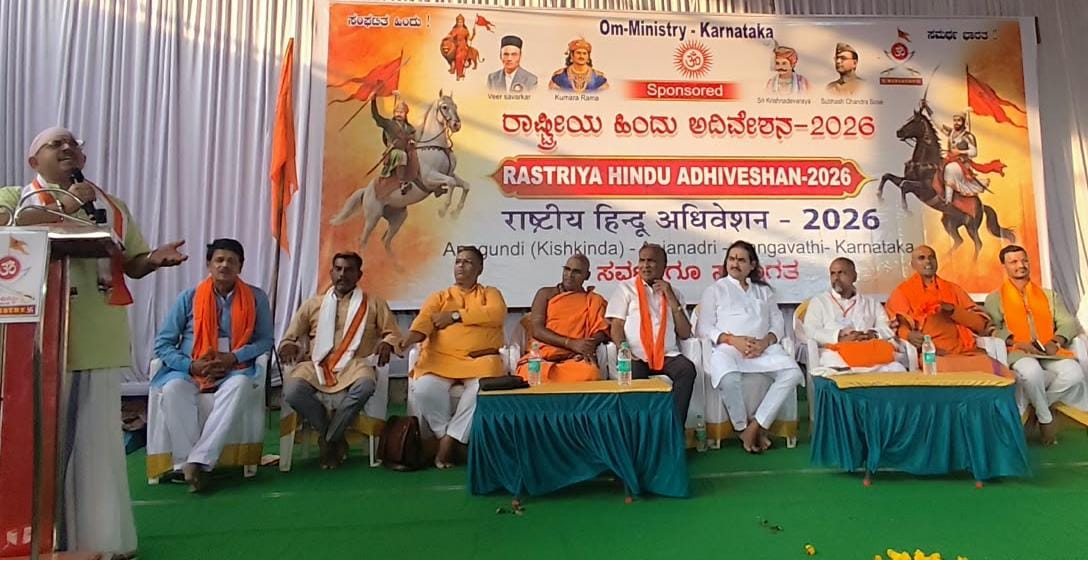
Hindu Leaders Call for National Movement to Free Temples from Government Control at Karnataka Convention.
Ramesh Shinde of HJS alleges government neglect of temple development despite substantial revenue generation; speakers call for Hindu unity, demographic safeguards and a Constitutional Hindu Rashtra. Upananda Brahmachari stressed for a Sanatan-Sanskritik, Samvidhanik and Sarvabhoum Hindu Rashtra in Bharat.
Upendra Bharti | HENB | Anegundi, Karnataka | Nov 16, 2026:: A National Hindu Convention (Rashtriya Hindu Adhiveshan) held on No 14-15 at Anegundi in Karnataka witnessed calls for an organised nationwide movement to liberate Hindu temples from government control, strengthen Hindu unity and address issues concerning religious conversions, alleged ‘Love Jihad’, ‘Land Jihad’ and the growing influence of the Halal economy. Speakers also stressed the need to protect Hindu culture, traditions and religious institutions, with some advocating the establishment of a Hindu Rashtra in Bharat through constitutional means.
Anegundi, Karnataka, situated within the Kishkindha circuit, is renowned as the sacred birthplace of Hanuman (Anjanadri Hills). It is also home to several other sites, including Bali Cave, Rishyamukh Hill, Chintamani Hills, Mallavata Phatak Shila and Madhuvan, which are associated with Prabhu Ram’s Vanvas (forest exile) and the search for Mata Sita (Sita Anveshan).
Ramesh Shinde, National Spokesperson of the Hindu Janajagruti Samiti (HJS), strongly criticised government control over Hindu temples, alleging that while temples generate substantial revenue for government exchequers, their development and the welfare of devotees remain neglected. He called upon Hindus to launch an organised and intensive struggle to secure the freedom of temples from government administration.
Addressing the National Hindu Convention, organised under the leadership of Om Ministry-Karnataka, Shinde pointed out that governments were primarily interested in the revenue generated by Hindu temples but failed to ensure their proper maintenance and development. He further alleged that places of worship belonging to other religions were not subjected to similar government interference.
He questioned the rationale behind collecting substantial revenue from temples without providing corresponding facilities and infrastructure for devotees. According to him, temples should receive development funds and essential amenities in proportion to the revenue they generate. He emphasised that providing basic infrastructure, improving temple facilities and ensuring the welfare of devotees must be treated as priorities.
Shinde maintained that the liberation of temples from government control could not be achieved without collective Hindu mobilisation and urged the community to unite for the cause.
The convention was held at the premises of the Sri Devi Durga Mata Go Shala (Cow Protection Centre), also described in the supplied event account as the Goshala of the Sri Adishakti Temple, situated on a hill at Anegundi, a historically significant location in the taluk. The gathering brought together Hindu religious leaders, organisational representatives and public figures from different backgrounds.
Calls for Hindu Unity and Action Against Religious Conversion
Dhananjay Jairam Desai, identified in the event inputs as a founding president of the Hindu Raksha Dal and also as the chief of the Hindu Rashtra Sena, addressed the gathering and called for greater Hindu unity and vigilance. He urged Hindus to remain alert to what he described as ‘Love Jihad’ and the conversion of individuals to Christianity, issues that he said required serious attention from the Hindu community.
Desai also stressed the importance of dialogue and collective action to establish a Hindu Rashtra in Bharat, arguing that the present circumstances offered an important opportunity for the Hindu community to pursue this objective.
Warning against losing the opportunity through organisational divisions or delays, he stated:
“If Hindus cannot achieve a Hindu Rashtra at this favourable time, the mission of Hindu Rashtra will be ruined with the passage of time, as Muslims and the PFI are jointly marching towards creating a further Pakistan within India.”
His remarks reflected his concerns about alleged attempts to create political and demographic conditions that, in his view, could threaten India’s national and cultural identity.
Demographic Change, Land Jihad and Halal Economy Among Key Concerns
Several speakers at the convention raised concerns about demographic changes and their perceived implications for Hindu society, culture and traditions. They called for measures to address what they described as unchecked Muslim population growth and its potential impact on the demographic composition of different regions.
The speakers also highlighted issues such as ‘Land Jihad’, ‘Love Jihad’, religious conversions and the Halal economy, arguing that these developments required greater public awareness and appropriate legal and institutional responses.
They maintained that safeguarding Hindu religious institutions, land, cultural heritage and traditional practices should form part of a broader strategy for protecting Hindu society. The discussions placed particular emphasis on temple autonomy, religious freedom, demographic concerns and the need for a coordinated organisational response.
Upananda Brahmachari Advocates a Constitutional Hindu Rashtra
Upananda Brahmachari, Editor of Hindu Existence, who represented the organisation at the convention, stressed the need to establish a Dharmik-Cultural, Constitutional and Sovereign Hindu Rashtra in Bharat.
In his address, Brahmachari argued that addressing individual problems in isolation would not resolve the wider challenges confronting Hindu society. He maintained that the issues of religious conversion, alleged ‘Love Jihad’, land-related disputes and the Halal economy were interconnected concerns requiring a comprehensive national approach.
Explaining his position, Bharhmachari observed:
“If the problem of Love Jihad is solved, the problem of Land Jihad will remain. If temples are freed from government control, the scourge of the Halal economy or religious conversion will not disappear. Hence, we need a declared Hindu Rashtra where all these anti-Hindu menaces can be regulated under appropriate laws and through institutional mechanisms.”
He emphasised that the proposed Hindu Rashtra should have a Dharmik and cultural foundation while being established through constitutional principles and sovereign national institutions. He argued that merely resolving administrative disputes or addressing individual incidents would not be sufficient to protect Hindu religious and cultural interests in the long term.
Brahmachari’s intervention thus placed the demand for temple freedom within a broader framework of Hindu religious, cultural and constitutional aspirations.
Prominent Personalities Attend the Convention
The convention was attended by several prominent personalities, political representatives and religious figures.
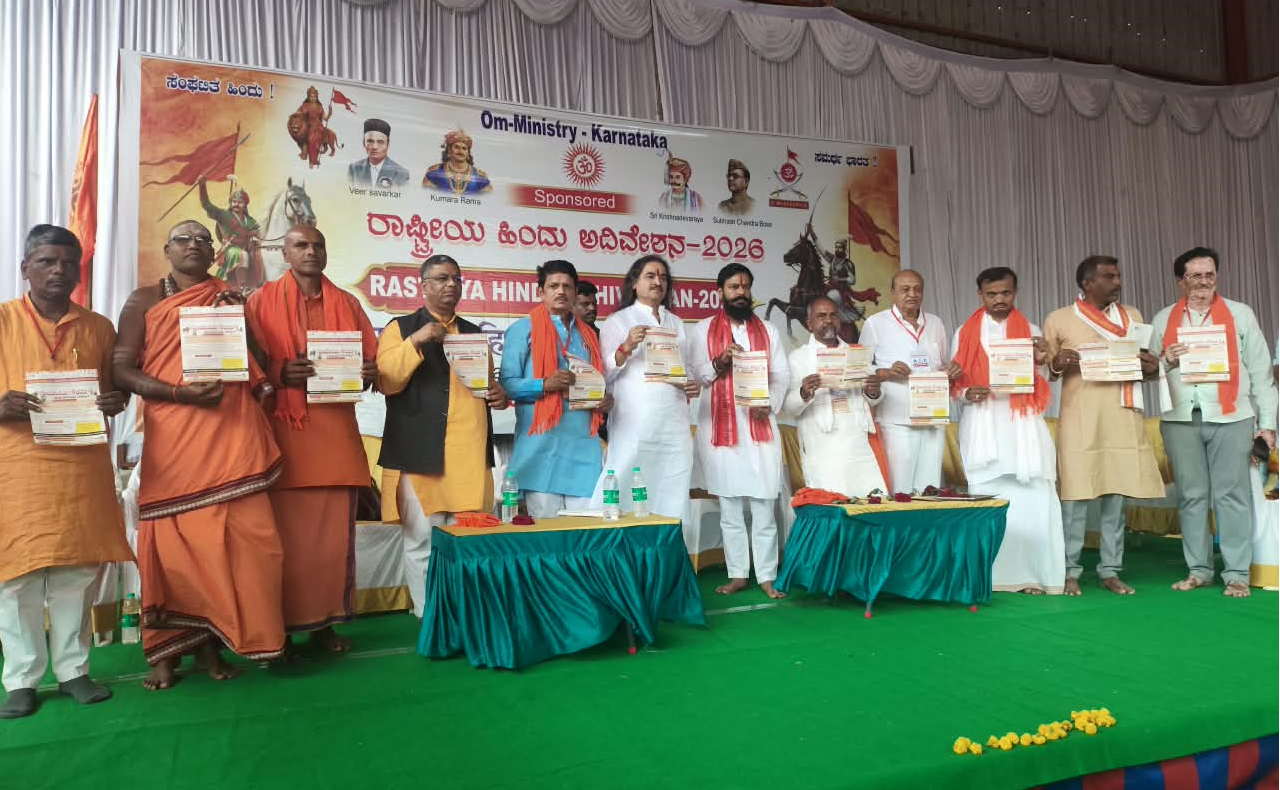
Those present included former MLA Paranna Munavalli; former MP S. Shivaramanagowda; Upananda Brahmachari from Kolkata; Shravan Kumar Raikar, Karnataka State Convener of the organising body and Convener of Om Ministry Karnataka; Raju Nayak, State Working President of the JDS Youth Wing; Dhananjay Jairam Desai; Ramanananda Guruji; Brahmananda Guruji of the Anegundi Durga Mata Goshala; Sandeep Guruji- President K’taka Chapter Hindu Rashtra Sena; eminent social worker Ugamaraj Jain; Raghunath Pawar; Gopal Swamy; Om Shiva; and other Hindu social and religious representatives.
During the convention, several resolutions supporting Hindu causes were adopted, reflecting the concerns and demands raised by the participating speakers.
The deliberations centred on freeing Hindu temples from government control, strengthening Hindu organisational unity, addressing religious conversion and demographic concerns, protecting Hindu cultural traditions and pursuing the establishment of a Dharmic-Cultural, Constitutional and Sovereign Hindu Rashtra in Bharat.
A rich Kannada song and dance performance was also presented at the function, which mesmerised the audience as well.
…
_Agency Inputs.


[…] immediate fact is narrow: the Hindu Janajagruti Samiti staged protests in Mumbai and Kolhapur, objecting to scenes it says…
[…] November 2026, a protest over an alleged conversion network in Burdwan reportedly turned violent; people described as members of…
[…] present concern is not merely demographic. INSIGHT UK has assembled allegations of decades of persecution and dispossession affecting Hindus…
[…] distinction became concrete in a temple-entry dispute in which the Madras High Court said Tamil Nadu Chief Minister Vijay…
[…] distinction matters in Jaunsar-Bawar, where eight Muslim Van Gujjar families were reportedly evicted by Hindutva organisations amid allegations described…