
Struggle for Hindu Existence
*Hindu Rights to Survive with Dignity & Sovereignty *Join Hindu Freedom Movement to make Bharat Hindu Rashtra within this lifetime *Jai Shri Ram *Jayatu Jayatu Hindu Rashtram *Editor: Upananda Brahmachari.
Thiruparankundram Deepathoon Row: VHP Slams TVK Govt for Defying SC Order, Warns Anti-Hindu Politics Nearing Extinction.
Deepathoon Row: Anti-Hindu Politics Nearing Extinction, Says VHP; Seeks Action Against TVK Government Over Defiance of Supreme Court Order.
Upananda Brahmachari | HENB | New Delhi | November 26, 2026:: The controversy over the traditional lighting of the Karthigai Deepam at the disputed Deepathoon atop Thiruparankundram hill near Madurai has escalated into a major confrontation involving the Tamil Nadu government, Hindu religious organisations and the judiciary. The Vishva Hindu Parishad (VHP) has strongly condemned the state government’s failure to implement the Supreme Court’s interim direction, describing it as an affront to Hindu religious sentiments, the Constitution and the authority of the judiciary.
VHP International President Alok Kumar, a senior advocate of the Supreme Court of India, accused the TVK-led Tamil Nadu government of displaying an obstinate anti-Hindu attitude by preventing the observance of a centuries-old religious tradition despite an express direction from the country’s apex court.
Kumar asserted that politics driven by hostility towards Hindu religious practices was nearing extinction in India’s political landscape and expressed confidence that such a political approach would soon disappear from Tamil Nadu as well.
The VHP’s statement comes amid a rapidly developing legal dispute following the Supreme Court’s November 20 interim order permitting the ceremonial lamp to be lit at the Deepathoon on November 24, subject to specific safeguards. The failure to conduct the ritual at the disputed pillar has subsequently triggered fresh proceedings, demands for enforcement of the apex court’s order and allegations of contempt against the state administration.
Supreme Court’s November 20 order: One-time permission to light the Deepathoon
The immediate legal developments began on November 20, when a Supreme Court Bench comprising Justices Aravind Kumar and Vipul M. Pancholi passed an interim order permitting the lighting of the traditional Karthigai Deepam at the disputed Deepathoon on November 24.
The order came while the apex court was hearing appeals filed by the Tamil Nadu government challenging the Madras High Court’s January 6, 2026 judgment, which had upheld the direction to light the lamp at the stone pillar.
The Supreme Court permitted a restricted team authorised by the Arulmigu Subramania Swamy Temple administration to perform the ceremony. The Madurai District Collector was appointed the nodal officer to coordinate the arrangements in consultation with the temple’s Executive Officer, the Archaeological Survey of India (ASI) and the Madurai Police Commissioner.
The apex court also stipulated the following safeguards:
-
Only authorised temple representatives and necessary government officials could access the Deepathoon.
-
Members of the general public were not permitted to accompany the team.
-
No procession, public gathering, demonstration or slogan-raising was allowed at the site.
-
The authorities were required to ensure adequate police protection, with the possibility of deploying the Central Reserve Police Force (CRPF), if necessary.
-
No excavation, permanent construction or structural alteration was permitted.
-
The lawful access to the Sikandar Badusha Dargah and mosque, along with worship at customary religious locations, was to remain undisturbed.
Importantly, the Supreme Court clarified that the permission was a strictly limited, one-time interim arrangement. It would neither establish an existing customary right nor recognise any claim concerning ownership, possession or religious rights over the disputed location.
The Court also stayed paragraphs 1–140 of the Madras High Court’s January 6 judgment, insofar as they concerned the issues under consideration before it, pending further orders.
The District Collector was directed to submit a compliance report within three days after the festival. The matter was scheduled for further consideration, with final arguments expected in the second week of January 2027.
Tamil Nadu government files review petition against the Supreme Court order
Despite the Supreme Court’s interim direction, the Tamil Nadu government’s Hindu Religious and Charitable Endowments (HR&CE) Commissioner moved a review petition challenging the November 20 order.
The petition was filed late on November 21, seeking reconsideration of the apex court’s decision permitting the Deepathoon ceremony.
The government’s challenge came even though the Supreme Court had already specified that the permission was temporary and would not confer any permanent religious, customary or proprietary entitlement on the petitioners.
The review petition subsequently became an important issue before the Madurai Bench of the Madras High Court on November 24. The High Court made it clear that merely filing a review petition before the Supreme Court did not absolve the state authorities of their obligation to comply with the existing judicial direction.
Madras High Court’s November 24 intervention: Officials reminded of constitutional obligations
An important judicial development took place on November 24, the very day scheduled for the Karthigai Deepam ceremony.
The Madurai Bench of the Madras High Court, comprising Justice G.R. Swaminathan and Justice M.D. Sumathi, heard a batch of five writ petitions challenging the district administration’s restrictions and seeking implementation of the Supreme Court’s November 20 order.
The petitions were prompted by a prohibitory order issued by the Madurai District Collector on November 23 under Section 163 of the Bharatiya Nagarik Suraksha Sanhita (BNSS), 2023.
The petitioners apprehended that the restrictions might be used to obstruct the Supreme Court-directed ceremony at the Deepathoon. They also sought permission for devotees to witness the lighting from surrounding public areas and to undertake their customary Girivalam (circumambulation of the hill).
District Collector Nishant Krishna, IAS, appeared personally before the High Court following its direction.
Justice Swaminathan recorded the Collector’s assurance that the prohibitory order was intended only to prevent unauthorised persons from climbing the hill and would not obstruct anything undertaken in compliance with the Supreme Court’s November 20 direction.
The High Court made a significant observation concerning Article 144 of the Constitution, which mandates that all civil and judicial authorities throughout India act in aid of the Supreme Court.
The Bench reminded the Collector that, as a public servant entrusted with implementing the apex court’s direction, he was constitutionally bound to comply with it. It specifically cautioned that he should disregard any contrary advice from other authorities.
The High Court also referred to the legal principle laid down in Israr Ahmad Khan v. Amarnath Prasad (2026 SCC OnLine 322), observing that filing a review petition does not suspend the obligation to comply with an existing judicial order unless the court grants an appropriate stay.
Consequently, the officials could not cite the pendency of the government’s review petition as an excuse for non-compliance.
High Court protects devotees’ right to Girivalam
The High Court also addressed concerns that the prohibitory order could interfere with the religious freedoms of devotees under Article 25 of the Constitution.
It directed that the restrictions must not be implemented in a manner that prevented devotees from undertaking the customary Girivalam around Thiruparankundram hill or assembling at suitable vantage points to witness the Deepam burning on the hill.
The Court, however, clarified that members of the public could not climb the hill itself.
Referring to the Supreme Court’s ruling in Gulam Abbas v. State of Uttar Pradesh, the Bench emphasised that administrative convenience or apprehensions about possible disturbances could not justify unnecessarily restricting the lawful religious activities of devotees.
John Doe injunction against calls to defy Supreme Court orders
Another significant aspect of the November 24 judgment was the High Court’s intervention against public calls for disobedience of the Supreme Court’s order.
The Bench observed that although judicial decisions could be criticised, even strongly, nobody could claim the liberty to openly incite others to disregard or violate an order of the Supreme Court.
Taking note of submissions made by the petitioners, the High Court issued a John Doe injunction restraining members of the general public from calling for the violation of the apex court’s November 20 order.
The Court eventually disposed of the five writ petitions after the state government’s counsel assured it that the Supreme Court’s directions would be complied with.
It also expressed hope that persons detained unlawfully by the police, including advocate Kutralanathan of Tirunelveli, would be released without delay.
The November 24 proceedings were particularly significant because the High Court explicitly reminded the administration of its constitutional obligations immediately before the scheduled religious ceremony.
November 24: Deepathoon remains unlit despite Supreme Court permission
Despite the Supreme Court’s November 20 direction and the Madras High Court’s intervention on November 24, the ceremonial lamp was not lit at the disputed Deepathoon.
Instead, the Karthigai Maha Deepam ceremony was conducted at the traditional Deepa Mandapam near the Uchipillaiyar Temple, as had been customary in previous years.
The temple administration reportedly maintained that its trustees had unanimously resolved to follow the established temple practice, under which the lamp was to be lit at the Deepa Mandapam rather than at the disputed stone pillar.
This development triggered serious objections from the original petitioners, who alleged that the temple administration’s decision had effectively frustrated the Supreme Court’s direction.
The controversy also intensified after questions were raised about a statement issued in the name of the temple’s Board of Trustees asserting that the ceremony should take place only at the traditional location. Petitioners’ counsel claimed that the temple’s sthanikars (traditional temple functionaries) had denied issuing such a statement.
The district administration, meanwhile, maintained that it had taken the necessary steps to implement the Supreme Court’s order, including communicating with the temple administration and requesting it to authorise a team for the ceremony. According to the administration, the temple had failed to nominate an authorised team until the last moment.
Thus, while the traditional Deepam ceremony was conducted, the specific ritual permitted by the Supreme Court at the Deepathoon remained unperformed.
November 25: Supreme Court examines non-compliance and seeks formal applications
The matter returned to the Supreme Court on November 25, when the original petitioners, including Rama Ravikumar, urgently mentioned the alleged non-compliance before the Bench of Justices Aravind Kumar and Vipul M. Pancholi.
The petitioners alleged that the state authorities had deliberately circumvented the November 20 order through administrative manoeuvres and had allowed the festival to conclude without implementing the direction.
Senior Advocate Guru Krishnakumar, appearing for the petitioners, described the failure to light the lamp at the Deepathoon as a serious violation of the apex court’s direction.
He argued that the temple administration’s decision to conduct the ceremony at the Uchipillaiyar Temple instead of the disputed pillar had defeated the very purpose of the Supreme Court’s interim relief.
He also urged the Bench to direct the authorities to transfer the flame, which was still burning at the Deepa Mandapam, to the Deepathoon.
The Madurai District Collector, meanwhile, submitted a status report informing the Supreme Court that the lamp could not be lit at the disputed pillar.
Senior Advocate Gopal Sankaranarayanan, representing the Collector, told the Bench that the district administration had taken the steps required of it.
However, the petitioners sought contempt proceedings against those responsible for the alleged disobedience.
The Supreme Court declined to initiate suo motu contempt proceedings merely on the basis of oral requests. Instead, it asked the parties to file appropriate formal applications and indicated that it would pass suitable orders after examining them.
This was an important procedural development: the apex court did not dismiss the allegations but required them to be brought before it through the proper legal process.
Contempt petition against three senior officials
The controversy escalated further when the Hindu Dharma Parishad filed a contempt petition against three senior Tamil Nadu government officials, alleging wilful disobedience of the Supreme Court’s November 20 order.
The officials named in the petition are:
-
T.G. Vinay, Commissioner of Hindu Religious and Charitable Endowments.
-
Nishant Krishna, Madurai District Collector.
-
S. Rajendiran, Madurai City Police Commissioner.
Filed by the organisation through advocate K.K. Ramesh, the petition invoked Sections 12 and 23 of the Contempt of Courts Act, read with Article 129 of the Constitution.
It sought initiation of contempt proceedings and appropriate punishment for the alleged wilful failure to implement the apex court’s direction.
The petitioners contended that the authorities were fully aware of the Supreme Court’s order but nevertheless failed to ensure that the lamp was lit at the Deepathoon.
They maintained that the failure constituted a serious breach of the rule of law and the constitutional obligation of public officials to comply with judicial orders.
Separately, Rama Ravikumar and other original petitioners moved an interlocutory application seeking implementation of the November 20 direction even though the festival date had passed.
Their argument was that the passage of November 24 could not extinguish the substantive relief already granted by the Supreme Court.
The Bench agreed to consider the enforcement application on November 26 or 27.
Therefore, the legal battle has moved beyond the original dispute over the location of the religious ceremony and now includes the question of accountability for alleged non-compliance with an order of the country’s highest court.
VHP: Denial of centuries-old tradition an insult to Hindu faith and judiciary
Reacting to these developments, VHP International President Alok Kumar strongly criticised the Tamil Nadu government’s handling of the controversy.
Kumar said that preventing a centuries-old religious tradition despite an express Supreme Court direction amounted to a grave insult to the Indian Constitution and the judiciary.
He said:
“Preventing a centuries-old religious tradition despite the Supreme Court’s order is a grave insult to the Indian Constitution and the judiciary. It is also a serious affront to the faith and beliefs of crores of devotees of Lord Murugan.”
Describing the government’s conduct as extremely unfortunate and condemnable, Kumar alleged that its adamant position had deeply hurt the religious sentiments of millions of devotees of Lord Murugan.
He maintained that Hindu society would respond to the developments democratically and expressed confidence that the Supreme Court would take appropriate action against those responsible for defying its direction.
“We are confident that the Supreme Court will take prompt action against those who have defied its order and ensure strict punishment,” he said.
Kumar also asserted that no elected government had the authority to disregard judicial orders because of its own political considerations.
“No elected government has the right to reject court orders on account of its own political obstinacy,” he said.
He added that defiance of a Supreme Court order following an earlier High Court ruling amounted to challenging the supremacy of the judiciary and the Constitution.
VHP questions the alleged attempt to alter Thiruparankundram’s religious identity
Emphasising the religious and cultural significance of Tamil Nadu, Kumar described the state as the sacred land of Lord Murugan, who occupies a central position in Tamil religious traditions and is revered as a deity closely associated with Tamil language and culture.
He said Thiruparankundram hill holds immense religious importance for devotees of Lord Murugan and objected to what he described as attempts to alter its religious identity by associating it with elements he characterised as hostile to Hindus.
Kumar specifically objected to attempts to associate the sacred hill with what he described as “killers of Hindus and jihadist elements”, asserting that such developments were unacceptable.
The VHP leader alleged that the TVK government’s position had not only hurt Hindu religious sentiments but also directly challenged the authority of the Supreme Court and the faith of Lord Murugan’s devotees.
He further accused the state government of adopting an inflexible position that had antagonised Hindu devotees instead of facilitating the peaceful observance of their religious tradition.
‘Anti-Hindu politics nearing extinction’
In his strongest political message, Kumar declared that politics based on hostility towards Hindu religious beliefs was approaching its end.
“Anti-Hindu politics and such a mindset are nearing extinction from the country’s political landscape. We are confident that such politics will soon disappear from Tamil Nadu as well,” he asserted.
He said Hindu society would respond through democratic means and expressed confidence that the judicial process would ensure accountability.
The VHP’s criticism has added a political dimension to the controversy, with the organisation placing the issue within the broader debate over religious freedom, equal treatment of religious traditions and the constitutional responsibility of elected governments.
Background: What is the Deepathoon controversy?
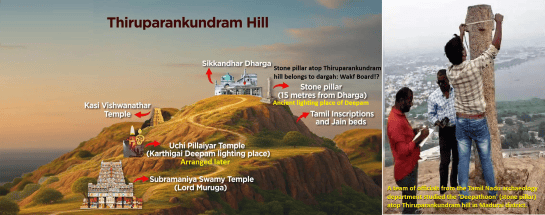
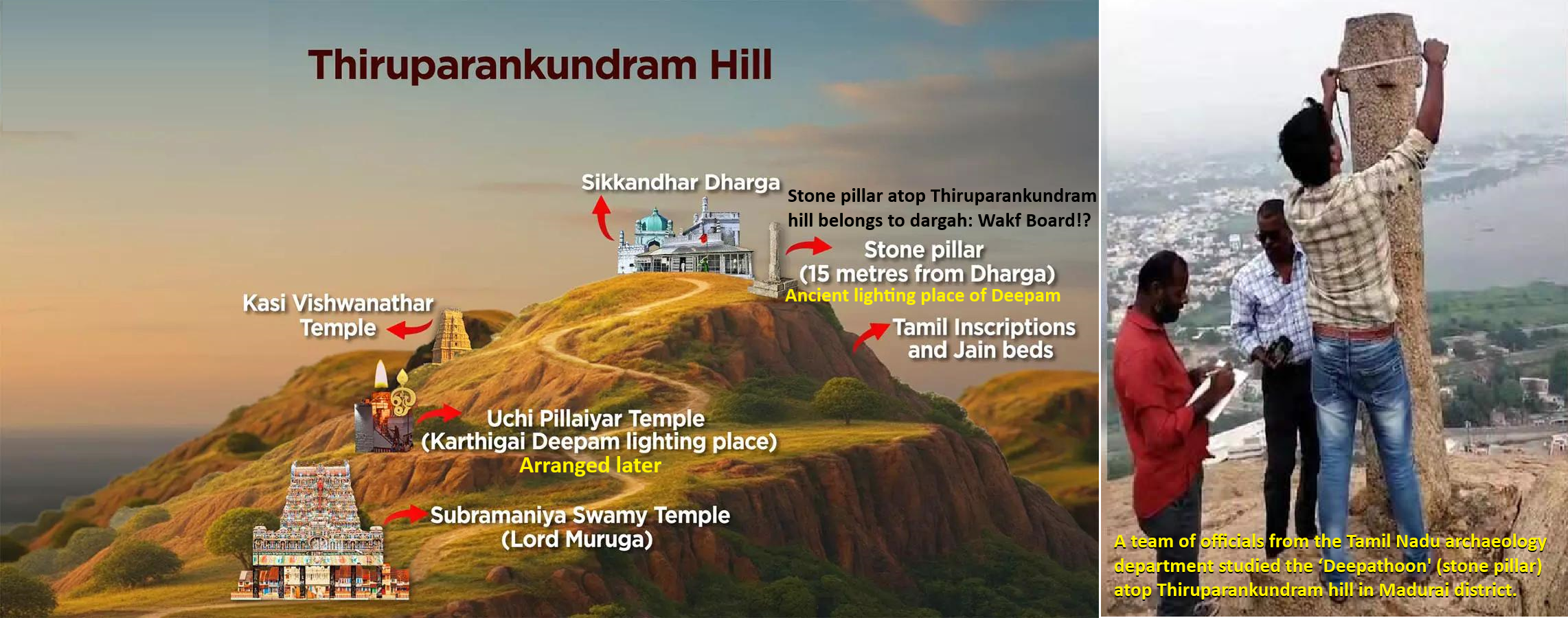
The Deepathoon, also known as Deepa Sthambha, is a stone pillar situated on the hilltop of Thiruparankundram, close to the ancient Arulmigu Subramania Swamy Temple and approximately 50 metres from the Sikandar Badusha Dargah.
The dispute concerns the location at which the traditional Karthigai Deepam should be lit and the status of the disputed stone pillar.
The controversy gained renewed momentum in December 2025 after devotee Rama Ravikumar approached the Madras High Court seeking permission to light the traditional lamp at the Deepathoon.
On December 1, 2025, Justice G.R. Swaminathan ruled that the pillar was a Deepathoon and directed the temple administration to light the lamp there in addition to the customary location near the Uchipillaiyar Temple.
When the direction was not implemented on December 3, the judge permitted Ravikumar and ten others to light the lamp with CISF protection. However, police prevented them from accessing the location, citing prohibitory restrictions imposed by the district administration.
The matter subsequently reached a Division Bench, which upheld the direction on December 4, 2025.
On January 6, 2026, another Division Bench of the Madras High Court upheld the direction to light the lamp at the Deepathoon, holding that the pillar stood on temple land and providing for a restricted temple-authorised team to perform the ritual.
The Tamil Nadu government subsequently challenged the High Court’s decision before the Supreme Court, leading to the November 20, 2026 interim order.
The larger constitutional question
The developments have brought several important constitutional and legal questions into focus:
-
Article 25: The right to freedom of conscience and the right to freely profess, practise and propagate religion, subject to constitutional limitations.
-
Article 144: The obligation of all civil and judicial authorities to act in aid of the Supreme Court.
-
Judicial supremacy: Whether executive authorities can delay or frustrate the implementation of a judicial direction while pursuing a review petition.
-
Contempt jurisdiction: Whether the alleged failure to implement the Supreme Court’s November 20 order warrants contempt proceedings against the officials concerned.
It is important to note that the Supreme Court’s November 20 permission was expressly limited to a one-time arrangement. It did not finally decide the ownership of the Deepathoon, the existence of a customary religious right or the ultimate merits of the dispute. Those questions remain open for adjudication.
The case is scheduled for further consideration by the Supreme Court, with final arguments expected in January 2027.
For now, the central question is whether the state authorities failed to implement an operative Supreme Court direction and, if so, what accountability should follow.
The latest proceedings have also made clear that the controversy is no longer confined to where a ceremonial lamp should be lit. It has become a significant test of constitutional governance, judicial authority and the protection of religious practices.
…
_Agency Inputs.


[…] 25 November 2026, four people were reported arrested in Murshidabad as Chief Minister Suvendu Adhikari declared cow pr… and…
[…] established event is narrow but significant: a member of Savarkar’s family sent Sonia Gandhi a legal notice alleging that…
[…] 24 November 2026, a spontaneous street protest took place in Diamond Harbour. Demonstrators opposed the persecution of Hindus in…
[…] West Bengal, two political moves have emerged: Samik Bhattacharya has called for statewide street protests, while Suvendu Adhikari has…
[…] campaign has been presented as a 15-lakh outreach drive involving village visits, with particular attention around Gujarat’s polls and…