
Struggle for Hindu Existence
*Hindu Rights to Survive with Dignity & Sovereignty *Join Hindu Freedom Movement to make Bharat Hindu Rashtra within this lifetime *Jai Shri Ram *Jayatu Jayatu Hindu Rashtram *Editor: Upananda Brahmachari.
Bangladesh Hindu Persecution: Samik Calls for Street Protests; Suvendu to Take Issue with Centre.
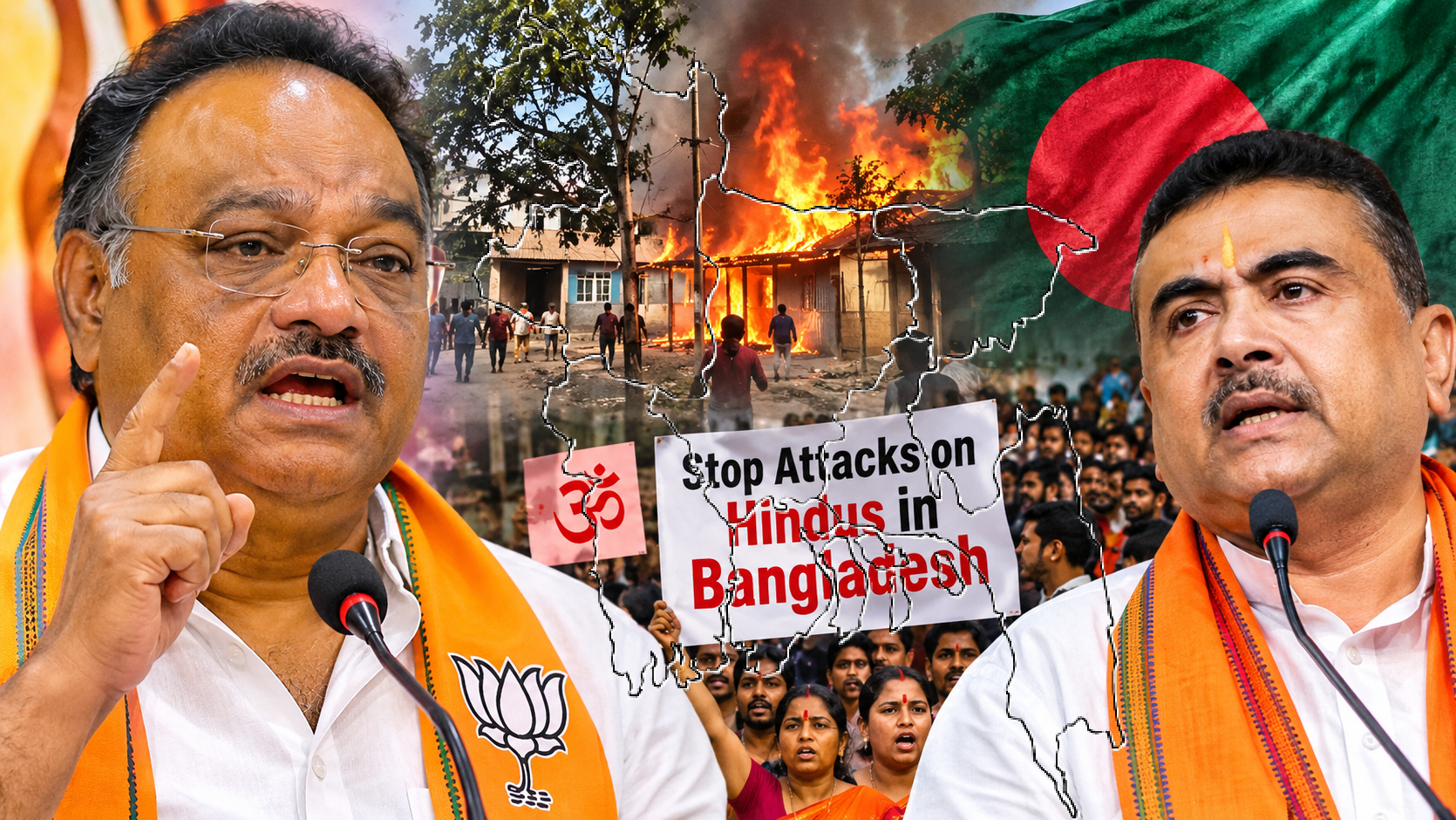
Samik Bhattacharya Calls for Statewide Protests Over Attacks on Hindus in Bangladesh. CM Suvendu Adhikari to raise the issue with Centre.
BJP state president invokes Bengali Hindu identity, questions religious foundations of Bangladesh and links the plight of minorities to the unfinished consequences of Partition
Anandita Mistry Patra | HENB | Kolkata | Nov 23, 2026: West Bengal Bharatiya Janata Party (BJP) president Samik Bhattacharya has called for public protests against the reported attacks and persecution of Hindus in neighbouring Bangladesh, urging people to rise above political differences and take to the streets in solidarity with the Hindu community across the border.
Speaking to media persons on Sunday, November 22, the BJP leader expressed concern over reports of violence and killings involving members of the Hindu community in Bangladesh. Emphasising the cultural, linguistic and familial bonds between the people on both sides of the international border, he said that the suffering of Bengali Hindus in Bangladesh could not be viewed as an issue concerning a neighbouring country alone.
“Blood is being shed in Bangladesh, and it is our brothers who are suffering. As a Bengali Hindu, I believe we must take to the streets,” Bhattacharya said.
The BJP state president’s appeal comes amid renewed political unrest in Bangladesh and growing concerns in West Bengal over the safety and security of religious minorities, particularly Hindus. He maintained that the attacks on Hindus across the border should evoke a collective response from Bengali Hindus and concerned citizens.
Bangladesh’s creation and the question of religious identity
Bhattacharya also revisited the historical circumstances surrounding the creation of Bangladesh, challenging the argument that its birth was primarily driven by the Bengali linguistic and cultural identity.
Pointing out India’s crucial role in the emergence of Bangladesh in 1971, he argued that the country’s subsequent treatment of its Hindu population raised fundamental questions about the protection of religious minorities and the ideals on which the new nation was established.
“Bangladesh was not created for the sake of language. If it had been, Bengali-speaking Hindus in Bangladesh would not be dying like this today,” he remarked.
He argued that ensuring the safety of people and establishing a genuinely democratic environment should have been fundamental priorities during the political transformation of the region. Instead, he alleged, the leadership had ultimately yielded to religious fundamentalism, leaving religious minorities vulnerable.
His remarks brought the question of minority protection in Bangladesh back into the political discourse in West Bengal, where historical, linguistic and cultural connections with the neighbouring country remain particularly significant.
Partition’s unfinished consequences
The BJP leader further linked the present predicament of Hindus in Bangladesh to the historical trauma of Partition, arguing that religious minorities, particularly Hindus, continue to bear its consequences decades after the subcontinent was divided.
He held former Congress leadership, particularly Jawaharlal Nehru and Mahatma Gandhi, responsible for the Partition of India, criticising the political decisions that led to the division of the subcontinent.
Bhattacharya also invoked Netaji Subhas Chandra Bose, asserting that had Bose become the first Prime Minister of independent India, he would never have accepted the two-nation theory or allowed the subcontinent to be divided along religious lines.
His comments reflected his broader criticism of the political leadership that presided over Partition and its long-term consequences for communities affected by the division.
CM Suvendu Adhikari to raise concerns on alleged attack on Hindus in Bangladesh with Jaishankar
The issue has also drawn the attention of West Bengal Chief Minister Suvendu Adhikari, who expressed concern over reports of attacks on Hindus and other minorities in Bangladesh. On Sunday, he said he would speak to External Affairs Minister S. Jaishankar on Monday, November 23, to discuss the situation and convey his concerns.
Adhikari described the developments in the neighbouring country as disturbing and said the violence could have repercussions in West Bengal. He also referred to the anxiety among people in the State over the safety of their relatives living across the border.
Meanwhile, reports from Bangladesh have highlighted fresh incidents of political violence, arson and vandalism. In Narail district, around 30 houses were reportedly set ablaze in Bendarchar village in Kalia upazila amid clashes involving supporters of the Bangladesh Nationalist Party (BNP) and the Awami League.
Local residents accused BNP supporters of attacking properties associated with Awami League leaders and activists, while BNP leaders rejected the allegations. Police statements and local media reports indicated that the violence was linked to political rivalries and retaliatory attacks following the deaths of two BNP leaders. The incidents have further underscored the deteriorating law-and-order situation in parts of Bangladesh, although the reported attacks on political properties should not automatically be classified as targeted attacks on Hindus.
A growing concern across the border
Bhattacharya’s appeal has brought the security of Hindus in Bangladesh into sharper focus in West Bengal’s political discourse. The historical relationship between the two Bengals, their shared language and cultural heritage, and the presence of family connections across the international border make developments in Bangladesh a matter of considerable public concern in the State.
The BJP leader’s call for protests also signals an attempt to mobilise public opinion beyond conventional party politics around the question of religious minority protection. He has urged people to recognise the suffering of Hindus in Bangladesh as a humanitarian and community concern rather than merely a political issue.
With the West Bengal Chief Minister also proposing to take up the matter with the Union External Affairs Minister, the developments have placed the Bangladesh minority situation on the State’s political and diplomatic agenda.
The immediate question now is how the Centre and the international community will respond to concerns over the safety of Hindus and other religious minorities in Bangladesh, and whether effective measures will be taken to ensure their security, constitutional rights and freedom to practise their faith without fear.
…
_Agency Inputs.


[…] campaign has been presented as a 15-lakh outreach drive involving village visits, with particular attention around Gujarat’s polls and…
[…] a Hindu convention in Karnataka, speakers called for a national movement to free temples from government control and also…
[…] immediate fact is narrow: the Hindu Janajagruti Samiti staged protests in Mumbai and Kolhapur, objecting to scenes it says…
[…] November 2026, a protest over an alleged conversion network in Burdwan reportedly turned violent; people described as members of…
[…] present concern is not merely demographic. INSIGHT UK has assembled allegations of decades of persecution and dispossession affecting Hindus…