

[…] 14 October 2026, Anand Dubey resigned from Shiv Sena (UBT), citing ideological differences and sayin… Two facts therefore stand…

Struggle for Hindu Existence
*Hindu Rights to Survive with Dignity & Sovereignty *Join Hindu Freedom Movement to make Bharat Hindu Rashtra within this lifetime *Jai Shri Ram *Jayatu Jayatu Hindu Rashtram *Editor: Upananda Brahmachari.
RSS on Ram Temple Daan Chori: What punishment should be imposed on RSS veteran Champat Rai?
Ram Temple Donation Theft Row: RSS Urges Hindu Unity, Calls for Strict Punishment of the Guilty, Then what should be done with RSS veteran Champat Rai? Storm on Social Media.
Upendra Bharti and Bharti Singh | HENB | New Delhi/Ayodhya, July 4, 2026: The Rashtriya Swayamsevak Sangh (RSS) has issued its first official response to the alleged embezzlement of donations collected for the Ram temple in Ayodhya, calling for unity among Hindus, demanding stringent legal action against those responsible, and warning against attempts to exploit the controversy to create social divisions.
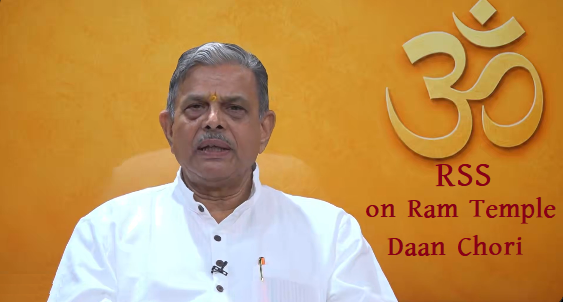
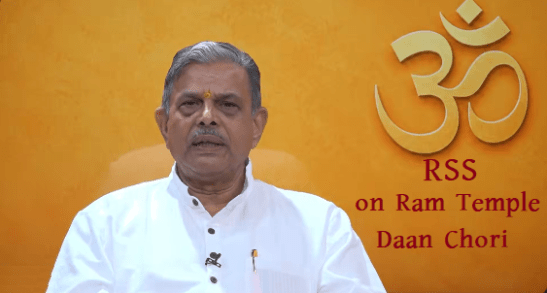
In a video statement released on Friday (July 3), RSS General Secretary Dattatreya Hosabale said that any financial irregularity involving the Ram temple should be dealt with firmly and transparently, while emphasizing that the incident must not be used to undermine the faith of millions of devotees or tarnish the broader Hindu community.
RSS Calls for Accountability
Hosabale stated that those found guilty of misappropriating temple donations should face strict punishment under the law, regardless of their position or status. He stressed that accountability was essential to preserve public confidence in institutions associated with one of India’s most revered religious sites.
“The guilty must not be spared. Appropriate legal action should be taken after a fair and impartial investigation,” he said, underlining that justice should be delivered swiftly and transparently.
The RSS maintained that criminal wrongdoing by individuals should not be allowed to overshadow the significance of the Ram temple or the devotion of millions who contributed to its construction.
Appeal for Hindu Unity
Addressing the wider Hindu community, Hosabale urged people to remain united and avoid being influenced by misinformation or politically motivated narratives.
According to the RSS leader, the Ram temple represents the aspirations and sacrifices of generations of devotees who struggled for decades for the construction of the shrine at the birthplace of Lord Ram.
He described the temple as not merely a religious structure but a symbol of civilizational faith, cultural heritage, and national consciousness for millions of Hindus.
“The Ram temple has become a centre of reverence and faith after the struggles of generations and the sacrifices of crores of Ram devotees,” Hosabale said.
Warning Against “Conspiracies”
The RSS also cautioned against what it described as attempts by “anti-Hindu” and “anti-national” forces to exploit the controversy.
Hosabale alleged that certain groups were attempting to use the alleged financial misconduct to malign Hindu society and discredit institutions associated with the Ram temple movement.
He appealed to the public not to fall prey to propaganda or efforts aimed at creating mistrust and social discord.
The RSS argued that while wrongdoing must be investigated and punished, isolated criminal acts should not become a pretext for targeting an entire community or questioning the legitimacy of the Ram temple movement.
Background of the Controversy
The controversy erupted following allegations of large-scale embezzlement involving donations made by devotees for the Ram temple. The allegations have generated widespread political debate and public concern, given the emotional and religious significance of the temple and the substantial financial contributions made by devotees across India and abroad.
Authorities are currently examining financial records and investigating the alleged irregularities. Officials have indicated that legal proceedings will continue against anyone found to have diverted or misused temple funds.
The issue has also sparked demands from several quarters for greater transparency, stronger financial oversight, and independent auditing of religious trusts handling large public donations.
Significance of the Ram Temple
The Ram temple in Ayodhya occupies a unique place in India’s religious and political landscape. Its construction followed decades of legal, political, and social developments and was widely celebrated by millions of devotees across the country.
For the RSS and several Hindu organizations, the temple symbolizes the culmination of a long-standing movement rooted in religious faith and cultural identity.
Against this backdrop, the organization has argued that allegations involving financial misconduct should be viewed strictly as criminal matters involving individuals rather than as issues reflecting on the temple itself or the sentiments of the broader Hindu community.
Political and Public Reactions
The controversy is expected to remain a major political issue as investigations progress. Opposition parties have demanded complete transparency and accountability in the handling of temple funds, while supporters of the temple trust have maintained that the investigation should proceed without politicization.
Observers note that the case has renewed discussions about governance standards, financial accountability, and institutional oversight in religious organizations that receive substantial public donations.
As investigative agencies continue their probe, attention remains focused on whether authorities can establish responsibility, recover any misappropriated funds, and reassure millions of devotees that appropriate safeguards will be strengthened to protect public trust.
The RSS has reiterated that while justice must be delivered against those responsible, the incident should not be allowed to diminish the spiritual significance of the Ram temple or become a source of division within society.
The question that now arises is: What punishment should be imposed on RSS veteran Champat Rai, the General Secretary of the Shri Ram Janmabhoomi Teerth Kshetra Trust, if he is found guilty in the alleged donation embezzlement case? Nobody can deny the questions that have been raised about his role and the alleged administrative negligence.
The Question Before RSS & the Investigators
As the investigation progresses, attention is also turning to the accountability of those responsible for the administration and oversight of the Shri Ram Janmabhoomi Teerth Kshetra Trust. Among the names under public scrutiny is RSS veteran Champat Rai, the Trust’s General Secretary, owing to his senior administrative position.
While the investigation is yet to determine individual responsibility, the controversy has raised broader questions about governance, financial oversight, and institutional accountability within one of India’s most prominent religious trusts. Critics argue that if serious financial irregularities occurred over an extended period, questions naturally arise about the effectiveness of the Trust’s internal controls and the responsibility of those entrusted with managing devotees’ donations.
The question that now arises is: If the investigation establishes that Champat Rai or any other office-bearer was responsible—whether through direct involvement, negligence, or failure of oversight—what action should follow? Should those found guilty face the same legal consequences that the RSS has demanded for all others, irrespective of their position or stature?
Ultimately, the answer will depend on the findings of the investigating agencies and the judicial process. However, the principle articulated by the RSS itself—that those found guilty should be punished without exception—would, if applied consistently, extend to every individual, regardless of office or influence. Equally, anyone accused is entitled to due process and should not be presumed guilty before the investigation and the courts reach their conclusions.
Social media flooded
There have been widespread reactions on social media against the alleged donation theft at the Ayodhya Ram Temple under the RSS-BJP-controlled management. Here are some examples:
Criticizing the row, Sandeep Deo of India Speaks Daily stated that this is the real face of the RSS. He said that Dattatreya Hosabale had proved the saying: “They have Ram on their lips and a knife at their side.”
…
_Agency Inputs.
2 comments on “RSS on Ram Temple Daan Chori: What punishment should be imposed on RSS veteran Champat Rai?”
Leave a Reply

[…] 13 October 2026, multiple complaints were reported against CPI(M) leader and advocate Bikash Ranjan Bhattacharya in W…. The complainants…

[…] a reactionary state. This is worrying. Already, Hindu radicals have occupied public discourse and have won favours from some…
no you are a fool
Wishing all success to his journey


Pingback: Ram Temple Donation Row: Why Accountability Must Protect Sacred Public Trust – DharmaRenaissance Blog
Pingback: Ram Temple Donations: A Governance Standard for Sacred Trust – DharmaRenaissance Blog