

Ok. Thank You brother for sharing this inmpoirtant information. Upananda Brahmachari, Editor in Chief, Struggle For Hindu Existence Website.

Struggle for Hindu Existence
*Hindu Rights to Survive with Dignity & Sovereignty *Join Hindu Freedom Movement to make Bharat Hindu Rashtra within this lifetime *Jai Shri Ram *Jayatu Jayatu Hindu Rashtram *Editor: Upananda Brahmachari.
Ram Mandir’s Critical Theft Tests Hindutva’s Crucial Plank in the Bid to Dethrone Yogi!
When Ayodhya Becomes a Battleground: How the Ram Mandir Donation Theft Controversy Could Shape the BJP’s Post-Modi Leadership Narrative.
~Upananda Brahmachari.
The alleged theft of donations at the Ram Mandir in Ayodhya is, on the face of it, a criminal investigation. Yet to view it solely through the lens of law enforcement would be to miss its larger political significance. In contemporary India, the Ram Mandir is not merely a place of worship; it is the ideological cornerstone of the Hindutva movement, the BJP’s most powerful political symbol, and the culmination of a decades-long campaign that fundamentally reshaped Indian politics. Consequently, any controversy surrounding the temple inevitably reverberates far beyond Ayodhya.
The issue is therefore no longer confined to missing donations or security lapses. It has evolved into a test of governance, institutional credibility, ideological consistency and, perhaps most importantly, political leadership.
More Than a Temple, a Political Institution
Few public institutions in India carry the symbolic weight of the Ram Mandir. It embodies faith for millions of devotees while simultaneously representing one of the BJP’s greatest political achievements.
That dual identity transforms every administrative controversy into a political event. A lapse in security, allegations of financial misconduct or failures in institutional oversight are not viewed merely as operational shortcomings. They invite broader questions about governance, accountability and the moral authority of a movement that has consistently presented itself as a champion of cultural nationalism and efficient administration.
In politics, symbols create legitimacy—but they also create vulnerability.
Ayodhya and the Politics of Leadership
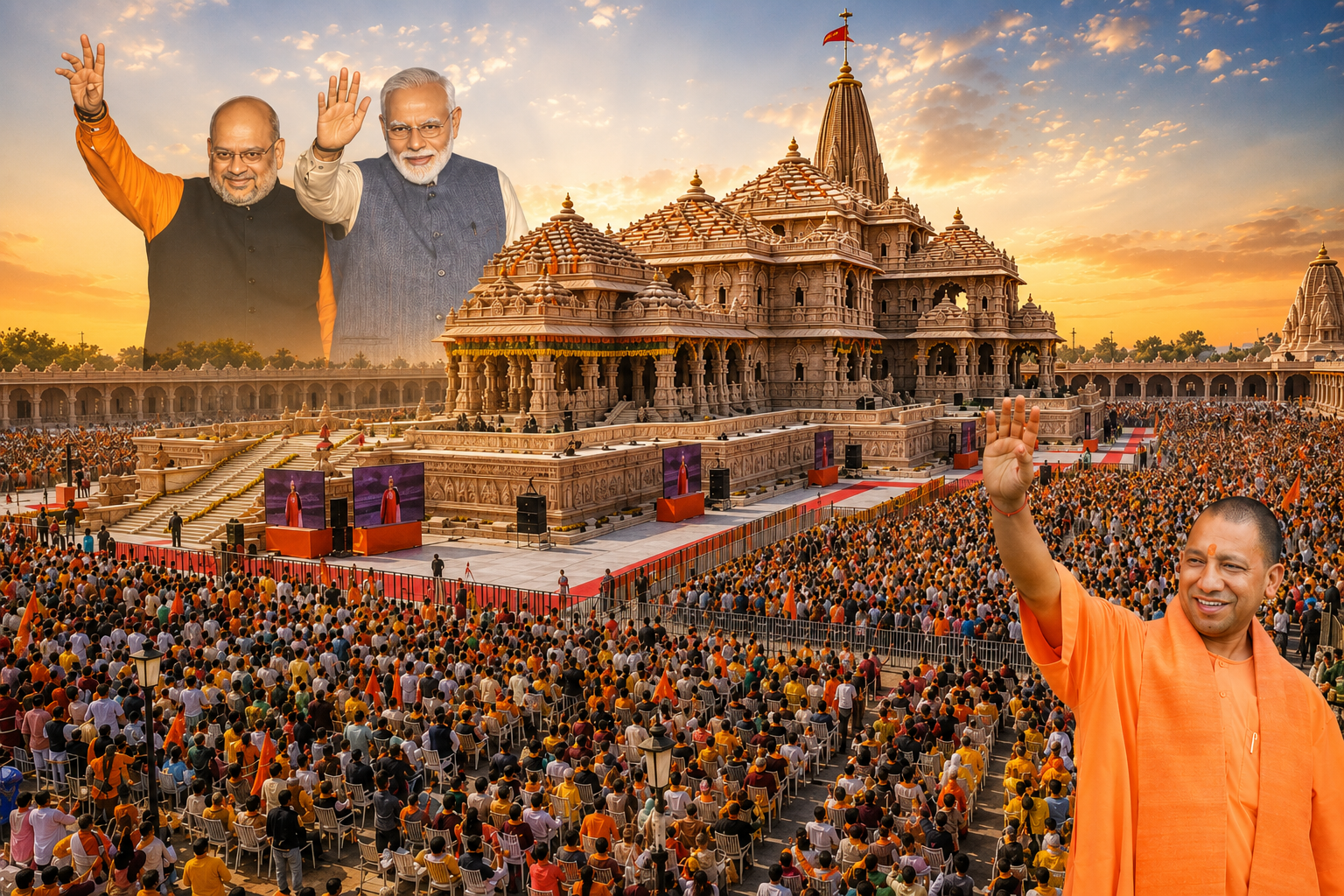
The controversy has emerged at a politically delicate moment. Prime Minister Narendra Modi remains the BJP’s undisputed national leader, while Home Minister Amit Shah continues to be its principal organisational strategist. Simultaneously, Uttar Pradesh Chief Minister Yogi Adityanath has established himself as one of the party’s most recognisable mass leaders.
His stewardship of Uttar Pradesh, combined with his distinct religious identity and uncompromising political style, has made him a central figure in discussions among political observers about the BJP’s future leadership. The BJP has never officially declared a successor to Prime Minister Modi, and any suggestion regarding future leadership remains speculative. Nevertheless, the emergence of strong regional leaders naturally generates public debate about the party’s long-term direction.
This makes Ayodhya politically significant in ways that extend well beyond Uttar Pradesh.
Why Perception Often Matters More Than Responsibility
In democratic politics, perception frequently shapes reality.
Because Ayodhya lies within Uttar Pradesh, any controversy associated with the city inevitably reflects, fairly or unfairly, on the state’s administrative machinery. Whether responsibility ultimately rests with the temple trust, local officials or security agencies, public opinion often attributes broader accountability to the political leadership governing the state.
This is particularly relevant for Yogi Adityanath, whose political identity is closely associated with Ayodhya’s transformation into the symbolic capital of the Hindutva movement.
Political opponents may therefore seek to interpret the controversy as evidence of administrative shortcomings. Conversely, Yogi’s supporters may argue that a transparent investigation and decisive institutional reforms would reinforce his image as a leader willing to confront failures instead of concealing them.
Neither interpretation is predetermined. Both depend on how the controversy is ultimately resolved.
The Internal Dynamics of a Dominant Party
Every dominant political party develops multiple centres of influence. The BJP is no exception.
Its remarkable electoral success has produced several nationally influential leaders with distinct political constituencies. Such diversity inevitably generates differences in style, priorities and leadership aspirations. Informal competition within a large political organisation should not automatically be interpreted as conspiracy; it is often a natural consequence of organisational growth.
There has been considerable political speculation about whether the Ram Mandir controversy could influence these internal equations. However, it is important to distinguish speculation from evidence. At present, there is no publicly verified evidence that Prime Minister Narendra Modi, Amit Shah or any identifiable faction deliberately orchestrated or exploited the controversy to weaken Yogi Adityanath’s political standing.
Recognising this distinction is essential for maintaining analytical credibility.
The Real Contest Is Over Narrative
Politics is not governed solely by facts; it is also shaped by narratives.
The Ram Mandir controversy demonstrates how quickly an administrative lapse can become an ideological debate. The BJP’s opponents may portray the episode as exposing contradictions between claims of exemplary governance and institutional realities. Supporters, meanwhile, may argue that the government’s willingness to investigate and correct failures demonstrates institutional maturity rather than weakness.
The eventual political impact will therefore depend less on the theft itself than on the credibility of the response.
Transparency, accountability, effective investigation and visible institutional reform are likely to influence public confidence far more than partisan accusations.
A Test of Hindutva’s Governance Model
The broader question raised by the controversy concerns the evolution of Hindutva from an oppositional movement into the governing philosophy of India’s largest political party.
Movements can mobilise public emotion through powerful symbols. Governments, however, are judged by administrative competence.
The Ram Mandir has become the point where these two realities intersect. It is simultaneously a sacred shrine, a national symbol and an institution expected to meet the highest standards of public accountability.
That is why the controversy resonates so deeply. It challenges not merely the security arrangements of a temple but the governance standards associated with one of the BJP’s defining political achievements.
The Road Ahead
Whether the Ram Mandir controversy ultimately influences the BJP’s future leadership debate remains uncertain. Leadership transitions in democratic parties are determined by electoral success, organisational consensus, political performance and strategic calculations—not by any single incident.
Yet the episode serves as a reminder that institutions carrying immense symbolic value inevitably become arenas of political contestation. Their successes enhance political legitimacy; their failures invite intense scrutiny.
The lesson extends beyond Ayodhya. Political symbolism can build extraordinary electoral capital, but it also imposes extraordinary expectations. Once a symbol becomes central to a party’s ideological identity, it must be defended not only through rhetoric but through transparent governance, institutional integrity and public accountability.
The Ram Mandir controversy may therefore prove to be more than a criminal investigation. It is a political stress test of governance, credibility and leadership. Whether it strengthens or weakens any individual leader will depend not on speculation about internal rivalries, but on how convincingly the institutions involved demonstrate that even the nation’s most revered symbols are not beyond accountability.
It is now becoming clear that the power play by the Gujarati lobby headed by Modi and Shah is aimed at sidelining Yogi from his perceived position as a potential successor for the office of India’s next Prime Minister.
That, ultimately, is the true measure of democratic leadership!
The alleged donation theft at the Sangh Parivar-controlled Ram Mandir has raised a dozen questions. Intelligence inputs reportedly warned the authorities time and again, well before the alleged large-scale theft came to light. However, the timing and circumstances of the revelations, coming ahead of the upcoming Uttar Pradesh Assembly elections, have raised another set of questions about whether the BJP’s Delhi leadership is seeking to politically undermine the state leadership in Lucknow through undesirable developments in Ayodhya.
Many critics see the entire sequence of events as nothing but a conspiracy by the central leadership to undermine Uttar Pradesh Chief Minister Yogi Adityanath and diminish his dominant position in the state’s politics.
One comment on “Ram Mandir’s Critical Theft Tests Hindutva’s Crucial Plank in the Bid to Dethrone Yogi!”
Leave a comment

Great reporting! Just wanted to add a bit more context here. The Sarvjan Sanatan Party isn't actually a brand-new outfit—it…
[…] CBI director M. Nageswara Rao took charge as the party’s national president in Varanasi on 8 October 2026 while…
[…] narrow factual record identifies a campus confrontation involving people described as members of Bangiyo Hindu Jagran Manch. Their action…
[…] core is narrow: Congress leader Digvijay Singh directed critical remarks at the RSS and VHP; Ayodhya seers rejected his…


Pingback: Ram Mandir Donation Allegation Tests Trust in Ayodhya – DharmaRenaissance Blog