

[…] from a government that speaks in its name. In fact, the dignity of the Kumbh requires both. The Dhami…

Struggle for Hindu Existence
*Hindu Rights to Survive with Dignity & Sovereignty *Join Hindu Freedom Movement to make Bharat Hindu Rashtra within this lifetime *Jai Shri Ram *Jayatu Jayatu Hindu Rashtram *Editor: Upananda Brahmachari.
Worrisome Demographic Shifts and the Rise of Hindutva in Keralam.
Demographic Shifts and the Rise of Hindutva in the South: From “Kanniyakumari” to Kerala’s “Sangh Villages”.
~ B Upendran
The political geography of southern India is witnessing a visible transformation, with Hindu identity increasingly becoming an explicit part of public and political life in areas that have historically been shaped by strong regional, caste and minority identities.
From Tamil Nadu’s Kanniyakumari district to emerging “Sangh villages” in Kerala, the growth of Hindu nationalist networks illustrates how demographic change, religious identity, grassroots organisation and local political anxieties are intersecting in new ways. The phenomenon is not simply about electoral victories. Increasingly, it is about how communities publicly define themselves and how organisations such as the Rashtriya Swayamsevak Sangh (RSS) have built neighbourhood-level networks over decades.
Kanniyakumari: A Distinct Political Landscape
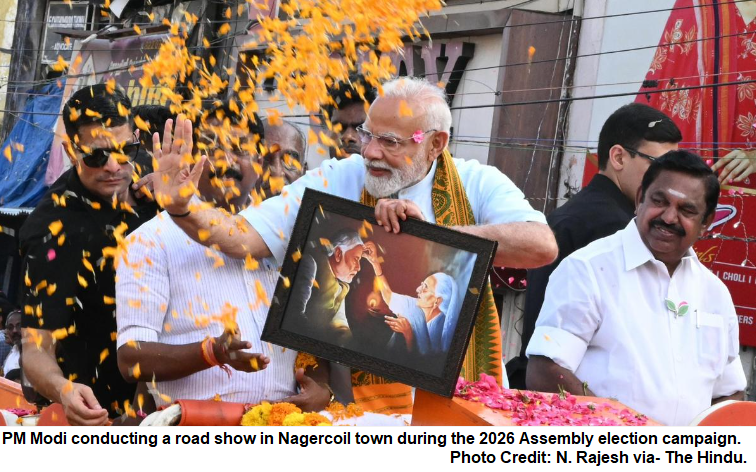
Kanniyakumari occupies an unusual position in Tamil Nadu. While Dravidian parties have dominated the State politically for decades, the southernmost district has historically provided comparatively fertile ground for Hindu nationalist politics.
The district, formerly part of Travancore, was incorporated into Tamil Nadu in 1956 following the reorganisation of States. Its social and cultural history, however, remains distinct from much of the rest of Tamil Nadu. The region was historically known as Nanjil Nadu and was renowned for its fertile agricultural land. Its prosperity is even celebrated in Manonmaniam, the verse drama by P. Sundaram Pillai.
Kanniyakumari also developed a distinctive religious and demographic composition. Christian communities became particularly influential through the historical expansion of missionary education, healthcare and social institutions. The resulting religious diversity has had a significant impact on the district’s social and political dynamics.
The Hindu nationalist movement gradually built upon these local circumstances. The Hindu Desam candidate V. Balachandram’s victory from Padmanabhapuram in 1989 was an early indication that Hindutva-backed politics could make electoral inroads in Tamil Nadu, even while Dravidian parties dominated the State as a whole.
From Demographic Change to Identity Politics
The political significance of Kanniyakumari cannot be understood through electoral figures alone. Demographic change, religious institutions, caste mobility and competing perceptions of cultural identity have all contributed to the district’s political evolution.
For sections of the Hindu population, the growing visibility and institutional strength of Christian communities and missionary organisations became associated with concerns about religious conversion and the future of Hindu identity. Hindu nationalist organisations subsequently used these concerns as a basis for mobilisation.
At the same time, the district remains deeply pluralistic. Hindus, Christians and Muslims continue to share economic, social and civic spaces. Therefore, the rise of Hindutva should be understood as one strand of a much more complicated social transformation rather than as evidence that the district has become politically homogeneous.
Kerala: The Rise of the “Sangh Village”
A similar, though distinct, development is becoming visible in Kerala.
A June 2026 report by The News Minute described the emergence of localities increasingly identifying themselves as “Sangh villages,” or sangha gramams. The report examined pockets of Thiruvananthapuram and Palakkad where Sangh-linked organisations have become increasingly visible in neighbourhood life.
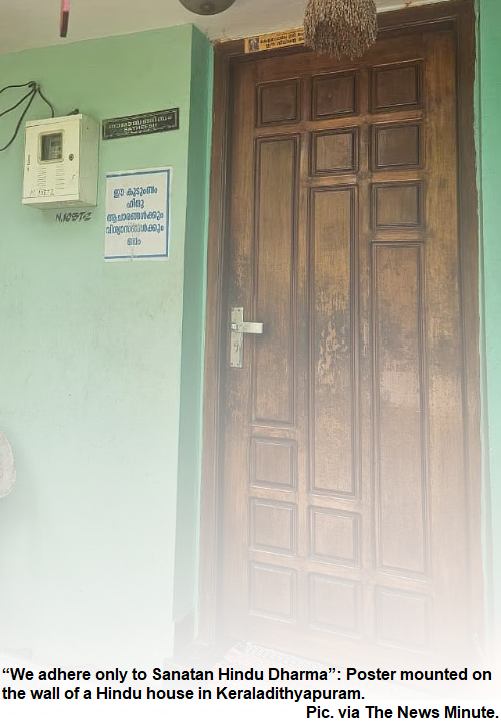
At Keraladithyapuram, on the outskirts of Thiruvananthapuram, Sreekala and her husband Satheesh, a retired Air Force officer, have displayed a notice outside their home stating: “This family adheres to Hindu traditions and beliefs.” According to Sreekala, the family put up the sign following the controversy surrounding the Sabarimala temple issue in 2018.
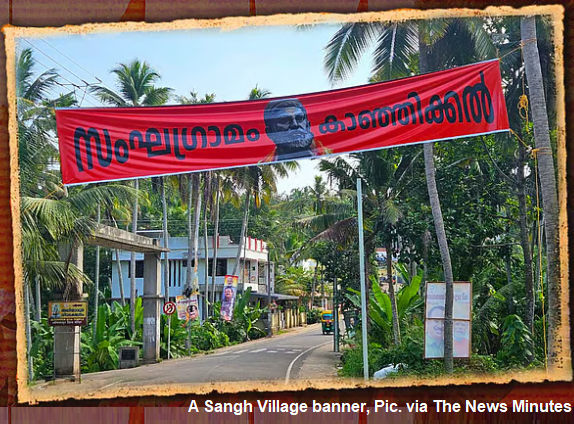
A few kilometres away, Keraladithyapuram Junction carries an even more overt political symbol: a large red banner depicting the 17th-century Maratha ruler Shivaji alongside the words “Sangh village.” Residents told TNM that the banner had remained in place for several months.
The symbolism is significant because Shivaji has increasingly appeared in Sangh-linked cultural programmes, festivals and processions in Kerala, alongside saffron flags, Hanuman imagery and other symbols associated with Hindu nationalist mobilisation.
The RSS Network Beneath the Electoral Surface
Kerala presents an important example of the difference between organisational influence and electoral performance.
The RSS and its affiliates have maintained a substantial organisational presence in Kerala for decades. Their activities extend beyond conventional party politics and include shakhas, cultural organisations, trade unions, community welfare activities, temple committees and festival organisation.
The BJP, however, has historically found it difficult to convert this organisational infrastructure into major Assembly-level electoral success. Nevertheless, Sangh networks have established local influence in several pockets, particularly at the grassroots and local-body levels.
What appears to be changing is therefore not necessarily the existence of these networks, but their visibility.
The identity that was once expressed primarily through community organisations, religious programmes and neighbourhood activities is increasingly being displayed through public banners, household signboards, cultural events and the explicit branding of localities as “Sangh villages.”
“We Thought Our Dharma Needed Protection”
Sreekala’s account illustrates how political events can transform private religious identity into a more public declaration.
She told TNM that her family’s outlook changed during the 2018 Sabarimala controversy. She recalled watching the developments late into the night and said that the experience convinced her family that Hindu religious identity required greater public assertion.
Her comparison with Christian household religious symbols is particularly revealing. She questioned why Hindus should not similarly identify their homes through explicitly Hindu declarations.
The episode illustrates a broader phenomenon: religious identity is moving from the private sphere into visible neighbourhood spaces.
The Role of the BMS and Local Organisations
The Keraladithyapuram banner was reportedly installed by people associated with the Bharatiya Mazdoor Sangh (BMS), a trade union affiliated with the Sangh Parivar.
Deepuraj, a BJP ward councillor from Powdikonam, told TNM that the area has active RSS shakhas and workers and that an increasing number of young people are becoming volunteers and workers. He described the locality as having one of the highest concentrations of shakhas.
This is important because it demonstrates how the Sangh’s expansion does not necessarily begin with elections. It can begin with neighbourhood organisation, youth participation, cultural activity, welfare work and religious institutions.
By the time electoral politics enters the picture, an ideological and organisational infrastructure may already exist.
From Kannur to Thiruvananthapuram and Palakkad
The idea of the “Sangh village” is not entirely new in Kerala.
TNM notes that places such as Pareekadavu and Diamond Mukku in Kannur have previously been described in these terms. Its 2026 reporting identified newer pockets in Thiruvananthapuram and Palakkad where Sangh-linked organisations have become deeply embedded in local communities.
Supporters portray this activity as cultural revival, community service and the protection of Hindu traditions. Critics, meanwhile, view the same networks as mechanisms for expanding Hindutva ideology.
That difference in interpretation is at the heart of Kerala’s changing political landscape.
The Southern Hindutva Model
The developments in Kanniyakumari and Kerala point towards a form of Hindutva mobilisation that differs in important respects from the politics of northern India.
In these southern regions, mobilisation often operates through local culture, temple traditions, caste networks, community institutions, religious festivals and grassroots organisations.
The objective is not necessarily to begin with a direct electoral confrontation. Instead, it can involve creating a durable social network in which Hindu identity becomes increasingly visible and politically meaningful.
This strategy can be particularly significant in regions where the BJP’s electoral position remains comparatively limited.
Why Visibility Matters
The most important development may therefore be the transformation of Hindu identity from an assumed majority identity into an explicitly asserted public identity.
A signboard outside a home saying that a family follows Hindu traditions may appear insignificant in isolation. A banner declaring an entire locality a “Sangh village” is considerably more political. When such symbols appear alongside shakhas, youth mobilisation, temple activities, cultural programmes and trade-union networks, they become part of a larger organisational ecosystem.
The change is consequently less about a single banner or household notice and more about the normalisation of a particular political-cultural vocabulary in everyday life.
A New Southern Political Frontier?
Kanniyakumari and parts of Kerala therefore offer two different but interconnected examples of the southern expansion of Hindu nationalist politics.
Kanniyakumari demonstrates how demographic composition, historical religious tensions and decades of grassroots mobilisation can produce a durable Hindutva political constituency. Kerala demonstrates how a strong organisational network can create neighbourhood-level influence even when electoral gains remain comparatively modest.
In both cases, however, the transformation should not be mistaken for the disappearance of pluralism. These remain societies in which Hindus, Christians and Muslims live alongside one another and participate in shared economic and social institutions.
What is changing is the political salience and public visibility of religious identity.
From the fertile fields of Nanjil Nadu to the banners of Keraladithyapuram, the story emerging from India’s southern tip is therefore not simply one of electoral Hindutva. It is the story of a long-term grassroots contest over identity, culture and community space—one in which the RSS and its affiliates are increasingly seeking to turn organisational presence into a more visible social and political force.
The southern frontier of Hindutva is no longer confined to election campaigns. Increasingly, it is being built street by street, neighbourhood by neighbourhood, and village by village.
…
Read also: Is Kerala posed as Second Kashmir in Southern India?
.
_Inputs from The Hindu — “Demographic shifts and the rise of Hindutva in Kanniyakumari district” · The News Minute — “‘This is a Sangh village’: Inside Kerala’s new Hindutva strongholds”.
[Views expressed in the story are personal].
One comment on “Worrisome Demographic Shifts and the Rise of Hindutva in Keralam.”
Leave a Reply


Pingback: Kerala’s Demographic Change and Hindutva’s Expansion – DharmaRenaissance Blog