

Ok. Thank You brother for sharing this inmpoirtant information. Upananda Brahmachari, Editor in Chief, Struggle For Hindu Existence Website.

Struggle for Hindu Existence
*Hindu Rights to Survive with Dignity & Sovereignty *Join Hindu Freedom Movement to make Bharat Hindu Rashtra within this lifetime *Jai Shri Ram *Jayatu Jayatu Hindu Rashtram *Editor: Upananda Brahmachari.
The Unfinished Christian Conquest Of Hindu India.
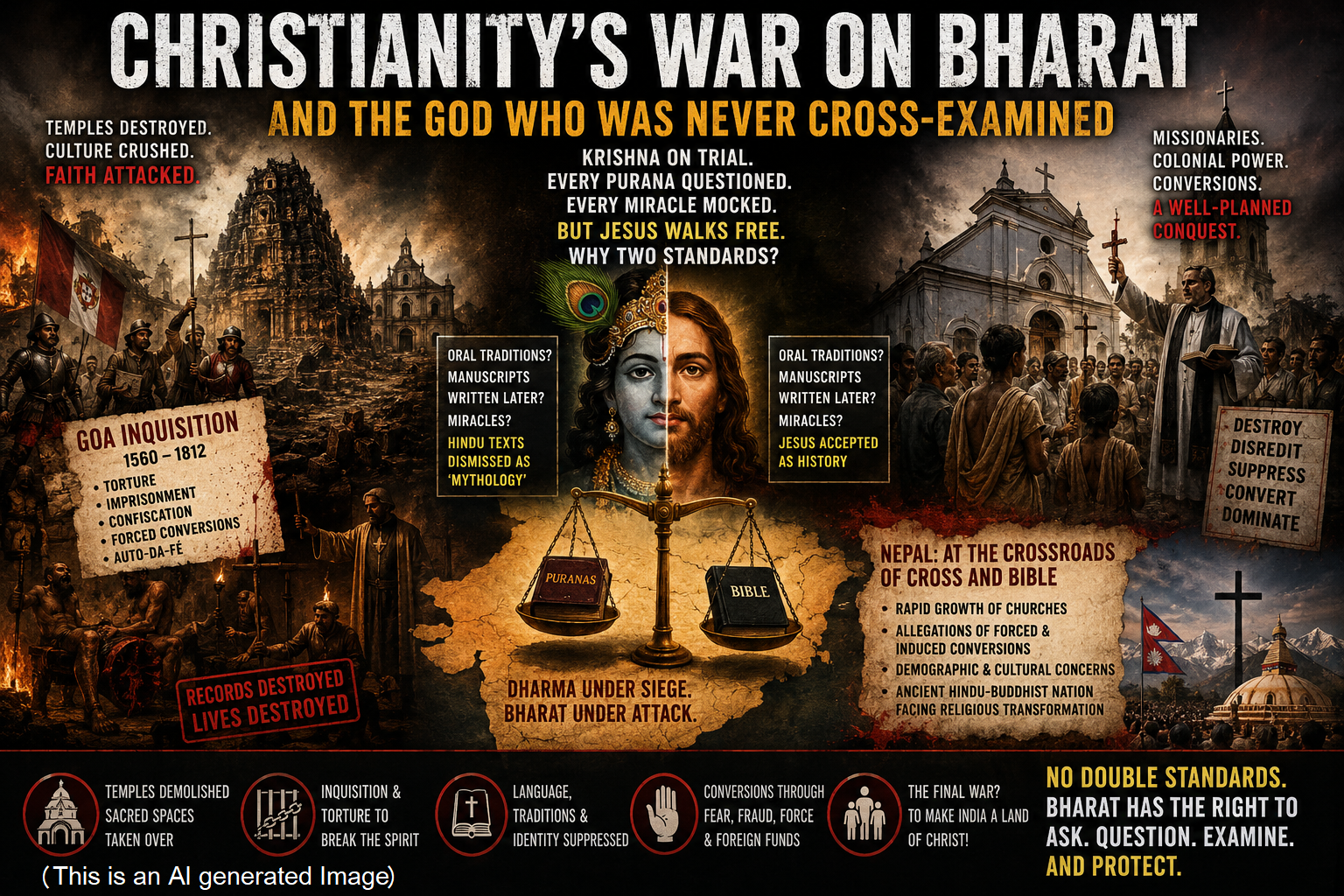
Christianity’s War on Bharatvarsha—and the God Who Was Never Cross-Examined.
Upananda rahmachari | HENB | New Delhi | Sept 8, 2026:: For centuries, Hindu civilisation was subjected to intense scrutiny by European missionaries, colonial administrators and Christian scholars. Hindu scriptures were examined, Hindu deities were described through the categories of “myth,” “idolatry” and “superstition,” and Hindu religious practices were frequently judged against Christian theological assumptions.
Yet the same sceptical standards were not always applied equally to Christianity itself.
That asymmetry raises a larger question: Why were Hindu traditions so often required to prove themselves according to standards of historical evidence, while the foundational claims of Christianity—particularly the divinity and resurrection of Jesus—were treated within a different evidentiary framework?
This is not an argument that one must accept the historicity of Krishna, Rama or any other Hindu figure simply because Christian claims are disputed. Nor does historical inquiry by itself settle theological questions. Rather, it is a demand for intellectual consistency.
If Hindu traditions are interrogated because their narratives were transmitted orally, because their surviving manuscripts are later than the events they describe, or because their stories contain miracles, then comparable questions can legitimately be asked of Christianity.
The New Testament itself emerged from a first-century religious movement whose traditions circulated within communities before the texts reached their surviving written forms. The canonical Gospels were written decades after the lifetime of Jesus, and the resurrection narratives contain differences in detail. Christian believers interpret these facts within a theological framework; historians, meanwhile, distinguish between what can be established historically and what belongs to faith.
The same distinction should be applied to Hindu traditions.
The problem becomes especially serious when theological disagreement is transformed into political and cultural power. In parts of colonial Asia, Christianisation was not merely a matter of individuals changing their faith. It could become intertwined with imperial authority, legislation, property confiscation, restrictions on indigenous religious practice and the destruction or appropriation of sacred institutions.
Goa provides one of the clearest examples.
GOA: WHEN CONVERSION BECAME AN IMPERIAL PROJECT
The Portuguese conquered Goa in 1510. During the following decades, Portuguese rule increasingly connected political authority with Catholic expansion.
The process was not simply one of peaceful missionary preaching. Portuguese authorities and Catholic institutions introduced restrictions against Hindu religious practices, temples and institutions. Archival evidence records orders against the construction and repair of Hindu temples, restrictions on Hindu ceremonies and measures intended to facilitate Christianisation. A 1546 directive issued by the first resident bishop of Goa, Juan de Albuquerque, explicitly instructed clergy and missionaries to destroy temples regarded as places of “idolatry.”
By the middle of the sixteenth century, temple destruction had become a significant feature of Portuguese religious policy in territories under their control. Scholarly research describes a violent campaign between approximately 1540 and 1580 that resulted in the destruction of large numbers of temples, mosques and indigenous religious images in the islands of Goa, Bardez and Salcete.
The precise number of temples destroyed remains difficult to establish because the surviving documentary record is incomplete and historians differ over the interpretation of particular sources. What is beyond serious dispute, however, is that Portuguese authorities imposed policies hostile to Hindu religious institutions and that temples were demolished or prevented from being repaired or rebuilt.
The symbolism was unmistakable.
A sacred institution that had served a community for generations could disappear, while a Christian institution could emerge in its place.
The physical transformation of the landscape therefore became part of the religious transformation of society.
THE GOA INQUISITION
The most notorious instrument of this system was the Goa Inquisition, established in 1560.
The tribunal was modelled on the Portuguese Inquisition and operated primarily against people suspected of violating Catholic orthodoxy, including converts accused of secretly maintaining elements of their former religious practices. Its jurisdiction extended beyond questions that would conventionally be described as Christian heresy and included cases involving Hindu and Muslim practices.
The tribunal operated for more than two and a half centuries, apart from a short interruption between 1774 and 1778, before its final abolition in 1812.
Its surviving records provide evidence of an extensive machinery of religious surveillance and prosecution.
People who had converted to Christianity could come under suspicion if they were believed to be continuing elements of their ancestral religious traditions. The boundaries between private custom, cultural identity and religious practice became matters for official scrutiny.
The tribunal’s history also demonstrates an important problem for historians: much of its archive was destroyed.
After the Inquisition was finally abolished, a substantial portion of its records was deliberately destroyed. Researchers therefore cannot reconstruct its complete history from a continuous surviving archive.
This does not justify inventing numbers to fill the gaps. It does, however, explain why claims about the total number of victims must be treated cautiously.
What the surviving evidence does establish is enough to demonstrate that religious coercion was not an accidental side effect of Portuguese rule. It was embedded in a broader programme of Catholic confessionalisation.
THE WAR AGAINST MEMORY
Religious persecution does not always require killing.
It can operate through the destruction of institutions, the confiscation of property, the prohibition of rituals, restrictions on public worship and the suppression of language.
In Goa, language itself became a target.
A 1684 measure sought to strengthen the use of Portuguese and restrict the public use of Konkani. The policy reflected a wider attempt to reshape the cultural environment of Portuguese-controlled Goa.
Language matters because civilisation is not stored only in monuments and books.
It lives in songs.
It lives in ritual vocabulary.
It lives in family traditions.
It lives in the names of rivers, villages and sacred places.
It lives in the words used by a grandmother to teach a child a prayer.
When a language is marginalised, an entire cultural ecosystem can be weakened.
That is why the history of conversion cannot be reduced simply to a debate over individual religious belief. Where political power intervenes, conversion can become connected with the restructuring of society itself.
SRI LANKA: ANOTHER COLONIAL RELIGIOUS FRONTIER
The Portuguese experience was not confined to India.
In Sri Lanka, Portuguese expansion from the sixteenth century brought Christian missionary activity into direct conflict with established Buddhist and Hindu institutions.
The history of the Kelaniya Raja Maha Vihara provides a particularly striking example. According to the temple’s historical account, Portuguese forces destroyed the temple in the sixteenth century, while temple lands and revenues were subsequently drawn into the colonial religious order.
The broader Portuguese strategy involved the weakening of Buddhist institutions and the establishment of Catholic institutions and influence.
Temple lands were particularly important because religious institutions were not merely places of worship. They were centres of education, culture, landholding, charity and social organisation.
When their lands were confiscated, their economic foundation was weakened.
When their buildings were destroyed, their visible presence was diminished.
When religious personnel were driven away or prevented from operating, institutional continuity was broken.
And when Christian institutions received the confiscated resources, the colonial religious order acquired both spiritual and material strength.
The Dutch conquest of Portuguese-held territories in the seventeenth century changed the colonial power and the dominant Christian denomination, but religious and administrative pressure on Buddhist institutions continued in different forms. The history of Kelaniya records attempts to restrict restoration and worship at the site under Dutch rule.
The instrument had changed.
The political authority had changed.
But the indigenous religious institutions remained vulnerable to colonial power.
NEPAL: AT THE CROSSROADS OF CROSS AND BIBLE
Nepal, once officially identified as the world’s only Hindu kingdom, has undergone a remarkable religious transformation since becoming a secular republic in 2008. Christian organisations have expanded their presence through churches, schools, social-service initiatives and evangelisation, while the Christian population has grown substantially in recent decades, albeit from a very small base. For many Nepalis, this rapid expansion has triggered concerns about the erosion of the country’s Hindu and Buddhist cultural heritage, particularly in communities facing poverty and social vulnerability. The debate has also intensified over allegations of conversion through inducement, coercion or exploitation—claims that Christian organisations have repeatedly disputed and that must be assessed case by case. Nepal’s Constitution guarantees religious freedom but prohibits conversion of another person from one religion to another. Against this backdrop, the country stands at a sensitive crossroads: between constitutional secularism and its deeply rooted Hindu-Buddhist civilisational traditions, and between legitimate freedom of religious belief and fears that aggressive proselytisation could reshape Nepal’s demographic and cultural landscape. For critics, the growing visibility of the Cross and the Bible symbolises a larger struggle over whether Nepal’s ancient religious identity can withstand a rapidly changing religious environment.
FROM THE TEMPLE TO THE TEXTBOOK
The deeper legacy of colonial Christianity was therefore not confined to physical destruction.
It also involved the production of knowledge.
European missionaries and colonial scholars increasingly described Indian civilisation through European categories. Hinduism was frequently portrayed as polytheistic, irrational, idolatrous or morally deficient, while Christianity was positioned as the culmination of religious truth.
This created an intellectual hierarchy.
Christianity became the standard against which Indian religions were judged.
Hinduism became the object being judged.
That hierarchy survived even after colonial political rule ended.
The question today should not be whether Christianity has the right to make theological claims. Every religion has that right.
The question is whether the same standards of historical and philosophical scrutiny should apply to all religions.
If a Hindu account of a divine incarnation is dismissed because it contains supernatural elements, then Christian accounts of miracles deserve equally serious examination.
If Hindu oral traditions are treated as inherently unreliable because they were transmitted across generations, then the development and transmission of early Christian traditions must also be studied critically.
If Hindu scriptures are examined for contradictions, textual layers and later interpolations, Christian scripture must be subjected to the same scholarly methods.
And if historical uncertainty surrounding Krishna is used as an argument against his historicity, uncertainty surrounding particular details of the Gospel narratives cannot simply be ignored when discussing Jesus.
This is not an attack on Christianity.
It is an argument against double standards.
JESUS, KRISHNA AND THE QUESTION OF EVIDENCE
The central question is therefore not:
“Do you believe in Krishna?”
Nor is it:
“Do you believe in Jesus?”
The more fundamental question is:
“What standard of evidence are you applying—and are you applying it equally?”
Christianity makes extraordinary claims about Jesus: his divine nature, miracles, death and resurrection.
Hindu traditions make extraordinary claims about divine manifestations, avatars, cosmic events and sacred history.
A historian does not have to accept either tradition’s supernatural claims as established fact merely because believers accept them.
Faith and history operate differently.
A believer may regard the resurrection as a historical reality supported by the testimony of the early Christian community. A historian may examine the textual traditions, chronology, manuscript evidence and development of the resurrection narratives without making a theological judgement.
The same intellectual framework should be used for Hindu traditions.
That is the point at which the old colonial hierarchy begins to collapse.
FROM CONVERSION TO COLONIAL POWER
The history of Portuguese Goa demonstrates why religion and empire cannot always be examined separately.
The Portuguese crown, Catholic institutions, missionaries and colonial administrators did not operate in completely separate worlds. Political authority could reinforce missionary activity, while religious institutions could benefit from imperial power.
Temple destruction, restrictions on religious practice, property transfers and missionary expansion consequently formed parts of a wider colonial transformation.
This does not mean that every Christian individual was an agent of colonial oppression.
Nor does it mean that Christianity as a global religion can be reduced to the actions of Portuguese colonial authorities.
Christians themselves have frequently opposed colonialism, defended indigenous communities and criticised religious coercion.
Historical honesty requires acknowledging that complexity.
But acknowledging complexity should not become an excuse for erasing documented abuses.
The destruction of temples remains destruction.
The suppression of religious practice remains suppression.
The confiscation of religious property remains confiscation.
And the coercive use of state power in the name of religious conversion remains coercion.
THE LEGACY IN MODERN INDIA
The colonial period ended, but the argument over religious authority did not.
Modern India remains a civilisation in which multiple religious traditions coexist. Christian communities are an established and integral part of Indian society, and millions of Indian Christians have no connection whatsoever with European colonialism.
At the same time, debates continue over missionary activity, religious conversion, foreign funding and the relationship between evangelisation and indigenous cultures.
These questions deserve scrutiny—but scrutiny must be based on evidence rather than collective suspicion.
The historical record should neither be romanticised nor weaponised.
If there are documented cases of coercion, fraud or unlawful inducement, they should be investigated.
If there are legitimate humanitarian activities by Christian organisations, those should also be acknowledged.
And if accusations are made against particular institutions, they should be supported by evidence rather than attributed to an entire religious community.
That distinction is essential.
BHARAT MUST BE ALLOWED TO CROSS-EXAMINE
For centuries, India was told to explain itself.
Its gods were questioned.
Its scriptures were classified.
Its temples were examined through foreign theological categories.
Its traditions were labelled superstition.
Its sacred stories were reduced to mythology.
But the same critical gaze was not always directed back toward the institutions making those judgements.
That era should end—not by reversing the hierarchy, but by abolishing the hierarchy altogether.
Bharat does not need to prove the superiority of Krishna by disproving Jesus.
Nor does Christianity need to prove the truth of Jesus by denigrating Krishna.
The proper standard is intellectual equality.
Let Krishna be examined.
Let Rama be examined.
Let the Vedas, Puranas and epics be examined.
But let the Bible be examined too.
Let the historical development of Christian doctrine be examined.
Let the Gospel narratives be examined.
Let the history of the Church be examined.
Let colonial missionary records be examined.
Let the Goa Inquisition be examined.
Let temple destruction be examined.
Let conversion policies be examined.
And let every civilisation be permitted to ask questions of the religious tradition that once questioned it.
The lesson of history is not that one religion must now become the oppressor of another.
The lesson is that no religion should receive immunity from historical scrutiny merely because it once possessed political power.
The courtroom must have one standard.
The evidence must be examined consistently.
And the right to ask questions must belong to everyone.
If Hindu civilisation was once placed in the dock, Bharat now has every intellectual right to cross-examine the history, claims and institutions of those who once placed it there.
THE LOOMING DEMOGRAPHIC AND CULTURAL ANXIETY
For many Hindus, the concern goes beyond individual religious conversions. It touches on a deeper question of India’s demographic and civilisational future. The fear is that sustained conversion activity, particularly in economically and socially vulnerable communities, could gradually alter the religious composition of certain regions and weaken traditional Hindu cultural practices, institutions and social networks. This anxiety becomes sharper when missionary activity is perceived not merely as evangelisation, but as part of a broader ambition to transform India into a predominantly Christian nation. The idea of an impending “final war” to make India a Christian country is, however, a political and religious claim rather than an established demographic fact. India remains overwhelmingly Hindu, while Christians constitute a relatively small minority. The more substantive question is whether India can protect its indigenous cultural and religious traditions while preserving constitutional freedom for every community to practise and propagate its faith. For Hindu society, the challenge is therefore not simply to resist another religion, but to ensure that India’s civilisational inheritance, demographic stability and cultural continuity are not gradually eroded through coercion, exploitation or aggressive proselytisation.
…
_Inputs from Reason in Revolt.
One comment on “The Unfinished Christian Conquest Of Hindu India.”
Leave a comment

Great reporting! Just wanted to add a bit more context here. The Sarvjan Sanatan Party isn't actually a brand-new outfit—it…
[…] CBI director M. Nageswara Rao took charge as the party’s national president in Varanasi on 8 October 2026 while…
[…] narrow factual record identifies a campus confrontation involving people described as members of Bangiyo Hindu Jagran Manch. Their action…
[…] core is narrow: Congress leader Digvijay Singh directed critical remarks at the RSS and VHP; Ayodhya seers rejected his…


Pingback: Christian Missionary Expansion: A Hindu Civilizational Response – DharmaRenaissance Blog