
Struggle for Hindu Existence
*Hindu Rights to Survive with Dignity & Sovereignty *Join Hindu Freedom Movement to make Bharat Hindu Rashtra within this lifetime *Jai Shri Ram *Jayatu Jayatu Hindu Rashtram *Editor: Upananda Brahmachari.
Bring UCC Nationwide, Akhilesh Must Apologise for Kar Sevak Killings Before Ram Temple Visit: VHP Chief.
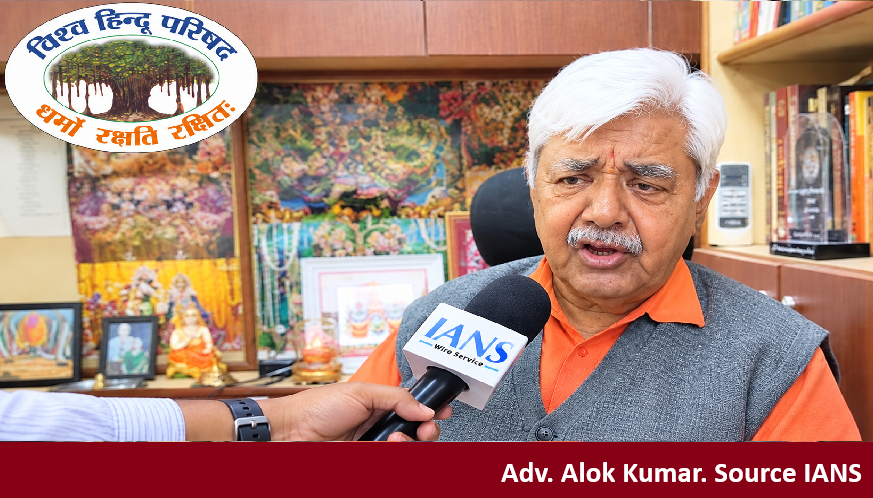 UCC Must Be Implemented Nationwide; Akhilesh Must Apologise for Kar Sevak Killings Before Ram Temple Visit: VHP Chief Alok Kumar.
VHP chief accuses Rahul Gandhi and Congress of Muslim appeasement; holds Tamil Nadu government responsible for Deepathoon controversy; demands atonement from Akhilesh Yadav for firing on Kar Sevaks and neglect of Ayodhya…
Upananda Brahmachari | HENB | New Delhi | Nov 27, 2026:: The Uniform Civil Code (UCC) must be implemented throughout the country to ensure gender justice and equality for women, while Samajwadi Party (SP) president Akhilesh Yadav should apologise and undertake an act of atonement for the killings of Kar Sevaks during his father Mulayam Singh Yadav’s tenure before visiting the Shri Ram Temple in Ayodhya, Vishva Hindu Parishad (VHP) International President Alok Kumar has asserted.
In an exclusive interview with IANS, published on November 27, Kumar spoke extensively on the Karthigai Deepam controversy in Tamil Nadu, the alleged violation of Hindu religious rights, Congress leader Rahul Gandhi’s silence on the issue, the UCC, the Ram Temple movement, the Krishna Janmabhoomi dispute and the continuing persecution of Hindus in Bangladesh.
The VHP chief launched a particularly sharp attack on the Congress and the INDIA bloc, accusing them of pursuing Muslim vote-bank politics at the expense of Hindu religious sentiments. He also expressed confidence that the Hindu side would succeed in the ongoing legal proceedings concerning Kashi and Mathura.
Deepathoon controversy: VHP holds entire Tamil Nadu government responsible
Reacting to the controversy surrounding the lighting of the traditional Karthigai Deepam lamp at the Deepathoon pillar atop Thiruparankundram hill, Kumar accused the Tamil Nadu government of deliberately insulting Hindu religious sentiments by preventing the ritual despite judicial directions.
He asserted that the prevention of the lamp-lighting ceremony was not simply an act of disregard for Hindu sentiments but a deliberate insult that could not have occurred without the consent of the head of the state government. Holding the entire Tamil Nadu government responsible, he said the matter had assumed serious constitutional and judicial dimensions.
Kumar welcomed the Supreme Court’s initiation of contempt proceedings against the state’s Chief Secretary, Director General of Police, Secretary of the concerned department and other officials over alleged non-compliance with its directions. The officials had been directed to be served notices within five days and asked to submit their responses.
He also expressed satisfaction over the dissolution of the Board of Trustees, which had reportedly adopted a resolution declaring that it would not comply with the Supreme Court’s order. The responsibility had subsequently been entrusted to two retired High Court judges appointed as receivers, with a clear direction for the traditional lamp to be lit at the location on Saturday.
Significantly, he pointed out that the Central Reserve Police Force (CRPF) would provide security to ensure compliance with the judicial order instead of relying on the local police.
According to Kumar, these arrangements demonstrated that the Supreme Court lacked confidence in the state government’s ability to implement its directions and was taking concrete measures to ensure compliance.
He warned that failure to implement the order would amount to an insult to the judiciary and its authority, besides constituting an attack on Hindu religious sentiments, traditions and practices protected by the Constitution.
Expressing confidence that Hindu society in Tamil Nadu would not accept such an affront, he said people would respond appropriately and hold the state government accountable within the constitutional and democratic framework. He further warned that the government would have to face political consequences.
Hindu religious traditions cannot be arbitrarily denied
Responding to whether Hindu faith and religious traditions were being deliberately targeted through the Deepathoon controversy, Kumar said the issue was straightforward: whether the traditional lamp should be lit at the pillar once every year on Kartik Purnima.
He pointed out that the Single Judge Bench had recognised the existence of the tradition and directed that the ritual be performed. The Division Bench subsequently affirmed that position and directed that permission be granted, followed by directions from the Supreme Court.
Questioning whether all these judicial findings could simply be disregarded, he argued that Hindus were merely asserting their constitutional rights, which had also been affirmed by the courts.
He maintained that no individual or authority could arbitrarily claim that an established tradition never existed and thereby deny permission for its observance.
Rahul Gandhi’s Constitution book represents vote-bank politics, alleges VHP chief
Launching a scathing attack on Congress leader Rahul Gandhi, Kumar questioned his alleged silence over the Deepathoon controversy and the non-compliance with Supreme Court directions in Tamil Nadu.
Referring to Gandhi’s practice of carrying a red-covered copy of the Constitution, he sarcastically questioned whether the book actually contained the Constitution and whether the Congress leader had ever read it.
Kumar alleged that Gandhi frequently invoked constitutional principles and human rights whenever a terrorist was killed, but remained silent when Hindus were eliminated from Kashmir or when judicial orders concerning Hindu religious rights were allegedly violated.
He claimed that the book had become a symbol of what he described as petty politics intended to insult Hindu sentiments and consolidate the Muslim vote bank.
Citing the religious composition of legislators elected by Congress in Tamil Nadu and Assam, as well as its electoral arrangements in Kerala with the Indian Union Muslim League, Kumar alleged that the party was increasingly abandoning its character as a national political organisation.
He also referred to the Congress MLA elected from West Bengal, alleging that the party’s political approach was increasingly centred on Muslim electoral support.
“They are no longer behaving like a national party. They appear to be trying to become the Muslim League, and the country is beginning to understand this,” Kumar said.
Congress and INDIA bloc accused of systematic anti-Hindu approach
On the broader political position of the Congress and the INDIA bloc regarding Hindu religious sentiments, Kumar alleged that their stand reflected a consistent pattern of appeasement and hostility towards Hindu organisations and traditions.
He cited statements by Karnataka Minister Priyank Kharge, son of Congress President Mallikarjun Kharge, and referred to calls for campaigns against Hindutva, abusive remarks against the ideology, repeated allegations against the Rashtriya Swayamsevak Sangh (RSS) and what he described as deliberate attempts to hurt Hindu sentiments.
He further accused the Congress and its allies of pampering people belonging to a particular religious community while neglecting the concerns of Hindus.
Kumar attributed the INDIA bloc’s electoral defeats in Maharashtra and Bihar partly to this political approach. He predicted that Hindu voters would increasingly question opposition parties over their position on Hindu religious rights and cultural identity in future elections.
Nationwide UCC essential for gender justice and women’s equality
Strongly advocating the implementation of the Uniform Civil Code across India, Kumar said there should be no controversy over a measure fundamentally concerned with gender justice, women’s dignity and equal rights.
He emphasised that a woman was neither an animal nor anybody’s possession and was entitled to the same dignity, equality and rights as a man.
Explaining the need for uniform civil laws, he questioned why a man should be permitted to have four wives when monogamy was the accepted norm in much of the world. He also raised questions about unilateral divorce through the pronouncement of triple talaq and the denial of equal inheritance rights to women.
He questioned why a woman who devoted her life to her husband and family and bore children should not receive an appropriate share of her husband’s property after his death.
According to Kumar, equality between men and women, respect for women’s dignity and recognition of their right to life and equal treatment must constitute the foundation of civil laws.
He unequivocally stated that the UCC was necessary and should be implemented throughout the country. Welcoming the initiatives taken by several states, he specifically mentioned Uttarakhand and Gujarat, which, according to him, had already implemented the Code.
Ram Temple represents cultural renaissance; VHP hopeful about Kashi and Mathura
Speaking about India’s growing confidence in its civilisational identity following the construction of the Shri Ram Temple in Ayodhya, Kumar described the temple as the fulfilment of a commitment made by Prime Minister Narendra Modi.
He recalled that Hindu society had carried forward the Ram Janmabhoomi movement under the leadership and guidance of saints and religious leaders. Millions endured immense hardships, and many sacrificed their lives during the prolonged movement.
With the magnificent temple now constructed, Kumar said India was witnessing a cultural renaissance and a period in which Hindu civilisation and cultural identity were flourishing and growing stronger.
Referring to the ongoing legal disputes concerning Kashi and Mathura, he expressed confidence that Hindus would ultimately succeed through the judicial process.
He described the efforts to restore these sacred sites as an act of atonement for historical wrongs committed through the destruction of Hindu temples.
Confident of victory in Krishna Janmabhoomi case
On the Shri Krishna Janmabhoomi–Shahi Idgah dispute in Mathura, Kumar said the matter was currently before the courts and that the VHP was closely following its legal developments.
Speaking as a lawyer, he disclosed that he had examined the case files and was confident about the strength of the facts and legal arguments presented by the Hindu side.
He expressed the firm belief that the Hindu petitioners would win the case and that a temple would ultimately be constructed in accordance with the directions of the court.
However, when asked whether the VHP was preparing for another Kar Seva movement in Mathura if circumstances demanded it, Kumar made it clear that the organisation currently had no plans in that direction.
VHP approaches governments in over 100 countries over persecution of Hindus in Bangladesh
Highlighting attacks on Hindu communities and their places of worship in neighbouring countries, Kumar particularly expressed concern over the situation in Bangladesh.
He disclosed that the VHP had approached governments in more than 100 countries, drawing their attention to the condition of the Hindu minority in Bangladesh.
The organisation urged these governments to examine the continuing attacks on Hindus, particularly in view of their trade relations and economic assistance to Bangladesh.
Kumar argued that attacks on religious minorities were unacceptable and that countries maintaining commercial and diplomatic relations with Bangladesh should not overlook the persecution of its Hindu population.
He claimed that the VHP’s international efforts had generated considerable pressure. Referring to the political developments following the Bangladesh Nationalist Party (BNP) coming to power, he said the BNP had not dared to allow riots of the magnitude witnessed earlier.
He also observed that Hindus in Bangladesh were increasingly fighting back for their rights.
The VHP, he said, was closely monitoring the developments and would take appropriate steps from time to time.
Akhilesh must seek forgiveness for Kar Sevak killings before Ram Temple visit
The most politically significant part of the interview concerned the proposed December visit of Samajwadi Party president Akhilesh Yadav to the Shri Ram Temple in Ayodhya.
Asked whether the VHP would welcome his visit, Kumar said Akhilesh should first take a dip in the sacred Saryu River and apologise for the atrocities and police firing on Kar Sevaks during the tenure of his father, Mulayam Singh Yadav, as Uttar Pradesh Chief Minister.
Several Kar Sevaks had lost their lives during the firing in 1990, when the Ram Janmabhoomi movement was at its peak.
Kumar also demanded an apology for Akhilesh Yadav’s own record as Chief Minister, alleging that he had neither introduced any development plan for Ayodhya nor visited the city during his tenure.
He clarified that the Ram Temple was open to everyone and to all Hindus, but maintained that Akhilesh should first seek forgiveness and undertake an act of atonement before entering the temple.
Questioning the motive behind the proposed visit, he said it could be driven either by genuine devotion or by political considerations ahead of the 2027 Uttar Pradesh Assembly elections. Whatever the reason, he insisted that an apology should come first.
VHP chief asks saints not to oppose visit if Akhilesh apologises
Responding to a question about some saints declaring that they would oppose Akhilesh Yadav’s proposed visit, Kumar said their position was essentially the same: he should apologise for the Kar Sevak killings.
He referred to alleged statements made by Akhilesh Yadav at public meetings and in Parliament concerning the firing incident, claiming that the SP leader had spoken about the deaths of Kar Sevaks as though they were a matter of political pride.
Kumar specifically referred to an alleged statement in which Akhilesh reportedly said that even if 38 people had been killed, his government would still have protected the mosque. He further claimed that Akhilesh had spoken about the incident in a manner that treated the killings of 18-19 people almost as a trophy.
Pointing out that videos of these statements were available on YouTube, the VHP chief said Akhilesh must atone not only for the killings but also for his subsequent remarks.
The VHP’s position, therefore, was not that the temple should be closed to the SP leader. Rather, Kumar insisted that a visit to the sacred shrine should be preceded by an acknowledgement of the past, an apology to the families and the Hindu community, and an act of atonement for the suffering of Kar Sevaks.
The interview underscored the VHP’s determination to raise issues concerning Hindu religious rights, temple restoration, the UCC and the persecution of Hindus, while sharpening its political criticism of Congress, the INDIA bloc and the Samajwadi Party ahead of the next round of electoral battles.
..
Source: IANS.


[…] the first Mumbai Book Festival, RSS, Hindutva and Sanatan literature were reported as prominent across t…, while a left-wing…
[…] 26 November 2026, VHP accused the TVK government of defying a Supreme Court order in the Deepathoon …, sought…
[…] 25 November 2026, four people were reported arrested in Murshidabad as Chief Minister Suvendu Adhikari declared cow pr… and…
[…] established event is narrow but significant: a member of Savarkar’s family sent Sonia Gandhi a legal notice alleging that…
[…] 24 November 2026, a spontaneous street protest took place in Diamond Harbour. Demonstrators opposed the persecution of Hindus in…