

[…] discipline does not weaken Hindu advocacy. It makes it credible. In the current confrontation, Hindu groups are demanding scrutiny…

Struggle for Hindu Existence
*Hindu Rights to Survive with Dignity & Sovereignty *Join Hindu Freedom Movement to make Bharat Hindu Rashtra within this lifetime *Jai Shri Ram *Jayatu Jayatu Hindu Rashtram *Editor: Upananda Brahmachari.
Why Hindu Rashtra in Bharat Remains Unachieved: Confusion, Compromise, and Consequence.
Hindu Rashtra: A Confusion, a Confession, and a Conclusion.
By Upananda Brahmachari
 As the English year 2025 fades into history and 2026 begins, I write with a heavy heart to the readers and well-wishers of Struggle for Hindu Existence. No one compelled me to clarify my position, nor was I abused for what I had earlier written or asserted regarding the emergence of a Hindu Rashtra by 2025. Yet, honesty demands reflection.
The reality today is stark: there is no Hindu Rashtra in “India that is Bharat.” India continues to function as a secular nation—one that offers no civilizational, constitutional, or political advantage to its Hindu majority. Instead, under the persistent pretext of secularism, Hindus find themselves targeted, discriminated against, repressed, and often tormented within the domains of polity, judiciary, economy, and social life.
Those who have been mentally or physically associated with the mission of establishing a Practical Hindu Rashtra—a Cultural, Constitutional, and Sovereign Hindu Rashtra, as envisioned and articulated through Struggle for Hindu Existence—would have noticed a glaring fallacy in our earlier tagline:
“Join Hindu Freedom Movement to make Bharat Hindu Rashtra within 2025.”
The year 2025 has passed. The Hindu Rashtra remains unrealized.
This failure has triggered unavoidable questions. Has the Hindu Rashtra movement collapsed? Was the vision flawed, or was the will lacking? Are Hindus truly serious about achieving a Hindu Rashtra in Bharat—not merely for India’s majority community, but for over a billion Hindus across the world?
Confusion: The Unfulfilled Promise
My association with the idea of Hindu Rashtra began in 1983, when I joined the Rashtriya Swayamsevak Sangha (RSS) shortly after the First Ekatmata Yatra. At that time, I was a student of Class 10+2. In the daily Prarthana at RSS Shakhas, every swayamsevak reaffirmed the belief that this land is a Hindu Rashtra and that one’s life is to be dedicated—if necessary, sacrificed—for it.
Like countless other swayamsevaks, I imbibed the concepts of Hindutva and Hindu Rashtra as articulated by Veer Savarkar, the ideological proponent of Hindutva, and Dr. K. B. Hedgewar, the founder of the RSS. Around this time, I encountered the seminal work compiled by senior RSS pracharak Eknath Ranade, “Swamijir Hindu Rashtra Chinta” (Bengali) and “Swami Vivekananda’s Rousing Call to Hindu Nation” (English). Later, I studied “We or Our Nationhood Defined” by Guruji M. S. Golwalkar.
Through years of organizational work within the RSS, I internalized a firm belief: without the evolution of a true Hindu Rashtra, Hindus would inevitably remain second-class citizens in their own land. The RSS, I believed, was striving—wholeheartedly—for this objective.
I had the privilege of listening directly to RSS Chiefs such as Balasaheb Deoras, Prof. Rajendra Singh, and K. S. Sudarshan. Each of them spoke, in their own way, of a Hindu Rashtra rooted in Hindu might and moral right.
In 1988, I spent a brief but influential period with K. S. Sudarshan Ji—then likely serving as Akhil Bharatiya Sharirik Pramukh—at the Bhawanipur Niwas in Kolkata. His words deeply influenced my early Hindutva writings. He explicitly spoke of the necessity of a Constitutional Hindu Rashtra, alongside the already accepted idea of a Cultural Hindu Rashtra, whenever circumstances became favorable.
That same year, I joined government service. Yet, risking my career, I participated in the Ayodhya Kar Seva of 1992, an event that culminated in the removal of the disputed Babri structure. Like millions of Hindus, I believed that moment marked the foundation of a real Hindu Rashtra.
History, however, unfolded differently.
Soon it became clear that pro-Islamist, pro-Christian, and anti-Hindutva forces—the Congress, Communists, Samajwadis, and Bahujan formations—had united under the banner of secularism to prevent even the remotest possibility of a Hindu Rashtra.
The Ram Janmabhoomi movement energized Hindu society, and the BJP came to power twice under Atal Bihari Vajpayee. Yet this phase failed to advance the cause of Hindu Rashtra. Vajpayee, a committed secularist rather than a Hindutvawadi, presided over a period marked by several decisions perceived as adverse to Hindu interests. The BJP lost power in 2004.
From that point onward, the demand for a Hindu Rashtra was quietly shelved. The RSS and BJP increasingly adopted the refrain that “India is already a Hindu Rashtra”, a rhetorical device that effectively diluted the demand for constitutional recognition and sovereign authority.
An Alternative Assertion: Sanatan Sanstha and HJS
In 2012, a significant departure emerged. The Sanatan Sanstha (SS) and Hindu Janajagruti Samiti (HJS) convened the All India Hindu Rashtra Adhiveshan in Goa. Through my blog Struggle for Hindu Existence (established in 2009), I had already developed close contact with them, particularly through their co-coordinator Dr. Manoj Solanki. I was invited to, and participated in, the convention.
That experience—and the subsequent annual Adhiveshans in Goa—stood out. SS and HJS openly and unapologetically advocated for a Hindu Rashtra grounded in Dharma, explicitly demanding constitutional recognition and sovereign status, comparable to the more than 50 Islamic states, hundreds of Christian states, over a dozen Buddhist nations, and even a Jewish state.
Their vision aligned with what I considered a true and practical Hindu Rashtra, sharply contrasting with the RSS’s abstract notion of a Hindu Rashtra devoid of constitutional power—an arrangement that, in practice, tolerated cow slaughter, religious conversion, illegal infiltration, love jihad, land jihad, corruption, and systemic discrimination against Hindus.
Crucially, SS and HJS also articulated a timeline. Through conventions, state-level programs, publications, and lectures, they identified 2025 as a decisive year for the emergence of a Cultural, Constitutional, and Sovereign Hindu Rashtra.
However, in recent years, this clarity appears to have weakened. SS and HJS have aligned more closely with the RSS–BJP ecosystem, rebranding their objective under the softer notion of a “Sanatan Rashtra.” The recent two phases of the Sanatan Shankhnad Mahotsav—in Goa and later at Delhi’s Bharat Mandapam—demonstrated this shift. Political patronage has effectively nudged them toward the RSS position: that Bharat is already a Hindu Rashtra and requires neither declaration nor constitutional transformation.
A Necessary Correction
This ideological ambiguity has forced me, as the editor and owner of www.hinduexistence.org, to revise our appeal. The earlier slogan tied to a deadline (“Join Hindu Freedom Movement to make Bharat Hindu Rashtra within 2025) is no longer honest.
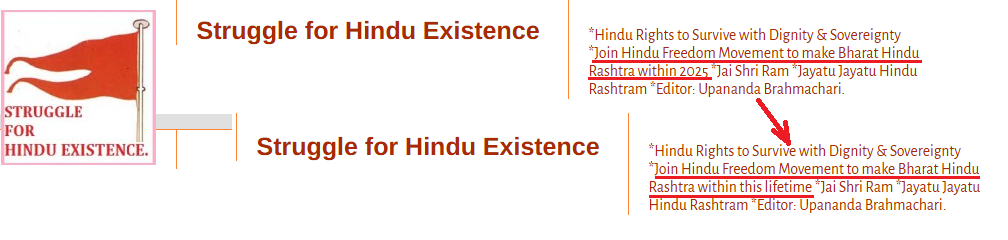
Henceforth, my present appeal reads:
“Join the Hindu Freedom Movement to make Bharat a Hindu Rashtra within this lifetime.”
Despite political jugglery, organizational rivalries, and semantic evasions, the mission remains unchanged. Faith in karma—dedicated action without obsession over results—demands perseverance. A Practical Hindu Rashtra can still emerge, provided devotion is matched with clarity and courage.
Confession: An Insider’s Disillusionment
Over more than four decades, I have worked with or closely observed organizations such as Bharat Sevashram Sangha (BSS), RSS, Hindu Samhati, HJS, Arya Samaj, Hindu Mahasabha, and Antarrashtriya Hindu Parishad (AHP).
A painful truth has emerged: most leaders and decision-makers within these organizations lack urgency—or intent—to reclaim a Practical Hindu Rashtra within a defined timeframe.
While BSS, Hindu Mahasabha, and AHP formally support a constitutional Hindu Rashtra, their mass reach is limited. Conversely, although a significant number of RSS swayamsevaks privately aspire to a constitutional Hindu Rashtra, the leadership—including current Sarsanghachalak Mohan Bhagwat—remains skeptical. His propositions, such as the “same DNA” theory and the assertion that “Hindu Rashtra is incomplete without Muslims,” further blur the objective.
The absence of unified leadership and a common roadmap has left Hindus vulnerable—to cow slaughter, conversion, infiltration, love jihad, land jihad, corruption, and systemic appeasement.
History offers a sharp contrast. Mohammad Ali Jinnah, through sheer resolve, realized Pakistan—an Islamic state masquerading as secular—culminating in Direct Action Day in 1946. No Hindu leader of equivalent stature including Dr Ambedkar, Sardar Patel, Shyama Prasad Mookerjee raised a parallel demand for a Hindu state at that decisive moment. The nation was partitioned in 1947 on the two-nation theory, granting Muslims Pakistan while denying Hindus their own Hindu Rashtra. RSS and then Sarsanghachalak Guruji Golwalkar did not demand a Hindu Rashtra at that time.
That denial continues—phase by phase—even under BJP regimes including PM Narendra Modi influenced by the RSS.
The RSS and BJP frequently criticize Indira Gandhi’s insertion of “Secular” and “Socialist” into the Constitution’s Preamble during the Emergency. Yet this criticism remains politically instrumental, not transformative. No sincere effort has been made to remove these insertions to open the constitutional path for a Hindu Rashtra.
From extensive public interaction, I must confess: there is no effective mass demand for Hindu Rashtra today, largely because Hindu organizations themselves have failed to cultivate it.
Each organization pursues its own agenda, prosperity, and institutional survival—often forgetting that without a Hindu Rashtra, they too may eventually succumb to Islamic or Christian expansion.
I say this with anguish but conviction: those Hindutva organizations that undermine the demand for a Cultural, Constitutional, and Sovereign Hindu Rashtra act—intentionally or otherwise—as facilitators of further Islamization and Christianization of Bharat.
As a former insider, I have experienced both fear and frustration witnessing this unpreparedness. It is difficult to express whether the role of the RSS is detrimental to the making of a Constitutional and Sovereign Hindu Rashtra, even at the level of its slightest intention.
Unless Bharat is declared a Hindu Rashtra soon, the coming decade may witness the emergence of Muslim and Christian territorial dominance within India itself.
Reclaiming a Hindu Rashtra: Civilizational Foundations
The RSS is correct in one respect: Bharat is a natural Hindu Rashtra. But nature alone offers no protection. The lived reality of Hindus today is fraught with existential threats.
The concept of Rashtra predates modern politics. Rooted in the Vedas, it envisions holistic well-being—of people, animals, and nature alike. The Rashtra Suktam of the Yajurveda (Shukla Yajurveda/22) prays for prosperity across all sections of society, timely rains, fertile lands, and collective harmony. The Manusmriti defines the state as a benevolent protector based on justice, while the Devi Mahatmya affirms the spiritual essence of nationhood by saying, “Aham Rashtri Samgamani Vasunaam Chikitushi Prathama Yajniyanaam” (I am the gatherer of wealth, the first among those worthy of worship).
Hindu nationhood is thus inherently spiritual, ethical, and inclusive.
A Hindu Rashtra does not imply theocratic tyranny. It signifies governance guided by Dharma, Ahimsa, Vasudhaiva Kutumbakam, and cultural preservation, applied to education, governance, economy, and environmental stewardship—while respecting diversity and modernity.
Yet ideals alone are insufficient. Without constitutional declaration and sovereign authority, Bharat risks transformation through Ghazwa-e-Hind or aggressive Christian proselytization.
Reclaiming a Hindu Rashtra is not merely political—it is existential.
Conclusion: The Final Choice
A genuine Hindu Rashtra cannot coexist with cow slaughter, forced conversions, love jihad, land jihad, corruption, appeasement, or violence against women. Any model tolerating these evils is not a Hindu Rashtra at all.
India stands at a crossroads: Hindu Rashtra or Islamic State. In any honest referendum, the people would overwhelmingly support the former. Hindus alone are denied a civilizational homeland in a world replete with religious states.
Failure to adopt a clear, practical roadmap will push Bharat toward catastrophe. The establishment of a Cultural, Constitutional, and Sovereign Hindu Rashtra is not optional—it is the only solution.
Hindus, beyond party lines, beyond RSS and BJP, must recognize this truth. Otherwise, the fate of Hindus in Pakistan and Bangladesh will cease to be distant warnings and become India’s own reality.
May wisdom, courage, and conscience for a Practical Hindu Rashtra prevail.
…
Writer can be contacted at upananda.br@gmail.com

One comment on “Why Hindu Rashtra in Bharat Remains Unachieved: Confusion, Compromise, and Consequence.”
Leave a comment


Pingback: Hindu Rashtra Through the Test of Constitutional Dharma – DharmaRenaissance Blog