

[…] The disputed words were reported as the slogan ‘Hindutva Murdabad.’ […]

Struggle for Hindu Existence
*Hindu Rights to Survive with Dignity & Sovereignty *Join Hindu Freedom Movement to make Bharat Hindu Rashtra within this lifetime *Jai Shri Ram *Jayatu Jayatu Hindu Rashtram *Editor: Upananda Brahmachari.
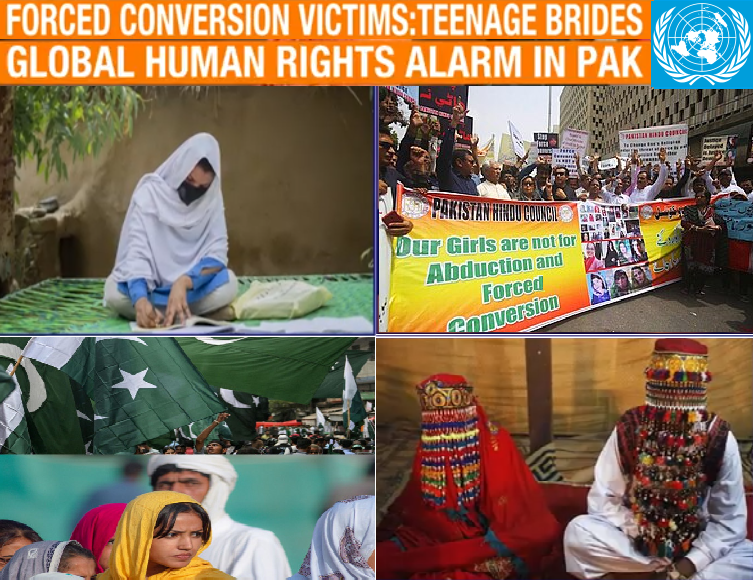
UN Raises Alarm Over Huge Forced Conversions of Minority Girls in Pakistan.
75% Hindu Victims, Girls 14-18 Targeted: Pakistan’s Forced Conversion Crisis Alarms UN.
Upendra Bharti | HENB | New Delhi | April 25, 2026:: United Nations human rights experts have expressed grave concern over what they describe as persistent patterns of abduction and forced religious conversion through marriage affecting women and girls from minority communities in Pakistan. The issue, long reported by rights organizations, has drawn renewed international attention due to what experts characterize as systemic impunity and insufficient institutional response.
According to UN findings, approximately 75% of reported victims of forced conversion and marriage in 2025 were from the Hindu community, while around 25% were Christian. A significant majority—nearly 80%—of these incidents were documented in Sindh province, where large portions of Pakistan’s Hindu minority reside. Adolescent girls between the ages of 14 and 18 appear to be the most vulnerable group, although some reported cases involve even younger children.
UN experts emphasized that conversion must be a matter of genuine personal choice and cannot be considered valid if it occurs under coercion or involves minors. “Marriage must be based on full and free consent, which is not legally possible when the individual is a child,” the experts noted. Victims in such cases often face multiple forms of harm, including physical and sexual abuse, psychological trauma, and long-term social marginalization.
Patterns Identified by Rights Groups
International human rights organizations—including Human Rights Watch and Amnesty International—have previously documented similar patterns. Reports indicate that minority girls are sometimes abducted, converted under pressure, and married shortly thereafter, with legal systems occasionally failing to provide timely protection or redress.
Local advocacy groups in Pakistan have also raised concerns about the misuse of religious conversion laws and the difficulty families face when attempting to challenge such marriages in court. In some cases, courts have accepted declarations of consent from minors, raising questions about the adequacy of age verification and judicial safeguards.
Legal and Institutional Gaps
The UN experts highlighted several systemic shortcomings. Law enforcement agencies have been criticized for dismissing complaints, delaying investigations, or failing to properly determine victims’ ages. These gaps, combined with social pressures and fear of retaliation, can discourage families from pursuing justice.
Pakistan’s legal framework on child marriage varies by province. While Sindh has set the minimum marriage age at 18, other regions still permit marriage at younger ages under certain conditions. The UN has urged the government to standardize the legal age of marriage at 18 nationwide and to explicitly criminalize forced religious conversion as a distinct offense.
Calls for Reform and Protection Measures
The United Nations has called for a multi-pronged response, including:
- Strengthening legal protections against forced marriage and trafficking
- Ensuring prompt, impartial investigations into all allegations
- Providing victim support services such as shelters, legal aid, and psychological counseling
- Developing child-centered and gender-sensitive protection systems
Experts also stressed the need to address underlying structural issues, including poverty, gender inequality, and discrimination against religious minorities, which can increase vulnerability to exploitation under Jihadi abduction, Islamic conversion and forced marriage.
Broader Context of Minority Rights
Religious minorities in Pakistan—including Hindus, Christians, Sikhs, and Ahmadis—constitute a small percentage of the population and have historically faced various social and economic challenges. While Pakistan’s constitution guarantees freedom of religion, implementation remains uneven, according to international observers.
It is important to note that civil society groups, journalists, and activists within Pakistan have actively campaigned against forced conversions and advocated for stronger protections. Their efforts highlight ongoing internal debate and reform initiatives within the country.
Plight of Vulnerable Religious Minorities
The UN’s findings underscore a complex human rights issue requiring careful legal reform, stronger institutional accountability, and sustained social change. While the reported cases are deeply concerning, addressing them effectively depends on accurate reporting, responsible discourse, and policies grounded in justice and equality rather than rhetoric.
The distress signals of vulnerable minority communities—including Hindus, Christians, Sikhs, and Ahmadis—are often perceived by critics as inadequately addressed by state institutions under the control of Islamist groups, contributing to what some observers describe as a deepening existential crisis for the matginal minorities in Pakistan, particularly the dying Hindus there.
…
_Inputs from News9 Live.
One comment on “UN Raises Alarm Over Huge Forced Conversions of Minority Girls in Pakistan.”
Leave a Reply

[…] 14 October 2026, Anand Dubey resigned from Shiv Sena (UBT), citing ideological differences and sayin… Two facts therefore stand…
[…] 13 October 2026, multiple complaints were reported against CPI(M) leader and advocate Bikash Ranjan Bhattacharya in W…. The complainants…

[…] a reactionary state. This is worrying. Already, Hindu radicals have occupied public discourse and have won favours from some…
no you are a fool


Pingback: Forced Conversion and Child Marriage in Pakistan: What to Watch – DharmaRenaissance Blog